
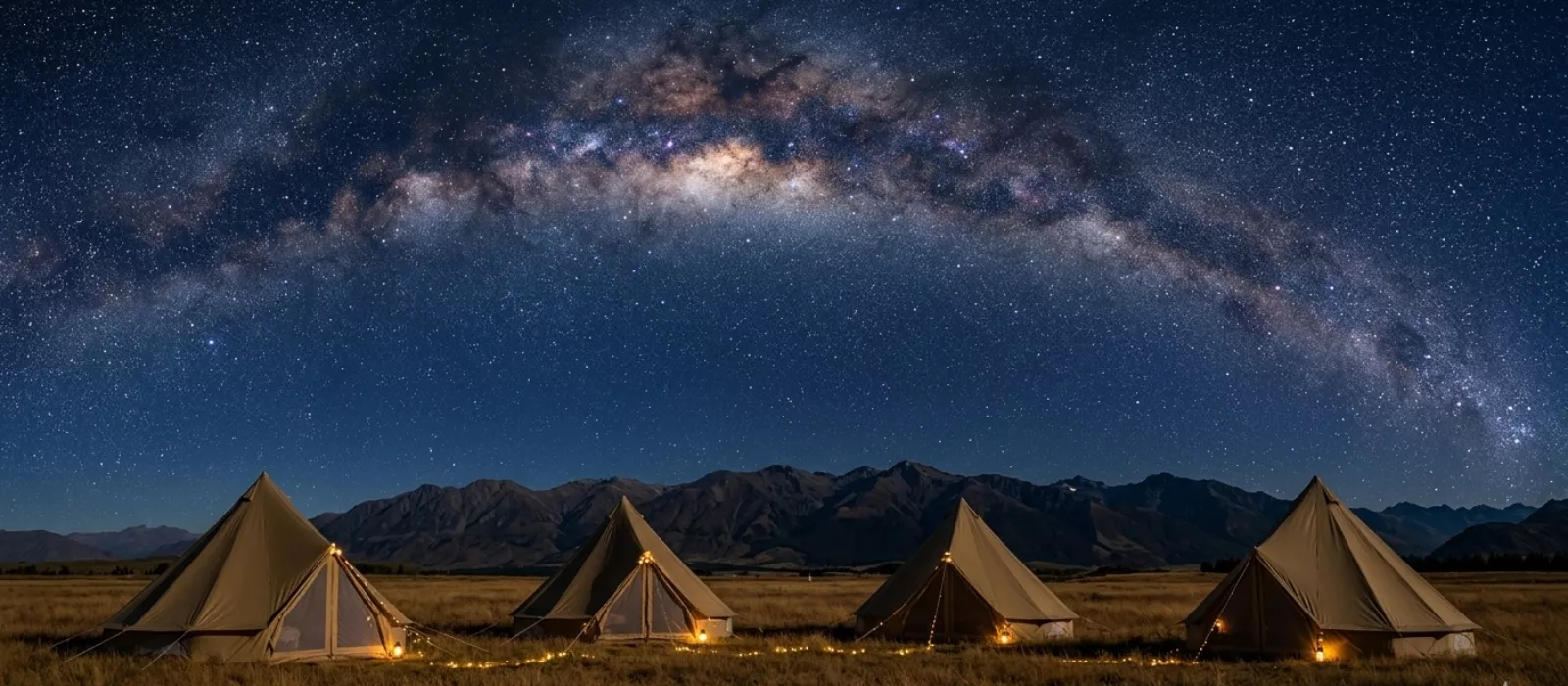
There’s no shame in admitting that we, as a society, have some problems. Some of them are mild complaints, like wifi going out on a flight when we’re ripping through the air at 35,000 feet. Others can be visceral issues, like pollution. When the word pollution pops up, the image of thousands of cars stuck in traffic comes to mind. Ten lanes spanning a large freeway, honking and red brake lights igniting through the mist of a gray-brown haze. It’s a familiar image, and it’s one we don’t, as a society, completely know how to handle. But there are some other kinds of pollution that we don’t easily think of. Noise pollution. That would be those horns constantly blaring in traffic (cars seem to be a recurring theme here), but in other circumstances, light can also pollute our way of life, our sleep, and our comfort.
Table Of Contents
- The Best Gear for Looking Up
- What Makes a Good Milky Way Camping Spot
- The Best Milky Way Camping Spots in the US
- Great Basin National Park, Nevada
- Cherry Springs State Park, Pennsylvania:
- Big Bend National Park, Texas:
- Natural Bridges National Monument, Utah:
- Death Valley National Park, Nevada:
- What to Bring for a Dark Sky Camping Trip
It’s well documented that when people sleep in darker places, they enter REM sleep more quickly, spend longer in deep sleep, and wake feeling more recovered. One big statistic that comes to mind is that the Journal of Epidemiology found that people exposed to a certain degree of light during sleep had a 65% increased chance of developing depression over two years. In short, sleep in the dark for healthier sleep.
On that note of needing dark, without the dark skies at night, how would we have learned to navigate on the open ocean? Or learn about celestial bodies outside of ours. Tycho Brahe was one of the earliest and most talented naked-eye astronomers, able to observe planets, the moon, and stars and record everything, making multiple recordings every day. There are dozens of scientists famous for simply looking up. But one remains a household name. Galileo
Galileo was famous for his observations of the Milky Way. Before telescopes, humans thought that the Milky Way was a large cloud, or nebula. They didn’t realize it was a group of stars until Galileo was able to prove what it was. This couldn’t have happened without extreme darkness. The kind of darkness that even a sliver of moon could ruin. The kind of darkness is unavailable to us today, with unnatural lights everywhere in the world.
There are, however, some good places to do some dark sky camping in the US. In this blog, we’re going to go over some of the best spots to see the Milky Way in the US. We’re going to cover the gear you need and the places to visit. If you’re set on seeing the Milky Way, this is your guide.
The Best Gear for Looking Up
Stargazing is really a three-season activity. It’s not bad in winter, but it’s difficult to stay out too long in the middle of January in Michigan’s Upper Peninsula. We need to be away from the cities, and we need to be away from the lights of the camp. This means shutting off the headlamps, putting out the kerosene lamps, killing the fire, and darkening the tent. And let’s talk about the tent.
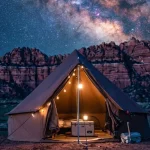
The ideal situation would be to hike a few hundred yards away from camp, but the truth is, many kids or elderly people who still love to look at stars cannot go that far at night, or might be afraid to (some grown adults, too). Keeping close to a comfortable setting is key. And here’s where the canvas tent comes in. There is plenty of space on the inside of a proper bell tent or wall tent for folks to come and go, spend some time outside, and then retreat inside when they need to.
Now, consider this scene: If some people are inside and others are outside looking at the Milky Way, the ones inside will need light. A polyester tent will glow in the dark, forcing those stargazing to step much further away (if you can see your hand in front of your face, it’s too light). A canvas tent keeps the light dimmed behind the thick material, so some can be inside and outside, and still enjoy their time.
For three seasons, canvas is also an ideal material. It is cool in the summer, and depending on the type of canvas tent, a cross breeze can be created. In a bell tent, the circular shape is ideal for hot summer days while you’re waiting for the sun to drop. The walls can be cinched up on whichever side the wind is hitting, and an immediately cool breeze flows through the tent.
Likewise, in a wall tent, the square structure can accommodate nearly any camper’s needs. The toll windows can be propped open, and the fall or spring air is welcomed inside. If folks are outside looking at the stars, then the window on the opposite side of the tent can be opened so
No one is disturbed by the light. For dark sky camping in the US, a canvas tent is the way to go.
What Makes a Good Milky Way Camping Spot
There are a few factors to consider when setting out to see the Milky Way. If the places below are not in a reasonable range to visit, then at least try to abide by the following rules:
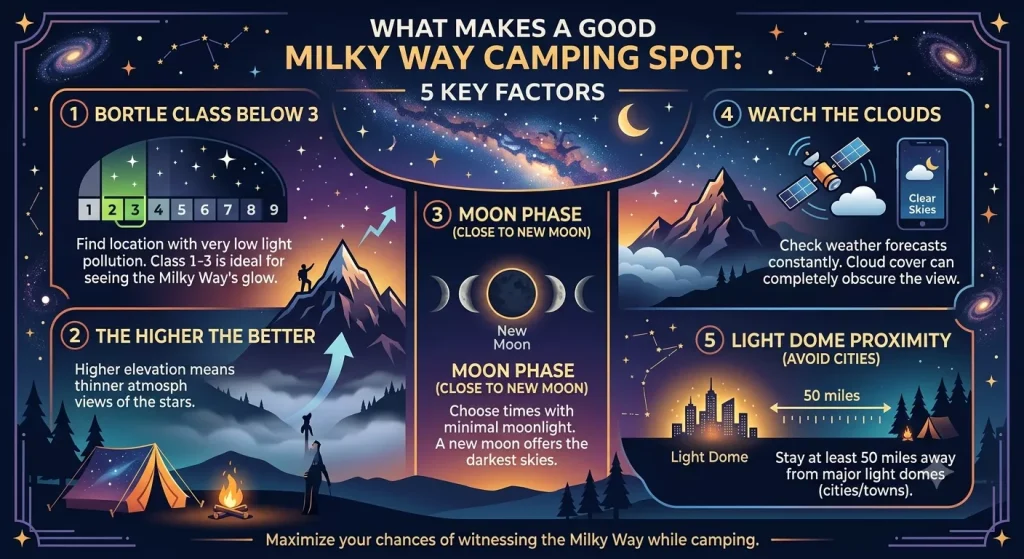
- Bortle Class Below 3: The Bortle class is a nine-level numerical scale (1-9) that measures the brightness of the night sky in a specific location. For purposes of viewing the Milky Way, shoot for 3 and below.
- The Higher the Better: At higher elevations, the atmosphere is thinner, which means it is easier to see more stars. So, naturally, it will be easier to see the Milky Way.
- Moon Phase: As mentioned above, seeing the darkest of skies requires even the moonlight to be gone. Choose a new moon, or close to it, for your ideal camping weekend.
- Watch the Clouds: All the planning in the world can be undone when a cloud cover moves in. Check the weather before you go.
- Light Dome Proximity: You might be able to see a hint of the Milky Way just outside of town, but realistically, any size of city within a 50-mile range can ruin chances of seeing the Milky Way.
If you can’t make it to the following places, then at least try to make these 5 features prevalent in choosing your location. These are some of the best places to see the Milky Way while camping in the US.
The Best Milky Way Camping Spots in the US
On the best nights, you might be able to see the Milky Way a few miles outside of town. Your local campsite might show a few stars in the dense center of the cluster. But plan for one of these locations, and it will be a sight you and your family have never seen.
Great Basin National Park, Nevada:
Some of the darkest places on Earth exist in the Western United States. Great Basin National Park is definitely one of them. In places, it is a Bortle class 1-2, and holds one of the darkest skies on the continent, with the nearest city being almost 200 miles away. This is not exactly a glamping scene as Wheeler Peak Campground sits at over 10,000 ft. in elevation. This is bound to be some cold winter nights, so a canvas tent is highly recommended. If you can get a tent wood stove in there as well, the light will be covered by the canvas while the warmth is trapped in.
Cherry Springs State Park, Pennsylvania:
If you’re on the East Coast, this is the crown jewel of dark sky camping in the US. This holds an official Dark Sky Park with a dedicated astronomy field. It is absolutely surreal that you can still find dark skies east of the Mississippi, but there it is. It’s perfect for campers who don’t have the time for a 20-hour drive west.
Big Bend National Park, Texas:
This is the least visited park in the lower 48. It is also one of the darkest and, frankly, one of the most underrated. Chisos Basin Campground features an enormous sky, ranging from focal point to focal point, and centers the Milky Way like a massive arch overhead. This is a very remote location, so make sure to plan ahead.
Natural Bridges National Monument, Utah:
This is a special one. It is the world’s first International Dark Sky Park. It’s a compact little location with beautiful sandstone formations around the park that make an incredible backdrop for a pitch-black night. And, with all the popularity that Utah state and national parks offer, this one is often looked over for flashier arches and narrower canyons. You can often slip in and out on an off weekend and never see a soul.
Death Valley National Park, Nevada:
This is a strange and intriguing spot on the globe, and it never disappoints. If you come for the dunes and the lowest point in the world, then stick around for Stovepipe Wells and Furnace Creek, as they sit inside one of the most expansive dark sky parks in the country. The low elevation actually helps here, with no mountain passes and 3.4 million acres of desert; there’s nothing to block the view of the pristine night sky. Mesquite Spring is the sweet camping spot at this one.
What to Bring for a Dark Sky Camping Trip
If you are out there to see the stars, it would be smart to assume others are out there to see the stars. If this is the case, you want to be mindful of the gear you bring while dark sky camping in the US. Let’s have a look:
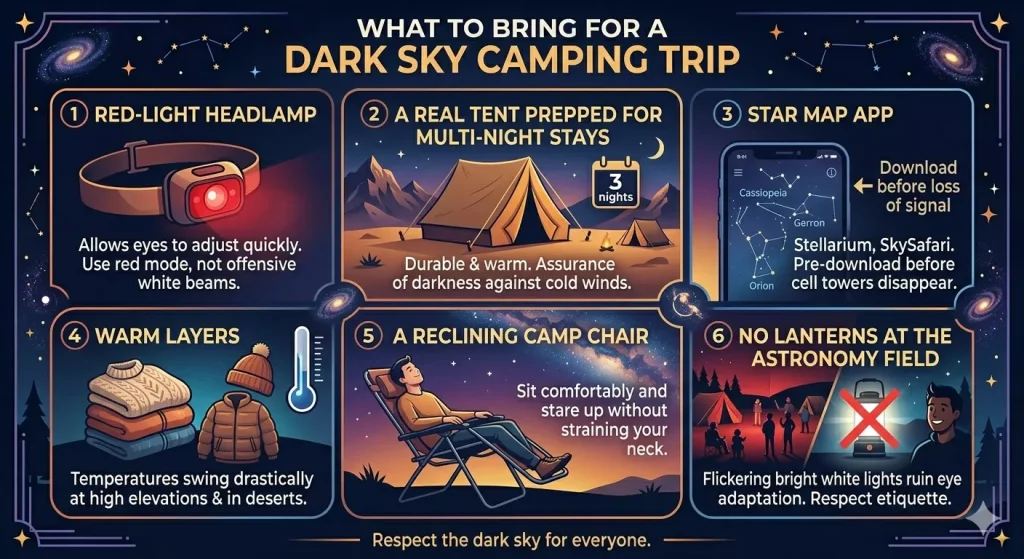
- Red-light headlamp: When the sun goes down, switch to red light mode and keep it that way. It allows your eyes to adjust more quickly and doesn’t offer an offensive white beam at night.
- A real tent prepped for multi-night stays: If you’re going to be traveling long hours into remote locations, then it’s likely you’re going to be out there for at least a couple of nights. The winds in these open locations, or in the high elevations, can be cold and brutal. A canvas tent is still the way to go for warmth and durability, and the assurance of darkness.
- Star map app: Not all of us are practicing Galileos. Stellarium and SkySafari are some good options, but you decide what works best for your devices and your crew. Just make sure you download it before you get 200 miles away from the nearest cell tower.
- Warm layers: The temperatures at night can swing pretty drastically in high elevations and in deserts. Make sure you can add or remove when the time is right.
- A reclining camp chair: It’s nice to stand out with your people and stare up at the sky. It’s also nice to sit down and not have to crane your neck.
- No lanterns at the astronomy field: It’s highly possible, even probable, that you will encounter some very devout and enthusiastic folks when visiting dark sky parks. This is basic etiquette. It can take some time for the eyes to adjust. Flickering on a bright white light can ruin some nice moments for everyone. Don’t be “that guy”.
The list is not much different than a normal camping trip, but there are some things that you should insist on. The truth is that many people travel a long way to spend time looking up at the dark sky. The harder truth is that most people don’t. We see a few small twinkles every night when we take out the garbage, or feel the cool night air in summer in the neighborhood, and we think that’s just how it is. But it isn’t. If it were, there would be no distinction between natural and unnatural light. We would not need to designate dark spaces. It would be a great shame if those places were lost to the light. It would be a greater shame if you never saw them before they’re gone. Grab a canvas tent, leave the lamp, and go see some stars.


No Comment! Be the first one.