
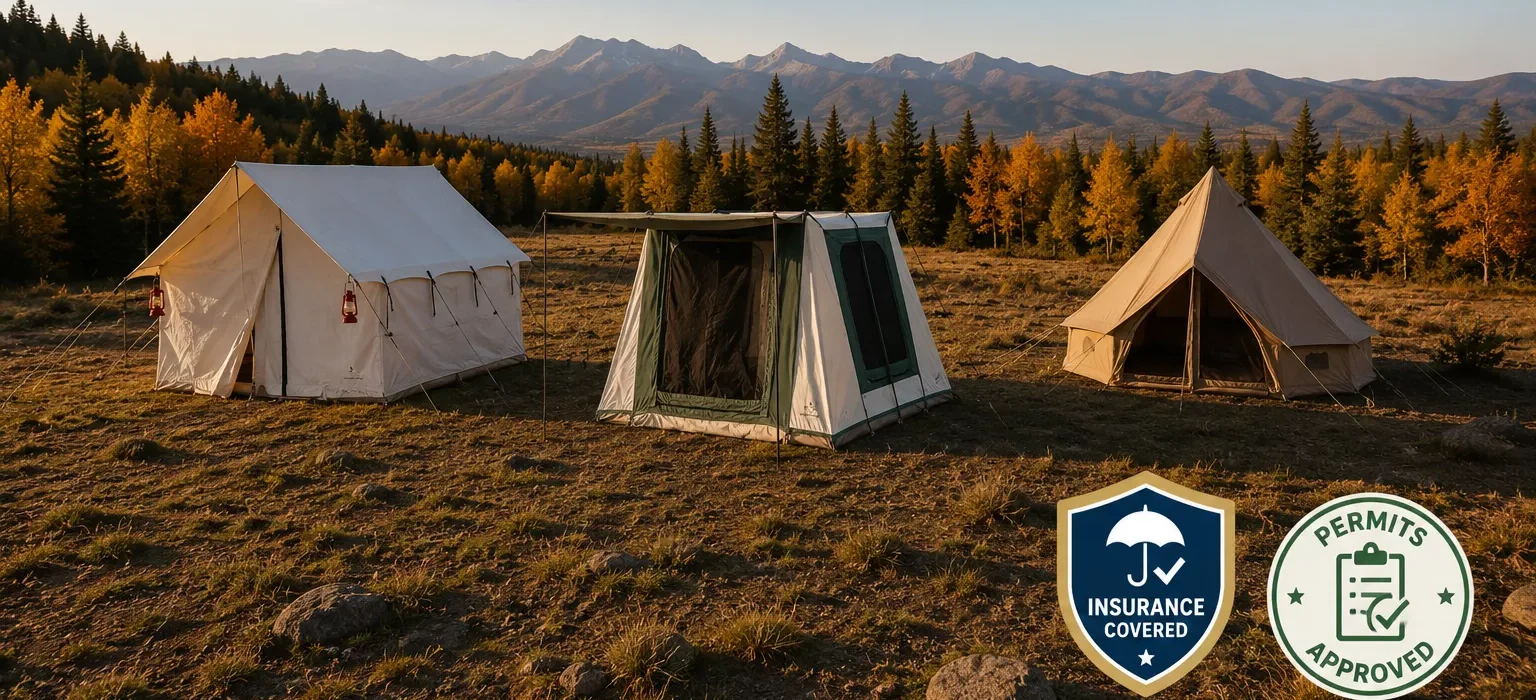
It happens more often than not. Someone buys three bell tents and props them up on the back lot of their property. They’ve built some platforms, maybe run some electricity, and posted on a rental or glamping website. In a short time, they get a letter from the county telling them the land is not zoned for short-term accommodations and the operation needs to stop. At that point, the tents end up sitting in a field, unused, aging in the weather without earning an income. It does happen, and it’s totally avoidable.
Table Of Contents
The same story plays out differently when a guest rolls an ankle on the platform the bell tent is erected upon, and then they file a claim. After a disappointing phone call, the business operator realizes that the incident isn’t covered on homeowner’s insurance. Their standard personal policy was not designed to cover paying guests.
Sorting out glamping business permits, zoning, and glamping business insurance before spending money on tents or decorations shouldn’t just be a task on a varying list. It should be the first thing you do. This piece will cover all three, beginning with the most important.
Zoning Comes First
Zoning is the first real gate, and it comes before land improvements, before purchasing a tent, or before setting up anything on a booking website. The question is simple: Does local zoning allow for this use on this specific parcel of land?
The response is rarely a straightforward yes or no. Most land falls into a zoning category: agricultural, rural residential, commercial, or mixed use. Each category has a list of permitted uses. Glamping, as a defined land use, is still relatively new in most zoning codes, so it usually fits cleanly under agritourism or recreational use, though it sometimes does not fit anywhere without a specific approval process.
When it doesn’t fit by right, the workaround is usually a special use permit or a conditional use permit (the terminology varies by district). These are formal applications to the local planning or zoning board, reviewed at a public meeting, and approved or denied based on criteria specific to the jurisdiction. The process can take a while, sometimes months, and the outcome is not guaranteed.
The distinction between private and public land matters here too. A glampsite on private land goes through the county or municipal planning process. A glampsite on public land such as BLM or National Forest land involves different federal permitting tracks entirely, which is a long and more complicated process than most first-time operators expect.
The American Glamping Association publishes a specific guide on zoning for a glamping business that walks through this process in practical terms and is worth reading before your first conversation with the local planning department.
Confirm everything with your local planning department directly. Zoning codes are local documents, and if there is one takeaway from this article, it is to abide by everything your local authorities recommend, suggest, or require.
The Permits Beyond Zoning
Zoning can be a tricky endeavor. It clears the land use issue, but it does not clear everything else. A separate layer of permits applies to how the site is physically built and operated, and each category below is a question to bring to your local building or health department (depending on where you live). These are not universal requirements that apply to everyone everywhere.
Structure of Platform Permits: Under typical local building codes, a raised deck or platform for a tent is considered a structure and requires a permit in most jurisdictions. It does, however, vary from place to place. Some locations are dependent upon the size, square footage, for instance. Other locations call anything standing off the ground a structure. A good rule to go by: ask before you build.
Sanitation and septic: Adding any type of bathroom facilities such as a compostable toilet, a septic system, or a connection to the municipal sewer involves a separate permit process held through the local health department. The requirement depends on soil conditions, proximity to water, and local health codes. This is one of the more expensive and complex permits in the whole gamut of glamping business permits. Approval for this specific permit can also be time-consuming, so start early in the project.
Business license: Most cities and jurisdictions require a business license to operate commercially, separate from any land or building permits. This is typically the easiest permit to handle and can be done at the city office or county clerk’s office.
Health department sign-off: If food is ever served to guests, a health department permit for food service may be required. If you are personally preparing the food, you will likely need a food handler’s permit. The threshold for this requirement varies from county to county.
None of these categories are optional. If you have a question or a concern about whether or not something is legal, allowed, or permitted, then research and inquire at your local city office.
Insurance: What Actually Needs Covering
A homeowner’s policy is not glamping business insurance. This point should be stated plainly and out in the open because this kind of topic gets frequently run through the rumor mill. The assumption that personal coverage extends into the business that is housed on your property is one of the most common errors new operators make.
Before you choose a policy, it’s worth taking a look at four policies.
General liability: This covers bodily injury and property damage claims from guests. Someone twists their ankle on a platform, they fall on a sprinkler head and need stitches, or a guest’s belongings are left outside and damaged in a storm all of these would be covered. General liability is the baseline coverage for any commercial hosting operation and is non-negotiable. The limits and specifics depend on your operation’s size, guest volume, and the activities you allow on your property.
Property coverage for the tents and structures: Your tent platforms, furnishings, and any fixed infrastructure are business assets, and they need to be covered as such. A personal property policy will not cover commercial equipment. Make sure the policy explicitly covers the structures as business property.
Business interruption coverage: If a natural disaster comes through, a forest fire or other major weather event, and makes the property temporarily unusable, business interruption coverage replaces lost income during the recovery period. For a seasonal glamping operation where a significant portion of annual income comes in a short window, this coverage matters more than it might for an operation running year-round.
Agritourism insurance: This is the coverage category built most directly for the glamping industry on farm or rural land, which is a significant portion of glamping operations. It is a real, standard insurance category, not a niche, and is specifically designed for operations that host paying guests on farmland or rural property. The Hartford publishes a clear explanation of what agritourism insurance covers and how it differs from a standard commercial policy.
The Right Order of Operations
None of this has been thrown together haphazardly. From the beginning, as stated, there is a logical and necessary order in which these permits should be acquired.
Zoning first. If the land cannot be used for glamping, then everything that follows is irrelevant. A zoning conversation with the local planning department costs nothing and takes a phone call or an email. This is the one step that most directly determines whether the project is viable at all.
Permits second. Once zoning is confirmed, the structural and operational permits define the buildout, such as what the platform can look like, what sanitation is required, and what the health department needs before guests arrive. These timelines will drive the project schedule more than any other factor.
Insurance comes third. Coverage needs to be in place before the first guest arrives. Starting the insurance conversation early may also surface requirements you didn’t even anticipate. Some policies require specific platform construction. So this is also good to start earlier than expected.
And lastly, the bell tents. Once zoning, permits, and insurance are sorted, the tent purchase is the simple part. The starting a glamping business guide covers the broader business decisions that will come with the operational setup.
It’s not a bad idea to review with an attorney who is familiar with local land use law. If any of this is unclear or becomes difficult along the way, a consultation may save you a headache down the road.
FAQ
Do I need a special permit to open a glamping site?
In most cases, yes. The specifics depend entirely on your location and the zoning classification of your land. Some parcels allow glamping as a permitted use by right. Others require a special or conditional use permit, which involves a formal application and a review process that can take months. Confirm with your local planning department before investing any money in the project.
Does homeowner’s insurance cover a glamping business?
No. A standard homeowner’s policy is designed for personal use and does not extend to commercial hosting operations. A paying guest who is injured on your property and files a claim will likely find that a homeowner’s policy does not cover the incident. Glamping business insurance, specifically a general liability policy, and agritourism insurance if you’re on a farm or rural land, are the right insurance to have.
What is agritourism insurance and do I need it?
Agritourism insurance is a standard commercial insurance product built for operations that host paying guests on agricultural or rural properties. It covers liability, property damage, and business interruption in the context of rural property. If, for instance, your land is on farmland, this is likely the most relevant coverage category for you. Work with a licensed agent to ensure your land qualifies and you are fully covered.
Can a glampsite go on residential or agricultural land?
Sometimes. Agricultural zoning in many jurisdictions allows agritourism as a permitted or conditional use, which gives glamping a legal pathway on farmland in those areas. Residential zoning is more restrictive and less likely to approve commercial hosting. These answers depend on the specific zoning code for the parcel in question. Confirm with your local planning department for your property specifically.
The Bottom Line
Call the local planning department before spending a dollar on tents, platforms, or land improvements. That one conversation either confirms the project is viable or redirects it before any real money is committed. Zoning, permits, and insurance are not exactly the interesting part about building a glamping business, but they are the part that determines whether everything else happens. When the groundwork is done, White Duck’s business page is the starting page for putting the tent order together.


No Comment! Be the first one.