
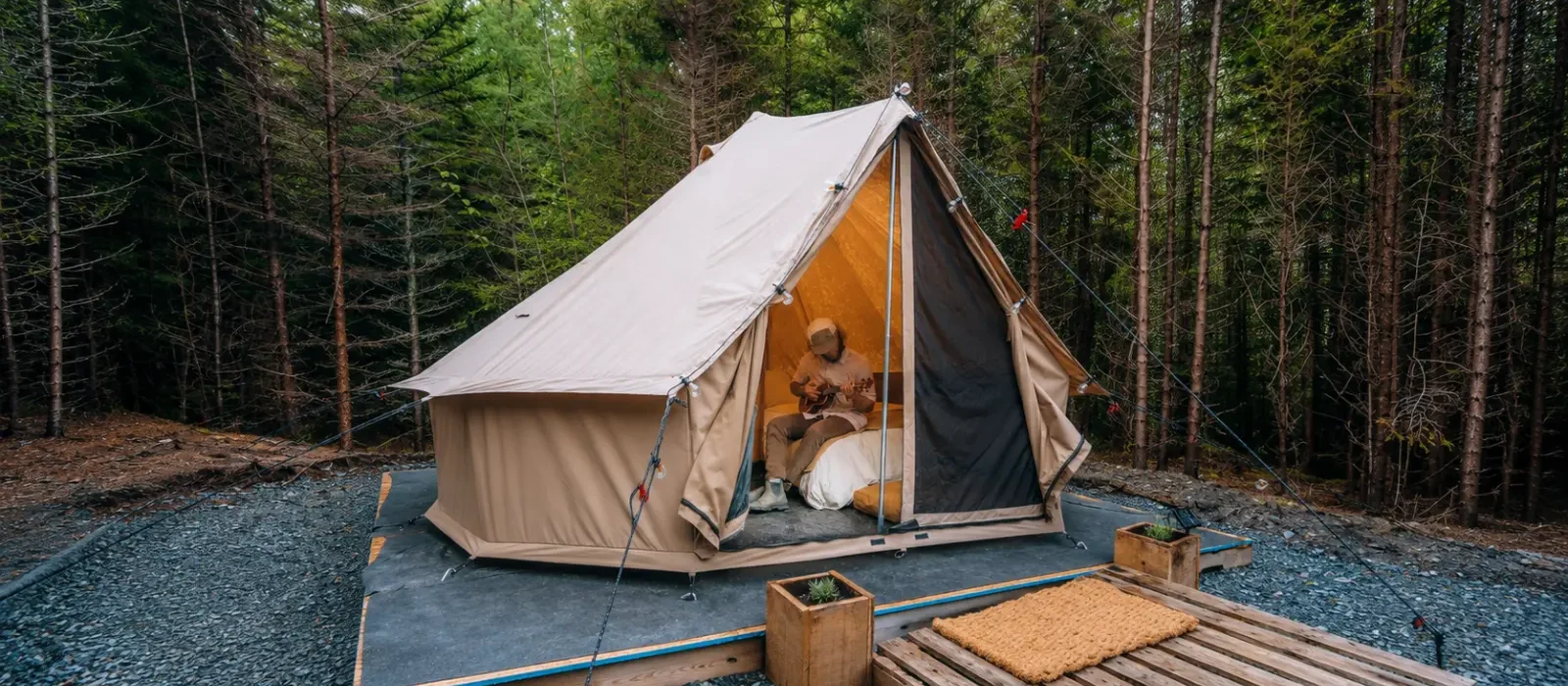
The question most people ask when they search for solo glamping isn’t whether it’s safe to camp alone. That ground is well covered, and the answer is yes, with the right preparation. The real question is whether it’s practical, or worth it, to drag a full canvas tent out to a campsite for one person, or whether it’s the outdoor equivalent of booking a hotel suite and sleeping in only one small corner of it.
Table Of Contents
This answers that question directly. The safety basics belong to their own conversation. They are so nuanced to the capabilities of the individual that one could write a book about that topic and still find curious avenues to pursue. What’s genuinely still open is the comfort and practicality question: when does a bell tent for one person make sense, when does it not, and what size are you actually looking for if you go in that direction? These concerns of comfort can translate into simple safety issues, so assuming you’re already comfortable with solo glamping, let’s look at what that means.
What Does Safe Actually Mean for a Solo Bell Tent?
The general solo camping checklist, which includes telling someone your plans, offline communication tools, campsite selection, and situational awareness, is covered in full in the solo female camping safety guide and the how to stay safe while camping alone post. So, there’s no need to repost those topics. What is interesting and worth going into some detail for is the bell tent itself.
There are a few factors to consider when using a bell tent for solo glamping. A larger tent is more visible at a campsite than a smaller dome tent. This works in your favor when having neighbors at an established campsite where neighbors might be part of the safety issue. The flip side is that a larger tent is more visible to those passing through.
When considering a solo camping trip, you’ll want to weigh these options. Are you more comfortable alone in the wild, or among people? Some folks don’t prefer to be alone with other groups of people. It often catches attention, seems odd to other campers, or just doesn’t offer the kind of solitude they’re looking for. Conversely, others like the comfort of other people around. If a rolled ankle or other accident happens, there are folks to assist. For tent-specific concerns, the bell tent works well in either location.
Door and zipper security are other tent-specific considerations. A canvas bell tent with a quality zipper that runs smoothly and closes fully is a comforting feeling when out in the wild on your own. It seems like an innocuous detail, but think about trying to sleep in the dark, alone, when your tent can only zip up halfway.
The Real Question is Comfort, Not Just Size
When you decide to set out for a solo glamping adventure, take stock of what it is you want to get from your trip. If you want to go as deep as you can into the wilderness as quickly as you can, you’re going to want to travel light. For this purpose, a backpacking tent is ideal. Sometimes, the idea of getting away alone is to achieve some kind of disconnect, to keep some peaceful time for yourself. This is, in effect, a kind of comfort-seeking trip. While a backpacking tent may work in this scenario as well, the only real comfort in smaller dome tents is lying down. To pack a shelter for comfort and to enjoy the glamping experience, a bell tent can transcend the space into a place where you can stand, lounge, and find some genuine relaxation.
The real difference here is that a bell tent is a place of comfort. A bell tent, even the smaller sizes, provides enough room for real bedding, a camping chair inside the tent, and space for a stove. Dome tents are built for utility. Bell tents are designed to be lived in. For a couple of days while you’re alone, you’re able to inhabit the space and make it your own. No distractions, just your preference.
On a more practical measure, a bell tent provides a comfortable shelter for you earlier in the spring and later into the fall. The shoulder seasons are no worry with the sturdy canvas construction, and if you add a tent stove, it will keep out even the worst temperatures. Shoulder seasons can have large swings in temperature between the midday and midnight hours. Afternoon winds can chill to the bone while the noonday sun can be a scorcher. The versatility of the bell tent, complete with a stove jack, is ready for all three seasons.
For its size and design, the bell tent goes up in a jiffy. The entire construction is focused around a center pole. This is easy enough to set up, and once it’s in place, the perimeter is staked into place to form the final shape. There is no need for multiple people to assist in getting it off the ground, and it packs small enough that one person can carry it, or drag it on a sled, for a substantial distance.
The solo camping comfort argument for a bell tent comes down to one honest question: are you going to sleep somewhere, or are you going to spend some time somewhere? There is a meaningful difference between those two kinds of trips, and the answer is up to you and the experience you want.
When a Bell Tent is the Wrong Call
As mentioned above, multi-day packing trips or backcountry traversing is the most obvious place to leave the bell tent at home. When you are covering real distance on foot between camps, pack weight becomes a real factor and will determine what your body can handle over multiple days of travel. A lightweight packing tent from any brand wins out in this need, and the right answer has nothing to do with canvas. It has to do with load management. The fact about canvas is that it is heavy. To achieve the many benefits that canvas boasts, that weight is necessary.
Single-night, roadside stops on a road trip are another place where the canvas tent doesn’t earn its setup time. If the idea is to cruise as far as possible into the night, find somewhere quick off the road to crash, then hit the road early, it’s simply not worth unpacking, setting up, and staking down a bell tent for just a few hours of shut-eye. This is exactly what small dome tents are good for.
If you have a vehicle-accessible campsite and can arrive early, set up a small home-away-from-home in comfort and style, and want to use your camp as the getaway site, then treat yourself to a canvas bell tent. Base camp weekends, solo glamping trips at a developed site, and shoulder season outings where a tent stove is needed are ideal settings to take a canvas bell tent. In these situations, there are real sacrifices being made in opting for a small dome tent.
Which Size Actually Fits One Person?
The title asks the question, and the answer is pretty simple: the smallest bell tent size in the collection. The smallest available bell tent is ideal for one person and offers every comfort advantage without adding a lot of extra weight. Regardless of the size you choose, you’ll be able to stand up inside, and the conical shape will manage the temperature well in any condition. The interior will have real room for sleeping, a space for a camping chair, and a stove in the shoulder season when the time is right. At the smaller diameters, you also have the ease of setting it up alone. There is less canvas to tension, which also results in a fast breakdown.
If you’re asking yourself, what tent should I buy, a guide on this blog already recommends a smaller bell tent as the right call for solo glamping.
A practical note on sizing up: The instinct to go larger because the price is manageable is something most people confront, and it’s understandable. But the fact is that the smallest bell tent in the collection fits one person best, and has the distinct features of being lighter and specifically sized for one person to stretch out with comfort. Going any larger can result in a more laborious setup time and a little extra investment in take-down time as well.
FAQ
Is it worth glamping alone, or is it a waste of space for one person?
It depends entirely on what the trip looks like or what your desired outcome is. Spending a few days at a fixed site, cooking food, reading, and actually inhabiting the space? Solo glamping in a canvas tent is worth every square inch. If you’re moving your tent daily and treating your tent as a storage space for your gear until it’s time to sleep, then a bell tent is more structured than the experience needs. Is glamping alone worth it comes down to what you’re doing out there, not who you’re doing it with.
What is the smallest bell tent size available?
The Regatta Bell Tent from White Duck comes in an 8-foot mini size. The ceiling height is over 5’, the door stands at 3’6”, and the floor is easily large enough to sleep two, which is why it provides ample space for solo glamping. One thing to consider with the 8’ mini is that there is no stove jack in this model. While the smaller versions have a smaller and thus easier space to heat up, it might be a colder experience deep in the shoulder seasons.
Is a canvas tent harder to set up than a small dome tent?
It is harder, but not by as much as people expect. For first-timers, raising the center pole is the most uncertain part. After that, it gets easier and becomes more routine. A dome tent is universally faster. The difference in speed is smaller than the difference in space allotment. In terms of solo camping comfort, the time sacrifice is nothing for the extra room of the canvas tent.
Can one person really pitch a bell tent by themselves?
Yes. The sequence is as follows: lay out the canvas, stake the perimeter, raise the center pole, then tension the guy ropes. Practice it once in the backyard or at a local park before heading out into the wild. You’ll never even think of the difficulty after the first setup.
The Bottom Line
The tent decision for solo glamping comes down to the length of your trip and what you plan to do with your time. One night on the move, a small dome tent will be just fine. Multiple nights at a fixed site while you actually inhabit the space and not just sleep in it- then a canvas bell tent for one person earns its place. Decide based on the trip, not just the headcount.
For everything you need beyond the tent, the solo camping checklist covers the full picture of what to pack and how to plan a solo trip from start to finish.


No Comment! Be the first one.