
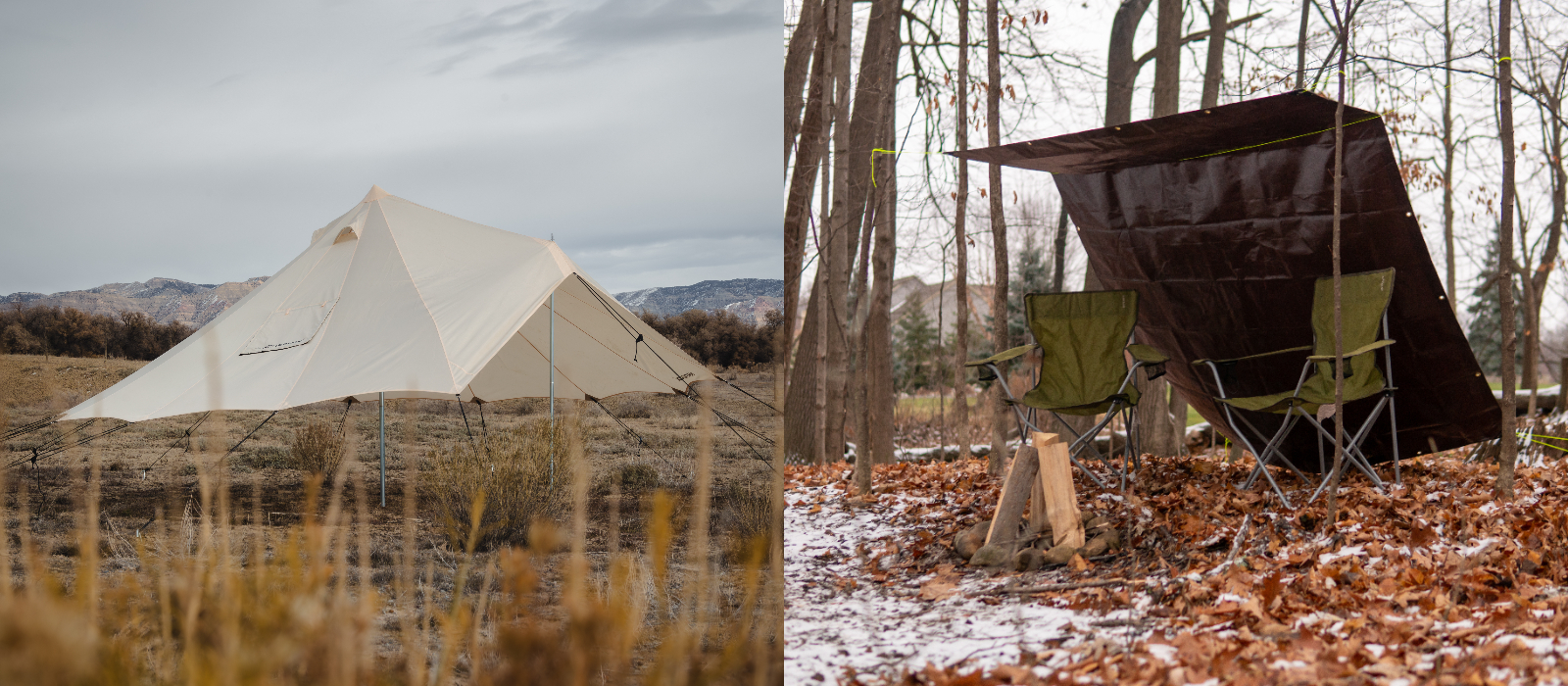
When getting into camping, backpacking, or just the great outdoors in general, people often get the minimal amount of gear necessary and just get by. There are some who really get into the gear, as well, and purchase all the bells and whistles that the outdoor retailer has to offer. Between these two extremes, there is a happy place, but that sweet spot can be difficult to find. Refining your camping setup takes time and knowledge, and there really is no other way to do it than to get outside and try whatever it is for yourself.
Table Of Contents
That said, there are some recommendations to take heed of that will help you decide on the best equipment for your setup. Today, to gain a little perspective and knowledge, we’re focusing on camping tarps and rainflies: what they are, and what the difference is. There are many unnecessary camping items out there that claim to perform some necessary, but very obscure, task around camp. Or, some advertising will sell you a product that will appear to make you safer. It’s really up to you what you want to invest in, but having a good knowledge of products like tarps and rainflies, and skills like ropes and guyline, will help you more than any other flashy product. So let’s get to it.
What is a Rainfly, Anyway?
This is a great question, and it’s one that many people are ashamed to ask. It appears logical enough to understand, it’s some kind of rain cover, yeah? But knowing how it works and its express purpose will help you secure one to your tent and make sure you, your crew, and your gear all stay dry.
A rainfly is essentially a secondary waterproofing layer that hovers over your tent’s main roof. Think of your tent as having two skins: the inner tent that is usually a breathable mesh fabric, and an exterior shell, or rainfly, that is waterproof. Many three-season synthetic tents will have a mesh interior as the top section of the roof. This is to keep airflow moving and allow the user to sleep in open air, if desired, at night. Over that mesh interior, a cover, or rainfly, can be attached to make sure the user stays dry in inclement weather. It also keeps it warmer inside and traps in some of the warm air.
This principle also applies to natural materials like wool and canvas tents. The rainfly on these tents hovers over the initial interior tent and provides the security of a rain shield in inclement weather. In other camper-speak, this is also called a Double-wall system, and in one way or another, most modern tents are equipped with at least the possibility of this system.
How Rainflies Actually Work
We don’t have to get technical here, so this will be just a little armchair science for you: The real issue at hand, sleeping inside a tent, is a wet one. There is a condensation problem when multiple, or even one, people sleep inside a closed structure. The average person exhales about 1 liter of moisture vapor per night while sleeping. That is a moisture factory! But when that air comes out of the body, it is very warm, around 96 degrees, but, and here is the issue, the air outside of the tent is much cooler, especially at night. When warm air hits a cold surface…you guessed it, condensation. Water droplets form, and at this point, you’re basically sleeping in a rain cloud.
Without a rainfly, your breath hits the cold tent wall and forms as water droplets. You wake up “wet” even when it’s not raining. This is probably the biggest complaint about cheap, single-wall tents. What a rainfly does in this case is let that warm air breathes. This is why canvas is one of the best materials from which to construct a tent. It is durable, and it breathes well. There are some instances, like dry summer weather, where you can open the doors and windows, and you might not need a rainfly. But if you’re strapping it down, a second layer is the way to go.
The Mighty Camping Tarp
If they were just lying on the ground next to each other, it would be difficult to tell the difference between a camping tarp and a rainfly for a tent. The real difference is that one is specifically designed to fit the shape of a tent, the rainfly, and the other is a multi-use product that can, in a pinch, double as a rainfly, the camping tarp.
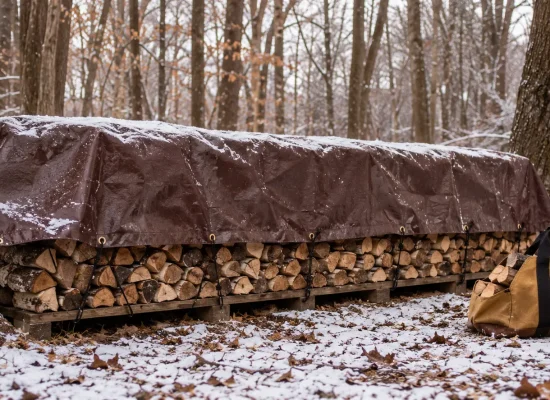
The most common type of tarp you’re probably thinking of is the one used to tie down a trailer, haul leaves raked in the yard, and is seen in about every shed in the United States. These are classic Heavy Duty Tarps (as they’re frequently labeled), and they’re made from polyethylene. But for camping, there are numerous different use cases for a good tarp, and myriad types of material these tarps can be made from.
Plastic Tarp:
These are handy tarps that are 100% plastic and 100% waterproof. If you intend to use these to cover an outdoor kitchen or a restroom in the wild, this material is a good option. But if you want to use this plastic material in place of a rainfly for a tent, you might want to rethink that. Plastic tarps are difficult to secure. They often don’t have eyelets and can tear easily. Without the ability to breathe, they trap air and moisture and can, in a quick minute, create the very problem that single-wall tents produce: indoor rain.
Polyethylene Tarp:
Polyethylene is very similar to plastic in its breathability properties, but it is very durable and can be easily tied down. Likewise, this is not a great tarp to use in place of a rainfly for a tent, but its uses extend far beyond that for the purposes of a camp. These tarps are waterproof, clean up very well, and are extremely durable.
Note: They will slice pretty easily when they come in contact with a knife blade, but if they are being tugged and pulled, they have great tensile strength. Use these in the kitchen and the latrine, and you’ll be pleasantly surprised at their versatility.
Cloth or Canvas Tarp:
This is the next best option if you don’t have a rainfly for your tent. These fold well, are malleable, and they breathe while remaining waterproof. This is what a rainfly for a tent is made from when you purchase a canvas tent. It will still be difficult to get a canvas tarp to cover the roof of a canvas tent, if only because it’s not cut to the shape of the tent. But in a pinch, it will at least provide an extra layer of waterproofing for your camp setup.
For general camp use, I highly recommend a canvas camping tarp. These are almost as soft as a blanket, but as durable as a polyethylene trap, and they are even more resistant to a blade. If you want to set up a picnic just outside of camp, throw one of these downs. You want an unobtrusive shade cover in a nice, neutral color, pitch a canvas tarp. Like any product, these come in various styles and degrees of quality. Getting one from a quality brand like White Duck Outdoors will improve your chances of keeping it for years.
Camping Tarps and Rainflies: Minimal Differences, Big Effect
As I stated before, to the layman, there isn’t much difference between a rainfly for a tent and a camping tarp. But the subtle differences can mean the world. The main difference is the specific shape of a rainfly for a tent. They are designed to fit the exact shape of the tent, remaining only a couple of inches from the surface of the tent shell. If the rainfly ends up touching the tent, the whole condensation event described above will happen. Camping tarps are a great substitute when in a pinch, but without being specifically cut and sewn to the shape of the tent, they are going to either hover too high above the tent or end up touching the exterior. If it hovers too high, the necessary pocket of warm air emanating from the tent won’t remain trapped, forcing the condensations on the rainfly to bead and drip to the ground. The air will pass through.
Tarps are great rain covers, but that is a different thing. If you are just looking for another waterproofing layer, perhaps a storm is just on the horizon, and you want to pitch a tarp between two trees, over your tent, that’s great. That is what a campaign tarp is used for, under the terms of protecting a tent from water. But to secure it close enough to act as a rainfly for your tent, it’s just not likely.
Practice Makes Perfect
Some rainflies, especially in synthetic tents, are specifically designed with buckles and straps that click into place and are easily adjustable. With other tents, such as wall tents or cabin tents, a rainfly must be secured using guyline, stakes, and a little care and precision. Just like the body of the canvas tent, you want your rainfly taut and strong. The water should bead off the outside with ease, and not rest upon the sheet sections of the tent frame. There should be a 2-4 inch pocket of air surrounding your tent where the rainfly will trap the warm air emitted from the sleeping people inside the tent.
It comes highly recommended to get familiar with your gear before trying it out in a real-world scenario. Make sure you’re comfortable with the guyline, the knots you need, and the proper angle to use to best secure your tent in high winds and rain. These kinds of learned skills are part of the fun of camping and outdoor mastery. It’s okay if you don’t want to be a rugged frontiersman, breaking ground in new territory. But it’s a good idea to procure some basic skills and understanding before putting yourself and your crew in danger. Practice up, and always have some fun.




No Comment! Be the first one.