

Yurts are becoming increasingly popular amongst campers and glampers all over. The domed dwellings provide plenty of space to move around, abundant natural light, and easy in and out-access. Yurts are the happy medium between a stable home-like structure and a primitive tent.
Table Of Contents
Yurts are made of materials like cotton canvas that offer greater insulation from the weather as compared to the average tent. They are sturdy, reliable shelters that are less expensive to rent than a cabin or even an RV–but can still be furnished similarly. You can almost always count on rentable yurts to include bunk beds, futons, or actual bed frames and mattresses, which sleep your whole family comfortably. If you choose to purchase your own yurt, know that the option to equip your temporary dwelling with all of the comforts of a permanent home is indeed possible, should you choose to do it. In the fanciest of glamping scenarios, it’s even possible to connect electricity to a yurt, equipping the place to handle running water, appliances and electronics.
What’s more, yurts can be outfitted with additional exterior features like platform decks, porches, and awnings which make it feel even more spacious and reminiscent of a permanent home.
What Is A Yurt?
Before we go any further with singing yurt praises, we should probably explain what exactly a yurt tent is, and where they came from. Yurts originated in Central Asia thousands of years ago, primarily used by the region’s nomadic groups. Modern-day North American yurts still retain the features and forms of the ancient shelter. Yurt designs feature a round, domed shape with a canvas or felt cover, tensioned across lattice walls. Often, these dwellings are built on permanent platform foundations offering a sturdier stay as opposed to a traditional tent. Modern-day yurt tents are made to handle rain, snow, and high winds and last for several seasons even under such weather. Yurts are different from traditional tents not only in structure but in terms of the spaciousness and versatility they offer. Often, yurts come equipped with a wood burning stove for warmth, windows, and large doors for smooth come-and-go. These convenient dwellings come in all sizes, from small two-person yurts to larger ones made to comfortably accommodate entire families.
Benefits Of Camping In A Yurt
Yurts are a universally recognized nomadic dwelling structure used by many people all over the world both personally and commercially. Individuals enjoy camping in yurts over traditional tents for their many added benefits including easy transport as well as luxurious, reliable comfort and superior protection from the elements. Yurts offer both short-term and long-term campers a sustainable, cost-efficient living shelter they can count on–as they have offered humans for thousands of years. In fact, yurt tents can be found at many state and national park campgrounds today as a comfortable, accessible option for folks who prefer a full glamping experience to primitive tent camping.
Comfort
Canvas yurt tents offer superior temperature control and protection from the elements. Heavy yet appropriately porous cotton canvas keeps body heat and accumulated heat from the sun inside during the night, but lets enough air pass through to keep it from becoming humid, stuffy, and stagnant. The dome shape of a yurt creates a natural heating and cooling system, slowly encouraging hot air up and out as cool air seeps in from windows and doors.
Durability
Yurt tents are typically made from durable, weather-resistant materials such as cotton canvas. The structure of the yurt itself diverts wind evenly all around the outer walls of the dwelling, making sure of a sturdy hold against weather volatility and extremes. The same goes for rainwater and snow–rather than accumulating water or ice, unevenly weighing down the outer covering of the structure and causing damage, moisture rolls right off thanks to the yurt’s domed shape.
The strength of the wooden skeleton of a yurt, and the tension and compression in the roof covering ensures that the structure’s roof and walls can hold thousands of pounds, so the snow that does manage to accumulate does not cause the roof to droop or cave in completely. However, it is just malleable enough to allow for some push and pull when it comes to the elements–slight flexibility prevents the yurt from collapsing altogether whether it is shaken from the foundation or from above.
Cost Efficiency
For those looking to travel on a budget, but who also do not want to sacrifice comfort, convenience, or luxury, yurt camping might just be the most cost-efficient way to accomplish your goal. Purchasing your own yurt tent, while expensive up front, can save you on hotel/cabin/RV rental costs for years to come. Overhead costs and maintenance costs on a yurt-style tent you’ve purchased for yourself are significantly less than those of an RV or cabin. Even if you do choose to deck out your yurt or run electricity/water to it, you still won’t be facing utility bills nearly as steep.
On the other hand, renting a yurt tent to stay in–whether from a private individual, rental company, or a state park–can be anywhere from one-half to one-fourth of the price of a hotel room that offers the same or comparable amenities. The choice is a no-brainer.
Unique Experience
Camping in a yurt is an immersive experience of the wonders of nature. Not only do a yurt’s thin walls offer you a front-row seat to the sensory experience of nature’s sounds, and smells, but many are made with multiple windows, skylights, and doors for optimal stargazing. Cozy up in your most comfortable sleeping arrangements–yes, there will be plenty of room for bringing along all of the pillows–and open your windows or skylights to enjoy a show. After falling asleep to the stars, nothing could be more magical than waking up to a breathtaking sunrise. Yurt camping offers the luxury of a hotel or cabin stay, but you won’t miss out on a single bit of therapeutic time in nature.
What’s The Difference Between A Yurt & A Bell Tent?
Yurts are wooden structures that feature latticed walls which offer support to several poles which uphold the roof of the tent. These tents, while a bit more involved than bell tents, are still relatively easy to set up and take down. Just don your trusty work apron containing the minimal tools necessary, and trust the simple materials to come together! The only potential drawback of using a yurt tent versus a bell tent is the weight of the wooden structural components–yurts are great for camping trips in locations where you are able to transport the structure via all-wheel drive vehicle. On the flip side, the weight of the wooden internal structure of the yurt tent makes it a much sturdier option against high winds, rain, and snow. If you can get behind a longer setup and take-down process, the comfort of a yurt is sure to exceed its labor demands.
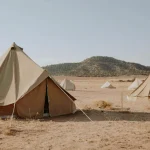
Bell tents, while technically falling into the “yurt” category, feature a simple, minimalistic design that includes a singular pole in the center and a large piece of canvas tensioned over the top of the center support to give the tent its “bell” shape. The idea of a bell tent most likely derived from a Native American tipi, but was greatly simplified from several poles to one in order to provide for ease of setup and transport using a nifty canvas bag. Bell tents are versatile across many terrains, as they do not necessarily require perfectly level ground for setup.
Both bell tents and traditional yurt tents can function as fantastic four-season tent options. Their versatile designs and durable materials provide the sturdiness needed to withstand severe weather patterns and the temperature control necessary to keep their inhabitants safe and comfortable.
Final Thoughts
Yurts are great options for temporary camping stays, but if you’re looking into a more long-term outdoor adventure, they can also be used as reliable primary dwellings. Yurts can be built anywhere from remote/rural areas, to suburban neighborhoods. They are easily customizable and simple to take down and move to new locations if the nomadic life appeals to you and yours. What’s more, yurt tents are a sustainably eco-friendly housing option if this is something you are concerned about. Because they require such little upkeep and little to no altering of the natural order of the land in order to set up, yurts have minimal impact on the natural ecosystems of the land you choose to settle on. Yurt tents also take up much less surface area than a traditional home, so they tend to use fewer resources both to complete the initial build and maintain long-term.
Yurts are easy to power using alternative energy sources since they generally require very little. If off-grid living appeals to you, you can easily run electricity to your dome home using sources such as solar panels or wind turbines. Whether your next adventure is a permanent or short-term one, yurt tents have proven to be comfortable, versatile options for shelter.



No Comment! Be the first one.