

If you’re here to compare snow shelters and winter tents, then it’s probably safe to assume you are gearing up for some cold, cold, temperatures. Camping in the winter is an experience like none other, and well worth the extra knowledge and preparation it requires.
Table Of Contents
It’s a thrilling adventure, to camp in the thick of winter, that puts your survival skills to the test. And that means first and foremost you’ll need to focus on shelter. In this post, we’ll be discussing and comparing snow shelters versus winter tents so you can learn a little bit about what each design has to offer and decide what shelter will best suit your icey winter adventures.
What is a snow shelter?
Maybe you’re snowed in and need a fun family activity to do in the backyard, or maybe you’re planning to be long-term trekking through a dense snowscape. Maybe you want to practice your survival emergency skills in case you need to build a shelter. Either way, you have the ability to create a shelter for yourself strictly from the natural resources around you.
Where did they come from?
Snow shelters are a fascinating tradition that developed amongst various indigenous people groups in arctic and frigid northern regions. Different types of structures were developed to act as long-term, insulated housing throughout the winter season.
These original structures offer incredible camping experiences and a glimpse into long-term living in below-freezing regions. Other snow shelters, or survival shelters, act as an important element to emergency preparedness when trekking or camping in the thick of winter when conditions are severe or unpredictable.
How long they’re meant to last
Snow shelters are meant to last for a long time. The packed snow in below-freezing temperatures (so long as it’s protected from the wind and out of the way of potential avalanches) can hold its structure for a whole season.
How they’re made
There are various types of snow shelters for various purposes, all requiring different skills and strategies.
Tree Pit – This is a simple survival shelter that requires a large sturdy evergreen tree with low hanging branches and a deep snowpack. Around the base of the tree trunk, dig out a pit and try to keep it as small as possible (while still allowing room to comfortably lay down to sleep and sit upright). The low-hanging tree branches act as a sort of roof and shield from the elements, and adding a tarp above you can help seal in the warmth. This is an easy, super warm option if you’re in need of shelter and protection in the harsh winter.
Snow Cave – A snow cave is a highly insulated shelter that is perfect for long-term, cozy snow camping. It does require hardened snow that may require heavy tools like metal shovels to help carve into. The structure begins with carving a tunnel through the length of a heavily packed snow drift that leads to a teardrop shaped “room”. This area ought to be large enough to sit upright and lay down comfortably to sleep. A ventilation hole that cuts through the roof will be necessary to allow carbon monoxide to escape and oxygen to flow (a general rule for all shelters– snow or not). You can cover the entrance with tree branches or gear.
Snow Trench – One of the more basic snow shelters, this is a great option for beginners getting used to working with snow, and for quick assembly in poor weather conditions to sit out a storm. It’s a trench dug in thick snow. Essentially, it will be dug to your size preferences– best to be high enough to sit upright and long and wide enough to lay down comfortably. The top is left open to be covered with branches or gear and a tarp, as is a small entrance in the front. It is not nearly as warm and insulated as other snow shelters due to having a less secure roof just covered by branches, but a great option for a quick, easy shelter.
Quinzhee (sometimes spelled quinzee) – The name comes from Athabaskan– a North American native language. This is a simplistic shelter design to last a long time. It’s made by hollowing out packed snow in below-freezing temperatures. It begins with a large, oblong mound of snow, left to sit overnight and freeze together. Then the center is hollowed out all the way through the length of the mound, keeping the walls at least 12” thick. It has a ventilation hole in through the top, one end closed by snow, and the front entrance can be sheltered by tree branches or gear.
Igloo – It’s likely you’ve heard of this classic snow-brick dome. This is an intricate design developed by the indigenous peoples of the Arctic, such as the Intuit, for long-term living. This is a highly time consuming build that requires a level of skill and expertise to do successfully.
Ideally, this is constructed in frigid temperatures, as it’s constructed of carefully crafted frozen snow blocks fitted tightly together. The blocks are stacked together to form a dome shape with a small entrance. Though this is an insulated, basically frozen structure, it is not nearly as warm inside as other snow shelters like a snow cave or Quinzhee, there is always ventilation, as the entrance is never fully covered. Because it’s constructed of blocks, there is also a chance for airflow through seams in the walls. The completed structure is roomy and comfortable for multiple people, and perfect for long-term winter living.
Pro’s
- Incredible way to fully immerse in the winter landscape
- Certain designs can be made in case of an emergency if you learn how to do it
- Are designed to last a long time–sometimes months at a time
- Insulated
Con’s
- Labor intensive
- Time-consuming
- Some are complicated designs that would require practice and expertise
- Requires bringing extra tools like a shovel.
Who should build and camp in a snow shelter?
- Those who desire to learn new skills
- More experienced campers and hikers
- More experience and knowledge regarding emergency preparedness and first aid.
- Those interested in a “close to nature” and educational experience.
- Longterm camping
What is a winter tent?
Also known as a 4 season tent, a winter tent is designed to endure harsh weather conditions and temperatures. It is typically built with a more rigid structure, with sloping sides for wind and weather protection. 4 season tents are often constructed with canvas that helps block out moisture and wind, keep things lightweight, and often have many more guy-out points to secure everything down.
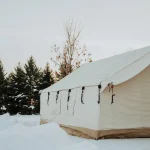
If you’re planning on a much longer-term winter trip and outfitting for a hunting trip or a season full of snow activities, a canvas winter tent might be the way to go. These wall tents come in different sizes but are generally structured with rigid walls and canvas fabric. The tightly woven fibers of canvas that are coated with waterproofing are ideal for keeping the space nice and insulated. A canvas winter tent will likely include a stove jack for easy installation and use of a propane or wood burning stove– a useful addition to your cozy home in the snow!
Gear & Weight
Camping in the winter with a tent will require some extra gear like tarps for ground covering and to use as a rainfly. You’ll need extra guy lines and snow pegs to keep everything taut to help withstand wind and allow precipitation to roll off the sides as much as possible.
Bear in mind that a tent advertised as multi-seasonal is likely going to weigh more than other tents. A canvas tent will certainly be heavier than a nylon tent. So for ultralight backpackers in the warmer months, a 4 season tent is likely going to be either too heavy or take up the bulk of what you’re packing.
Staking a winter tent
Regular tent stakes simply won’t hold up in dense snow conditions. A winter tent needs snow pegs which can be used horizontally like a T shape to anchor stronger in the snow. Secure these stakes by using extra bungee cord or guy lines to wrap around them, and pack snow over top of them to lock it into the ground.
Pro’s
- Reusable over and over! They are made to last a long time. You can invest in a high quality one now and be sure it’ll last you for many years and adventures to come.
- Waterproof
- Stove jack- most winter camping tents are constructed with a stove jack for easy installation and use of a tent stove.
- Convenient
Con’s
- Packing extra weight. Winter tents are much heavier than other kinds of tents because of their denser fabrics.
- Requires a little extra gear. Not simply the tent itself. Stakes, guylines, waterproof tarps, tent stove, rainfly, etc.
- Can be quite expensive upfront
- Will require maintenance over time
Who should use a winter tent?
- Those who are new to winter camping
- Backyard camping
- Group trips where you have more people to distribute weight in gear amongst.
- Casual campers
- Those camping long term with lots of gear for hunting, winter activities, etc.



No Comment! Be the first one.