

Tent camping has evolved. Since its inception and widespread popularity in the 1950s, when getting folks from suburban America into the backcountry, equipment has continued to advance, and the landscape of what camping looks like has drastically changed. Through the miniaturization trend of the 1980s and 90s, it seemed that everything cool needed to be small. Cell phones came out and needed to be smaller. Likewise for computers. Cars grew more compact, and all of a sudden, music was portable in our hands. The same thing happened with camping gear, especially with camping gear. In some instances, it might have gone too far.
Table Of Contents
Having a tent that weighs under one pound is nice. It’s going to be extremely expensive and way overkill for the average camper, but it’s still nice. Tents also grew much smaller, cramming as many people as possible into a 4’x4’ area. A four-man tent from 25 years ago now fits 6-8. In the event of a disaster, I’m sure many of the synthetic dome tents could fit numerous people, but clearly, these tents are not designed for comfort.
That’s really what it’s all about when a group of friends, or a solo trekker, hits the backcountry: getting comfortable. There are instances of folks pushing themselves to extremes, and that is admirable. But not all of us want to push ourselves to the extremes of Sir Earnest Shackleton, forging through ice to cross Antarctica. For the most part, we want beautiful scenery and a comfortable place to take it all in. During that time, some people might want their own space, a little time to relax on their own. Also, there are added benefits to sleeping in a personal space, and even finding some solitude.
Why Space Matters
This is a silly proposition when camping with kids: why space matters. To be fair, kids don’t always come equipped with the tolerance to rub shoulders with their siblings in a suboptimal environment. Even for adults, this can make our patience thin. It’s a simple reason why separating your family camping tent into quadrants, or even in half, helps everyone feel like they have a place. Oftentimes, when other people are driving us crazy, even the sight of them is enough to send us over the top. Putting up a barrier in a large tent can help solve this issue. Even if it’s not this extreme, maybe someone just wants a little privacy to read a book. If people are still carrying on a conversation, sitting behind a covered section can help block out the noise. It’s almost as if it’s the option that provides the comfort.
That is just for the waking hours. There are simple rules to follow to get the best sleep. There is some conflicting data out there. Some studies say 60% of people who don’t share a bed sleep better; they rate their sleep a 4 out of 5. But then other studies say that people experience less anxiety and higher levels of comfort when they sleep with a romantic partner. But wait! People who consistently record the best sleep are those who sleep in their own room with a romantic partner. So, for mom and dad to separate their space to get some good shut-eye, that is the best sleep outcome imaginable.
There are other reasons why sleeping alone can be better, such as fidgety sleepers and people who snore. It really depends on your situation. But when it comes to the kids or other camping friends, separating out the tent into rooms is clearly the way to go.
The right Tent for the Job
All of this separate rooms talk is nice, but it can only happen when you choose the right tent. Some tents with foldable or collapsible bars can come equipped with multiple areas. Most of them are “porches” or just a little room with bug nets, but there are some out there that have two large cabin rooms. With polyester material for the walls, though, the structures are not reliable in inclement weather. These are a good idea if you know you’re going to have nice weather for the whole trip, and don’t run the risk of rain or wind (or worse). That is a bet I don’t often like to take.
For those campers who are looking for something reliable, look no further than the canvas tent. These come in ideal shapes, bell tents, wall tents, scout tents, and more, and they are all durable in any kind of nasty weather. White Duck Outdoors makes these three shapes of canvas tent and depending on the size of your party and what you want from your tent, one of these can meet your needs. Let’s have a closer look:
The Bell Tent:
First off, the bell tent is beautiful. The shape is incredible, and it forms such a sleek and stylish interior. This is a great tent to section off into halves, or just a small room. They are round and are constructed with a center pole that is easy to attach fabric, a sheet, or some kind of separator to get the space you need. Their open design provides roomy options to move around, so even with a divider, no one feels cramped.
The Scout Tent:
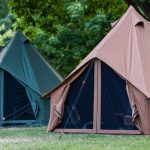
The scout tent from White Duck Outdoors is an awesome four-season tent that is versatile and pretty straightforward. It’s a classic design and looks like something your grandfather would have camped in. And I can’t tell you enough what a compliment that is. The pitch on the roof makes this a great tent to bisect. Kids to one side, parents to the other. Or gear and parents. Or a couple and friends. You get the idea. Like the other tents, it’s made from premium canvas with reinforced seams, and when you hand it down to your grandkids, they’ll know it as something their grandparents camped in, too.
The Wall Tent:
If you’ve got the whole crew and everyone must have their own space, the wall tent is the way to go. These come in numerous large sizes, and all of them are awesome. These are as solid as a brick house and as tall as a redwood. Okay, maybe not. But they do boast plenty of room. Their sturdy poles are perfect to hang items from, like string lights, or, say, a separation! With its immense size, a wall tent can be broken into different rooms, still have a tent wood stove, and still keep a corner for dirty gear. They’re ideal for basecamps and long stays in the wild, and perfect for a family of any size.
The Actual Dividers
This is a fairly common-sense topic, but it does depend on how permanent you want to get, and if propping up separators is something you’re going to do all the time. The most classic and easiest way to divide up a tent space is with, you guessed it, an old sheet. These pack small, they fold into your tent bag, and they can be easily attached to nearly any surface. There are some drawbacks, though. They do get dirty easily, and being out in the camping environment, and then thrown again into the tent bag, they can be easily forgotten and start to, well, smell. Just make sure you change them often.
If you’re going to be doing it all the time, like, say, if you have folks of different genders changing clothes, or just teen girls getting ready in general, then you might want to get something a little more permanent. Foldable semi-permanent room separators can slide nicely into the back of a truck, onto the floor of an SUV, or strap down on top of a vehicle very easily. These can be found for pretty cheap, and they go up in a second. There’s no hassle pinching and tucking a sheet only to have it fall down when someone tugs a little at it.
Furniture and Gear: Use What You Have
For some folks, it’s not necessary to have a tall separator or to be secluded to one side of a massive wall tent. And depending on the age of the person whom you are separating from, a large semi-permanent wall is overkill. Those with little tykes, kids under 4 or 5, gear can be used as a great separator to keep them away from the more dangerous side of the tent, like the hot tent wood stove. Duffel bags full of gear will stack nicely to keep kids away from one side or the other.
Often, in a larger canvas tent, foldable camp couches are a nice touch for a little couple to cuddle. With it positioned nicely, people can get the illusion they have their own space when the back of the couch is blocking their view. A little bit of privacy can go a long way.
In the warmer months, the best addition you can make to your canvas tent is a canvas awning. These will provide shade in the summer and block rain in the shoulder seasons. In the winter and muddy seasons, it is the most practical place to take off muddy shoes. This is not the exact idea of building a separation into your tent, but when you go without one and have a corner stuffed with wet gear for three nights, you’ll understand why it’s the best room in the house. Besides, there is no better place to hear the forest wake up with a cup of coffee while the rest of the family sleeps.
Where to Go When There’s Nowhere to Go
Getting away from the city already feels like an escape. The idea of making extra rooms in a one-room cabin tent, for instance, is to make sure whoever decides to come on the trip can also feel that sense of escape. Sometimes kids want to get away from their parents, or spouses need a space to block out even immediate responsibilities. None of this is a hurtful maneuver to avoid one another. They are just honest reactions to keeping in touch with a more primitive way of living. Humans are highly adaptable, and with time, we all grow more and more comfortable with shared spaces. Or maybe not.
The idea when experiencing wild spaces should be focused on freeing oneself from certain burdens. The keyword here is “free”. We should all be free to choose who we want to be and who we want to be with when we are in the wild. It is a place that requires some knowledge and understanding to get comfortable. Without that, humans are vulnerable and scared easily. Safety comes from feeling comfortable. And comfort comes from feeling free. So, if you or people in your crew feel more comfortable when they have their own space, then encourage that. Carve out a corner for them and find a place for yourself to get comfy. It’s gonna be fun.


No Comment! Be the first one.