
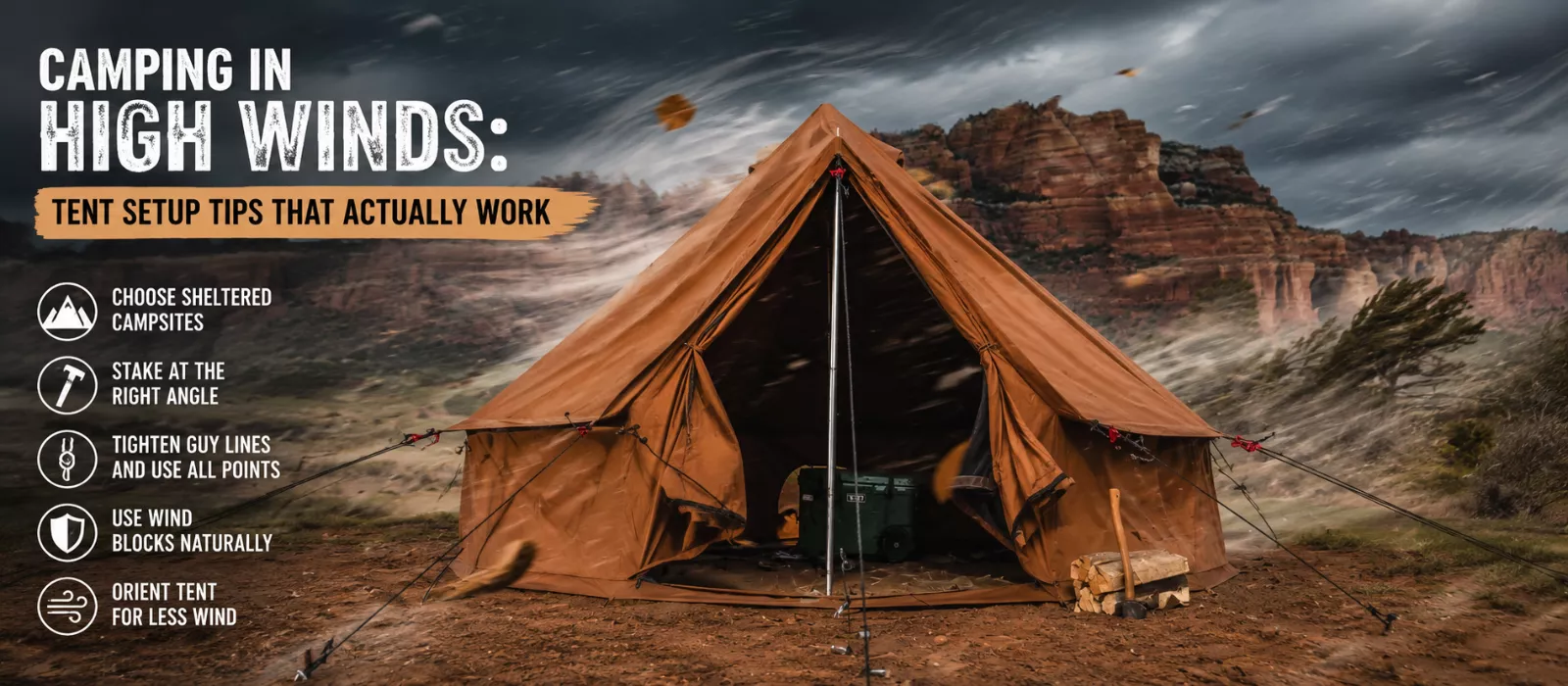
It doesn’t matter if you’re in the Sonoran Desert in the middle of July or northern Canada in January; outright cold and heat are not what bring your tent down. The biggest factor that contributes to a down tent is wind. Not heat, not cold, not rain, not fumbling with the zipper in the middle of the night. It’s wind. Wind will drive your tent to and for all night long until finally something gives. Most of the time it’s a tent stake that wasn’t driven into the earth at the appropriate angle, or a guy line that wasn’t tied right. Sometimes it’s a pole that gives under the weight of the pressure when it’s not properly reinforced.
Table Of Contents
- Section 1. Before the Tent Goes Up, Read the Site
- Find Natural Protection
- Read the Wind Direction, and Prepare for Change
- Section 2. Orientation, Staking, and Anchoring for Wind
- Orienting the Tent
- Stake Deep and Wide
- Guy Lines: All of Them, Every Time
- Section 3. How Each Type of Canvas Tent Handles the Wind
- Canvas Wall Tent
- Canvas Bell Tent
- Canvas Cabin Tent
- The Problem and Solution are Right in Front of You
No matter the cause, in most cases, the issue can be mitigated with proper securing techniques, including tying guy lines and proper staking. When a tent is set up properly, it performs dramatically better than a tent that is haphazardly thrown together. The difference isn’t a bunch of expensive gear or refined knowledge; it’s a set of decisions that’s made before the first stakes are set in the ground. Site selection, orientation, anchor depth, tension, and knowing how your specific tent responds to the elements.
This post covers it all, in order.
Section 1. Before the Tent Goes Up, Read the Site
The best defense for camping in high winds is a well-chosen campsite. The truth is, most campers don’t give this enough attention. If there is a spot for a fire pit, then most people are willing to break camp. In high winds, there shouldn’t even be a fire, and regardless of wind, camp selection should be taken seriously. Five minutes of reading your terrain can save a disaster from happening in the middle of the night.
Find Natural Protection:
Wind moves in predictable patterns through most terrains. Different temperatures and different times of day will also dictate that pattern, but ridgelines, meadows, exposed hilltops, and lake shores all amplify wind. They are the worst places to pitch a tent when conditions are active. What you want to look for when selecting your site is a break in the natural flow of the wind. Look for obstructions that can actually block the wind. Treelines to the windward side, a low rock formation, a large depression in the ground, or the downwind side of a hill will all help deter wind gusts against the side of your tent.
Read the Wind Direction, and Prepare for Change
Before committing to a site, spend a few minutes outdoors, outside of your vehicle, and get a good judge of where the wind is constantly blowing from. If it is cloudy and swirling in all directions, you’re likely to feel a little rain with that impending wind. Regardless, look at the treetops and see if they sway, look for dust blowing up off the ground, and find the direction. Whatever direction the wind is telling you at the moment, rest assured it will change throughout the night.
Wind directions shift with temperature changes, especially in mountain terrain where afternoon thermals can swing 180 degrees between midday and midnight. A tent that’s optimally oriented for the afternoon wind may end up with a broadside gale in the middle of the night. The fix isn’t to guess the wind in the middle of the night perfectly; it’s to set up with the smallest tent profile facing the prevailing wind and all guy lines fully deployed so the tent handles direction changes without needing to be restaked in the dark.
Section 2. Orientation, Staking, and Anchoring for Wind
Once the site is chosen, the setup execution will determine how the tent performs. Three variables matter most: which end faces the wind, how deep the stakes run, and whether the guy line system is fully deployed. As lightweight, synthetic tents maintain such low profiles, guy lines are not as important as canvas tents. For this portion, the recommendations will be made with canvas tents in mind.
Orienting the Tent
Every tent has a high-profile and a low-profile end. Even on rectangular tents like a canvas wall tent, the door side is the low-profile side and the back is the high-profile side. In a bell tent, it’s the door versus the solid panel opposite it. In a cabin tent, it’s typically the gabled end with the broad sidewall opposite it.
The low-profile end should always be facing the wind. A tent that is broadside to the wind presents maximum surface area to the gale. The structure is essentially acting as a sail. Turn that narrow end into the wind, and you can cut that load dramatically, letting the shape shed the pressure over the roof. This way, you can give your staking system a geometry it can work with rather than fighting against it.
Stake Deep and Wide
Standard tent stakes driven into the ground at 90 degrees hold reasonably well in calm conditions. In the wind, they don’t. The vertical load will pull them straight up and out of the ground. For high winds, drive the stakes at a 45-degree angle, pointing toward the tent, in the direction of the pull. This converts the upward force into a shear force that the stake resists far more effectively.
Stake depth matters as much as angle. In soft ground, double-stake high-tension corners by crossing two stakes in an X pattern. In candy or loose soil, use a dead man anchor: bury a stake, or a section of a log, or a stuff sack filled with rocks horizontally in a trench perpendicular to the guy line and attach the line to it. This acts as the anchor point and will hold the guy line taught and secure. This sounds like overkill, but it isn’t.
Extend your stake further from the tent than normal in high winds, at least 18-24 inches further. The wider the angle, the greater the tension your system can maintain without failure.
Guy Lines: All of Them, Every Time
An article in this series goes over the details and specifics of how to apply a guy line, the mechanics of it, and a setup guide in full. It covers the 45-degree angle, metal runners, and tension maintenance. In high winds, all of those principles apply at a higher standard. When the winds are kicking up, and you’re staking and securing your canvas tent, every guy-out point on the tent gets used. Any single guy out point that gets unused is a point of vulnerability.
If you’ve chosen to use a bank of trees to break the wind, it’s possible that some of those trees can obstruct the path of your guy line. If this is the case, use the tree as your anchor point. All the same principles still apply: 45-degree angle, use metal runners to keep good tension, and check your line before bed and after any amount of time.
Wind will require checking your guy lines more frequently. If you’ve done a good job securing your guy points, then you shouldn’t have to move anything, and the adjustment will only be sliding the metal runner an inch or two. If there are loose lines that continually droop over time, you have chosen a poor angle to secure your line. Your tent is pushing in a direction that isn’t securing the taught line. To make an effective guy line secure, it has to be under tension. That’s the idea. Some pushback is not only expected, but it’s also necessary.
Section 3. How Each Type of Canvas Tent Handles the Wind
Canvas tents as a category handle wind better than most synthetic alternatives. To find a dome tent that can hold the same number of people and gear, and still be able to withstand the kind of inclement weather a canvas tent can, you’re going to be in the high end of expedition tents. In this consideration, the canvas tent provides more secure camping in high winds, but it is also more cost-effective.
Canvas Wall Tent
This tent requires the most disciplined guying system out of the bunch. The tent’s rectangular profile presents 4 walls that will inevitably be facing the force of the wind. Every corner, every mid-wall guy-out point, and the ridgeline all have to be fully guyed and staked.
The advantage of this tent is the structural mass. It is a heavy-duty tent by nature and naturally equipped to withstand heavier winds. A well-set Alpha Wall Tent with a complete guyline system is one of the most wind-stable camp shelters available because the heavy canvas resists deformation and the pole system gets more secure as the durable shelter is draped into place and secured with stakes and guyed out. Holding shape is the fundamental principle for canvas tents in remaining strong while camping in high winds.
Canvas Bell Tent
These tents have thrived in every condition since their invention over 1,000 years ago. They are built to resist strong desert winds, and their conical, round shape is specifically designed for that. Wind approaching the cone shape gets redirected from the broad form of the tent and around the narrow roof structure.
The vulnerability in the bell tent is the perimeter ground skirt. If the wind gets up and under this skirt, it will be a nasty night indeed. With the skirt as a liability, it is necessary that the tent be staked in every location, completely around the entire base of the tent.
Canvas Cabin Tent
The cabin tent’s vertical sidewalls are its functional strength in fair weather and its vulnerable aspect in high-wind situations. The broad flat walls catch wind the same way a wall tent does, only the cabin tent is without the wall tent’s rigid height and pole mass to distribute the pressure from the wind.
Full corner staking and guying out every point is absolutely necessary with this tent. Pay close attention to the roof panels and secure them where possible. Wind can get up under the eaves, which makes these areas the setup priorities. In serious, sustained wind, a rain fly over the cabin tent adds a significant stabilizing layer that also protects the seams where the roof meets the walls.
The Problem and Solution are Right in Front of You
No matter how experienced a camper you are, wind is manageable. It is also inevitable, so it’s best if you prepare for it on every camping trip. Wind holds predictable patterns, crosses readable terrain, and can be nearly completely mitigated with proper camp choice and assembly. The campers who lose tents to wind are not the ones with faulty gear. They are the ones who don’t do the due diligence when choosing their campsite and when setting up their tent.
Get the site right. Orient your tent to the leeward side of protection. Steak deep, wide, and secure every point available with the guy line. That’s the whole system. It works on a bell tent outside of Moab in the sandstone desert, and it works in 13,000-foot meadows in the San Juan range in Colorado.


No Comment! Be the first one.