
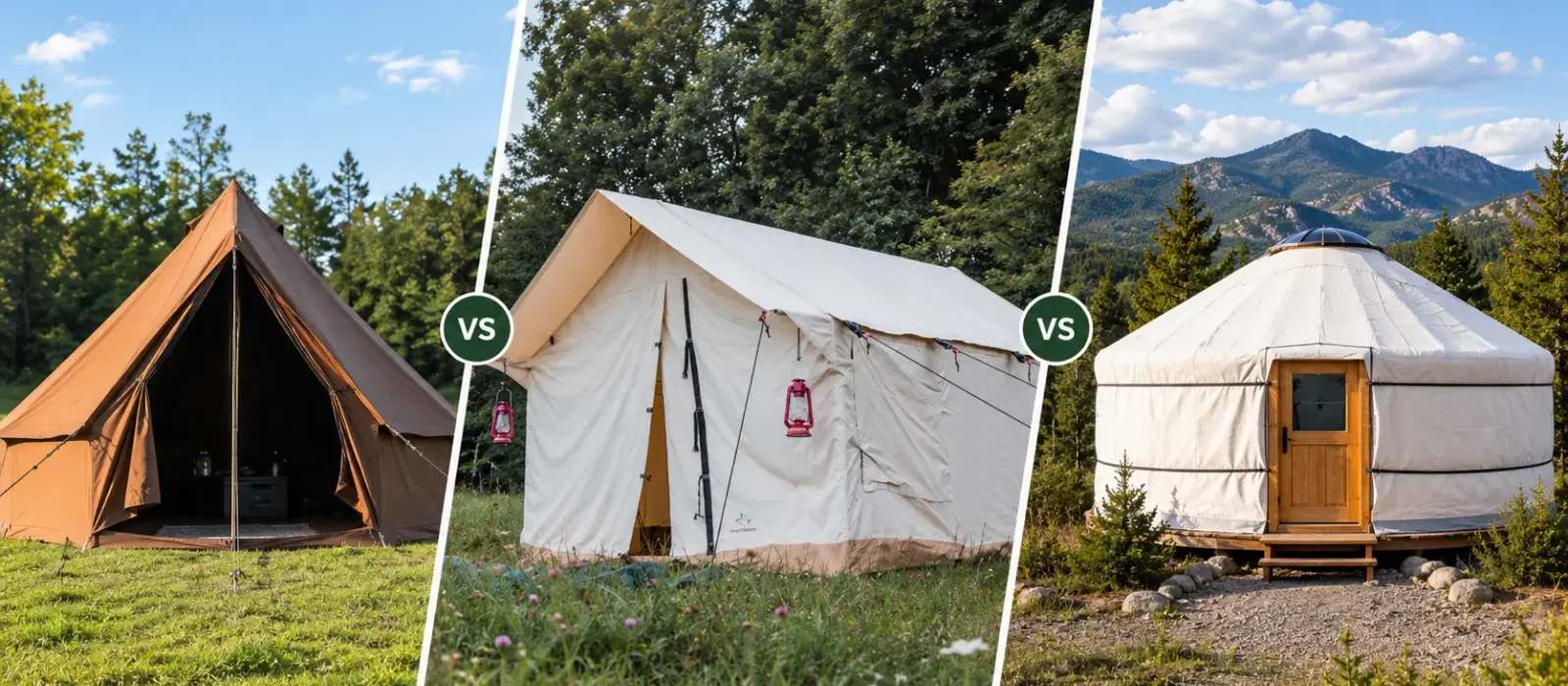
Spend a little time researching glamping structures that fit your backyard business, and you will come away with three terms that may or may not mean three different things: safari tent, bell tent, and yurt. The naming really isn’t consistent anywhere on the market, and buying the wrong structure because of a naming mishap can be an expensive mistake.
Table Of Contents
We’re going to do two things in this piece. First, we’ll clarify what each term actually refers to, quickly and without a long detour into architectural history. That won’t help anyone. Second, we’ll work through a real decision for two specific situations: a backyard glamping setup and a glamping business. The naming question has a clear, definable answer. The decision on the type of structure depends entirely on what you are trying to do with the tent once it’s pitched.
Clearing up the Names First
Considering a bell tent vs safari tent vs yurt, White Duck Outdoors actually has two of them in their lineup. The other structure, a yurt, is in a different product and structure category altogether.
If you’re wondering, is a safari tent is a wall tent, the answer is: Yes. The two names refer to the same structure: a rectangular canvas tent with straight walls set at 90-degree angles with a pitched roof and external pole frame. The safari name comes from being associated with African expedition camps and the wall tent being the backdrop of movies and photos, but make no mistake, it is a wall tent.
A yurt tent, with regard to the glamping market, is almost always referring to a bell tent. They share similar designs from the outside: a single center pole, which provides the structural integrity and exterior shape, draped with canvas and tied with guy lines around the perimeter. This design specifically describes a bell tent. While a yurt might appear in the same shape as a bell tent, the construction is quite different. A true yurt is a lattice-walled structure with a compression ring roof, not a center pole. This is a method for building these durable structures, and it has been the same for thousands of years.
White Duck Outdoors, on the other hand, designs and sells both wall tents and bell tents, but does not manufacture a lattice-walled yurt. The two structures, a bell tent and yurt, are not interchangeable in price tag, permanence, and permitting requirements.
The full history of how bell tents became yurt tents is traceable and recorded in a great yurt tents vs traditional tents comparison.
Side-by-Side Comparison
| Bell Tent | Wall Tent / Safari Tent | True Yurt | |
| Typical Cost | From the White Duck collection: $1,200 – $2,550 | From the White Duck collection: $1,650 – $3,800 | Base kit roughly $8,000 to $20,000+ before platform |
| Platform Required | No | No | Yes, permanent foundation required |
| Setup Time | 15 to 30 minutes, one person | 30 to 60 minutes, two people | Professional installation, days |
| Permanence | Temporary, pitches and strikes | Temporary, pitches and strikes | Semi-permanent structure |
| Permit Typically Required | No, treated as temporary structure in most jurisdictions | No, treated as temporary structure in most jurisdictions | Yes, often treated as a small structure or accessory dwelling |
| Portability | High, packs into a bag | Moderate, requires vehicle transport | None, not designed to move |
| Best Backyard Use | Flexible glamping, guest accommodation, events | Extended stays, serious base camp feel | Permanent guest house or studio |
| Best Business Use | Rental fleet, event setups, mobile glamping | Stationary glampsite, premium per-site experience | High-end permanent glampsite, highest nightly rate |
Which One Fits Your Backyard?
If you are considering one of these structures for your backyard, then the one question you have to ask yourself is: Do you want something permanent or something flexible that can be moved at will?
A true yurt is for someone who is looking for a permanent structure in their yard. This may come with the notion that it is movable, but in reality, they are built to remain in place. It is the equivalent of a small guest house or a home office in the backyard with real walls and the option for full utilities plugged in. It’s that permanent, and the cost reflects that. Pacific Yurts, one of the longest-running yurt manufacturers in the country, prices their base kits from roughly $8,000 on the low end to over $20,000 for larger configurations, and that’s before the platform. If you’re going to add a permanent foundation, any utility connections, and a professional installation, then the total investment will land many times that over a canvas tent. This might make sense for some interested in a permanent structure. Adversely, it doesn’t make a lot of sense for someone who wants to start a backyard glamping setup.
A wall tent in the backyard gives you serious interior space, room for standing without ducking, and a structure that genuinely feels like an indoor room without requiring the full build-out or the foundation, permits, and contractors. These are easy enough to set up for a summer season, take it down in the fall, and store it until next year. The footprint is there; it’s just not fixed.
A bell tent fits the backyard glamping use case at the lowest cost and effort of the three. For the most part, these tents go up in under thirty minutes; they come down even quicker, and they can be repositioned anywhere on your property without any formal structure underneath them. For backyard events, guest accommodations, or a personal outdoor space that changes with the season, the bell tent is the most flexible option by far.
Which One Fits Your Business?
Notably, there are other factors to consider when entertaining other use cases. For the business use case, a cost-per-unit calculation significantly changes the comparison.
A bell tent’s lower per-unit cost and portability make it the most logical starting point for a fleet of rental tents, or an event-based business. More units for the same capital outlay means more revenue potential, and portability means the same inventory can serve a backyard wedding on a Saturday and then serve a festival setup the following weekend. Operators like Glamp Odyssey and Kelly’s Pop-Up BNB built real businesses around this exact model. The bell tent is the unit that pencils out the start and continues to demonstrate value as the business grows.
For those who would like a more substantial glampsite with a permanent-feeling experience at each site, a wall tent is the best option there. The larger interior, the vertical sidewalls, and the option for a wood stove make it a premium option that justifies the higher nightly rate than a smaller bell tent. For a glampsite that is not moving inventory between events and wants to offer guests a more serious shelter, the wall tent is the way to go.
A true yurt only makes economic sense for a permanent glampsite targeting the highest nightly rates on the market. The foundation cost, the permitting process, and the professional installation timeline are all real barriers to entry that canvas tents do not have. A yurt at a glampsite commands a premium because the guest experience is genuinely different. The problem is, for the business owner, the cost to get that yurt is also genuinely different. For a first-time operator or a business still proving the concept, a bell tent or wall tent fleet gets the business running without substantial investment risk.
For operators thinking about multiple units, White Duck’s business page covers bulk purchasing options.
The Real Cost Difference, By the Numbers
For many folks, the cost gap between the yurt and the two canvas tents is a pretty clear distinction and thus a deciding factor in which way to go.
A bell tent starts at a few hundred dollars for the smallest size and scales up from there depending on diameter and configuration. A wall tent starts in a similar range for smaller sizes and moves up with size and bundled accessories. Both are complete purchases and include the tent proper, poles, hardware, and the option to erect the structure the same day it arrives at your door.
A bell tent vs yurt, on the other hand, is a different category of purchase. Pacific Yurts prices their base kits from the mid-single-digit thousands for the smallest size up to roughly $20,000 for the largest. These numbers don’t factor in the platform and buildout. A platform will add several thousand dollars more, and that is without utility connections. A yurt with electricity, plumbing, and insulation for year-round use will be a sizable investment.
A bell tent or a wall tent can be purchased, set up, and generating revenue, or just simple enjoyment, within days of the order arriving. A yurt requires a platform and, in most jurisdictions, permits, and professional installation before the first guest can even darken the door. Both products are legitimate and hold a good share of the market, but the right one depends on budget and your ROI expectations.
FAQ
Is a safari tent the same as a wall tent?
Yes. A safari tent is a marketing name for a wall tent. A wall tent is a rectangular structure with vertical sidewalls, a pitched ridge roof, and an external pole frame. The safari name carries an aesthetic association with African expedition camps, but the product often pictured or imagined is a wall tent. White Duck sells wall tents. If you are looking for a safari tent, a wall tent is what you are looking for.
Is a yurt tent the same as a real yurt?
No. In the glamping market, “yurt tent” almost certainly refers to a bell tent. A canvas tent with a single center pole structure and a circular floor plan and conical roof. A true yurt is a lattice-wood wall structure with a compression ring roof and no center pole, a construction method with roots in Central Asian nomadic culture that has not changed significantly in thousands of years. The two structures are different products at different price points with different installation requirements.
Which is cheaper, a yurt or a bell tent?
A bell tent is significantly less expensive than a true yurt. Bell tent pricing starts at a few hundred dollars for the smaller sizes. A true yurt base kit from Pacific Yurts starts around $8,000 and can run up to $20,000. A true yurt also requires an additional permanent platform before use. The total cost difference between a bell tent and an installed yurt commonly runs into the tens of thousands of dollars.
Do yurts require a permit?
In most jurisdictions, yes. A true yurt sits on a permanent platform or foundation and is commonly treated as a small structure or accessory dwelling under local building codes, which triggers permitting requirements similar to those for a shed or a guest house. Canvas tents, including bell tents and wall tents, are generally treated as temporary structures in most jurisdictions and commonly do not require a building permit. Confirm requirements with your local planning department before committing to either option.
Closing
The decision comes down to permanence and budget before style ever enters the equation. A true yurt is a permanent structure with a permanent price tag. A wall tent gives you serious space with a substantial structural feel without the permanence. A bell tent gives you the most flexibility at a lower cost and an added bonus of style. The best structure for a backyard glamping business is the one that matches your needs. And only you can make that decision.





No Comment! Be the first one.