
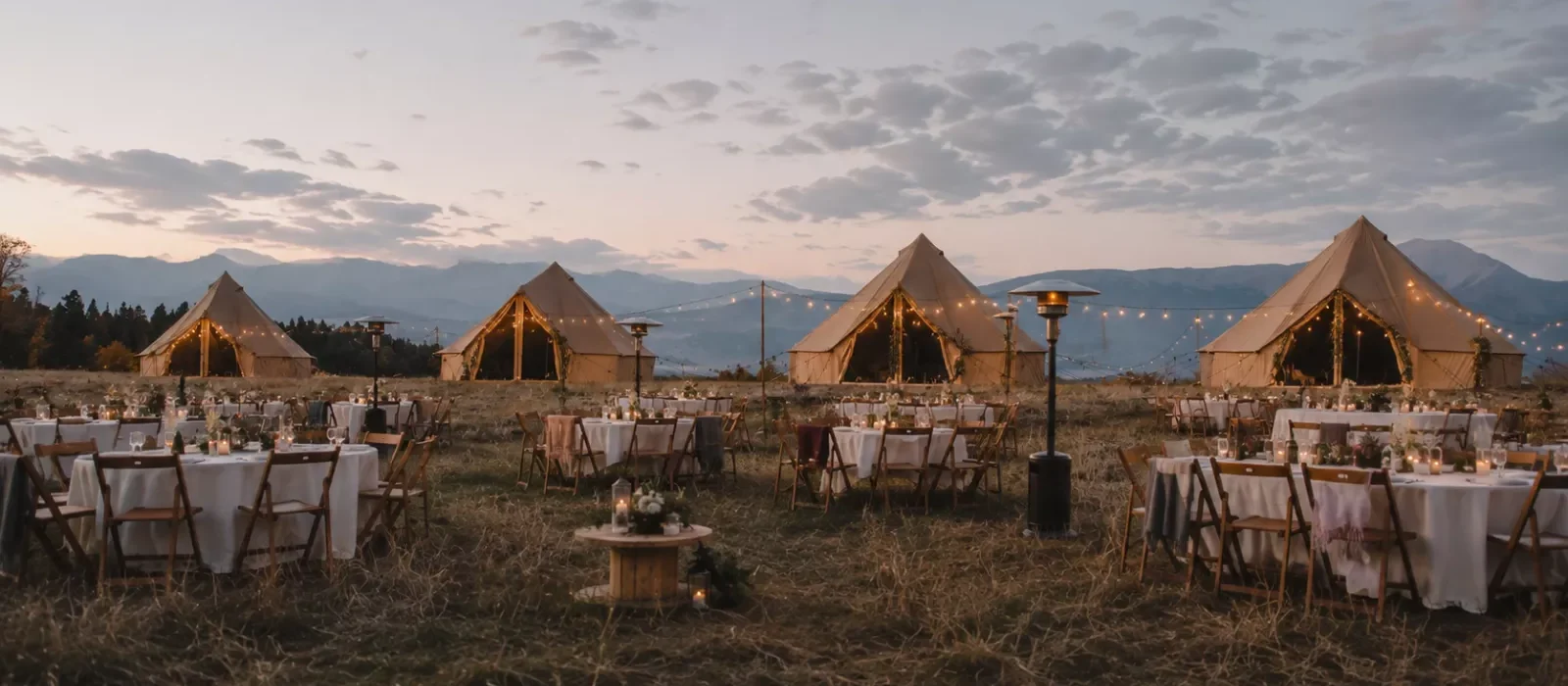
This blog already has several posts about people who built mobile glamping businesses around bell tent rentals for weddings, festivals, and private events. Those posts are great, and definitely worth a read. What none of them do is lay out the operational side of the business, such as the equipment, the pricing structure, the insurance requirement that usually surprises first-time operators, and the realistic channels needed to be in place before booking begins. That is what we’re here to talk about today. The story has been told. This is the playbook.
Table Of Contents
What Does This Business Model Actually Look Like?
A mobile glamping business is structurally different from running a fixed glampsite. In some ways it’s much easier, but in others it is more difficult. You don’t own or lease land, so that’s easier. There is no zoning question. Guests do not come to you. You load the equipment, drive to the event, set up, run the experience, break it down, and then head home after a job well done. The tent is the product; the venue is wherever the client booked.
Several operators are doing this at scale today. Kelly’s Pop-up BNB runs 35 tents plus canopies, operates with a team of fewer than 10 people, and stores everything in a rented warehouse between events. This is a great solution since they don’t own land.
Glamp Odyssey uses White Duck’s Regatta bell tent specifically for wedding and birthday setups, with a four-person team handling setup and teardown on event day. Perfectly Pitched Idaho will set up more than ten tents for a single event. Ouachita Wilde runs a two-person operation with three tents, working within a defined region close to their base. The examples are out there. These are real operators with documented business models.
The Equipment Logistics That Make It Work
Similar to any small business, the tent rental business lives and dies by logistics. One of the simpler notions about a fixed glampsite is that it is set up once, and it’s done. That is not the case with an event rental operation that sets up and breaks down every booking, and the turnaround between the events feels like the biggest risk for the operators. Let’s sort these logistics out properly.
Transport is the first logistics issue that needs to be solved before anything else. Full-sized tents with poles, canopies, and furnishings require a lot of space and can be extremely heavy. Most operators will work out of a trailer or cargo van, and sometimes both. Whatever you’re driving, make sure you know the load capacity and when too much weight is simply too much. That threshold will come quicker than you expect it, and a broken axle or burnt-up transmission can mean months of downtime for a beginning business.
The foundational rental unit for weddings and upscale events is the bell tent. The silhouette against the sun-dying sky is recognizable, the interior photographs well, and clients who have seen one at a previous event will know exactly what they are getting into. With various sizes, it really is an iconic shelter in the event rental space.
Other tent options should be considered for smaller, faster jobs where setup time and footprint matter more than atmosphere. For these instances, there are numerous scout tent sizes and colors. Quicker to pitch, easier to move, and useful for unique events where a full bell tent setup would be more than the budget or space allows.
Canopies are stylish, sleek, and a natural companion to tent setups for dining areas and guest-flow coverage. A canvas tarp rigged alongside the tents extends covered space and provides more shade in the hotter months and is easier than adding a whole other structure.
One of the real operational costs is the required storage between events. Kelly’s Pop-Up BNB doesn’t own land, and the solution is a rented warehouse where 35 tents, canopies, poles, stakes, and furnishings live between events. A storage unit works on a smaller scale, but a warehouse becomes necessary once the inventory grows past what fits in a garage. Build the storage cost into the budget from the beginning, and it won’t be a problem later.
Setup and teardown speed is the operational variable most new operators underestimate. Glamp Odyssey runs a four-person team on event day for exactly this reason. Know how long your setup actually takes with your current team before you quote a client on timing.
How Does Pricing Actually Work?
The pricing model for a tent rental business is not terribly confusing, but it is worth getting it down right out of the gate.
An event rental runs on a per-tent-per-event rate or a flat package rate for the full setup. The package model is more common for weddings because it is easier for clients to evaluate and easier for operators to protect their margin. One number that covers tents, setup, teardown, and basic styling is a cleaner transaction than an itemized quote with a number of line items.
What goes into the rate matters as much as the number of tents itself. Tent depreciation and replacement cost over time, transport and fuel to the venue (an increasing cost over time), labor for setup and teardown, any furnishings or styling included, and the time blocked from other bookings during the event window all need to be in the calculation. With an inexperienced crew, labor can be the most unpredictable factor in the first few bookings.
For glamping event rentals at the wedding market level, a single bell tent commonly runs $700/tent, with setup fees on top. Research local competitors before setting rates because pricing varies significantly by region and by the styling level the market expects. A tent rental in a rural market and a tent rental in a coastal wedding destination are different products at a different price point even when the equipment is identical.
Get your deposits and contracts in order as well. A booking without a signed contract and a non-refundable deposit is not a booking. It may be well-intentioned, but good intentions will cancel. Protect the time investment before you block it out.
Insurance and Contracts for Event Work
Event venues commonly require a certificate of insurance (COI) from every vendor working at the event. A COI is a document from your insurance company that confirms your coverage and names the venue as additionally insured for that specific date. It’s a standard part of vendor work across every vertical, not a glamping-specific requirement, and venues routinely ask for it. Not having one in hand can mean losing the booking.
Get commercial general liability in place before your first booking. A homeowner’s policy does not cover commercial event work, and a claim without the right coverage will end up being a worse outcome than the annual cost of the right policy. Talk to a licensed insurance agent with experience in event vendors or short-term accommodation policies before choosing one. The specifics do vary by state and by the activities you allow at your setups.
Property coverage for the tents and equipment in transit is the second category of insurance needed. Tents that get damaged at an event need to be replaced, and an insurance claim should cover the cost, not out of pocket.
For contracts: keep them plain, easily understood, and specific. Scope of setup, teardown timeline, damage liability, and cancellation policy are the four things a contract needs to cover at a minimum. Vague or unclear contracts will cause disputes, so be very clear.
Finding Clients: Weddings, Festivals, and Referrals
Starting a pop-up glamping business can feel uncertain, and until you get those first few bookings, everything can feel intimidating.
The wedding vendor marketplace is the most direct starting point for operators to target. The Knot and WeddingWire are where couples search for vendors, and a listing with professional photos of a styled bell tent setup will convert well. The visual is what transports the client. It is the pitch. A mobile glamping business with a good portfolio of event photos closes clients faster than any written description of the experience.
Festival vendor applications are a parallel channel worth pursuing from the start. Music festivals, food festivals, art and farmer’s markets actively look for distinctive vendor experiences. That is exactly what a bell tent setup offers. Begin by applying to smaller regional festivals. Large national events fill vendor slots months in advance and are harder to access without an existing track record.
Referral relationships are where most of the case study operators describe finding their most consistent bookings. It can take a while to establish a list of client recommendations, but it is an invaluable asset. Wedding photographers, planners, and venue coordinators see a well-executed bell tent setup at an event and will recommend it to their future clients. The chain of referrals compounds over time and is a more reliable source than paid advertising.
Perfectly Pitched Idaho’s event-focused model illustrates how quickly referrals become the primary booking channel once the first season is behind you. Build those relationships with photographers and planners directly. Don’t wait for them to come to you. Tag venues and photographers in every event post on social media. Comment on Instagram and give those event spaces you admire your public respect and admiration. Show that you will reciprocate the partnership and the relationship will flourish.
FAQ
Is mobile glamping a profitable side business?
Yes, with the right event volume and pricing structure. Labor and transport are the margins that can squeeze the outcome. Ouachita Wilde runs a profitable two-person operation with three tents. Kelly’s Pup-Up BNB scaled to 35 tents and a non-month season. Both started small and built from real bookings. Starting a side business with a small fleet and scaling from there is the route to take.
How many tents do you need to start an event rental business?
Three to five bell tents is a workable number of tents for small weddings and intimate events. One tent proves the concept but does not fill a meaningful event footprint. Ouchita Wilde started with three tents and a two-person team, which is an actual documented starting point. Scale once your bookings increase, not from your projection of profits.
Do you need special insurance for event tent rentals?
Yes. A homeowner’s policy does not cover commercial event work. Commercial general liability insurance is the baseline, and most venues require a COI naming them as additionally insured before the event date. Work with a licensed insurance agent before your first booking.
How much can you charge to rent a bell tent for a wedding?
Per-tent rates for weddings commonly run several hundred dollars per tent, with setup and teardown fees on top. Package pricing that bundles multiple tents with full setup and styling is the standard model for larger events. Research local competitors before setting rates because pricing varies meaningfully by region and by the styling level the local wedding market expects.
The Bottom Line
Start with three tents and a few local bookings before building out a full fleet. Every operator profiled on this blog started smaller than they eventually ran. The experience taught them more about pricing, logistics, and client expectations than any projection could. When the inventory is ready to grow, White Duck’s business page covers the bulk purchasing options to know before placing a larger order.


No Comment! Be the first one.