
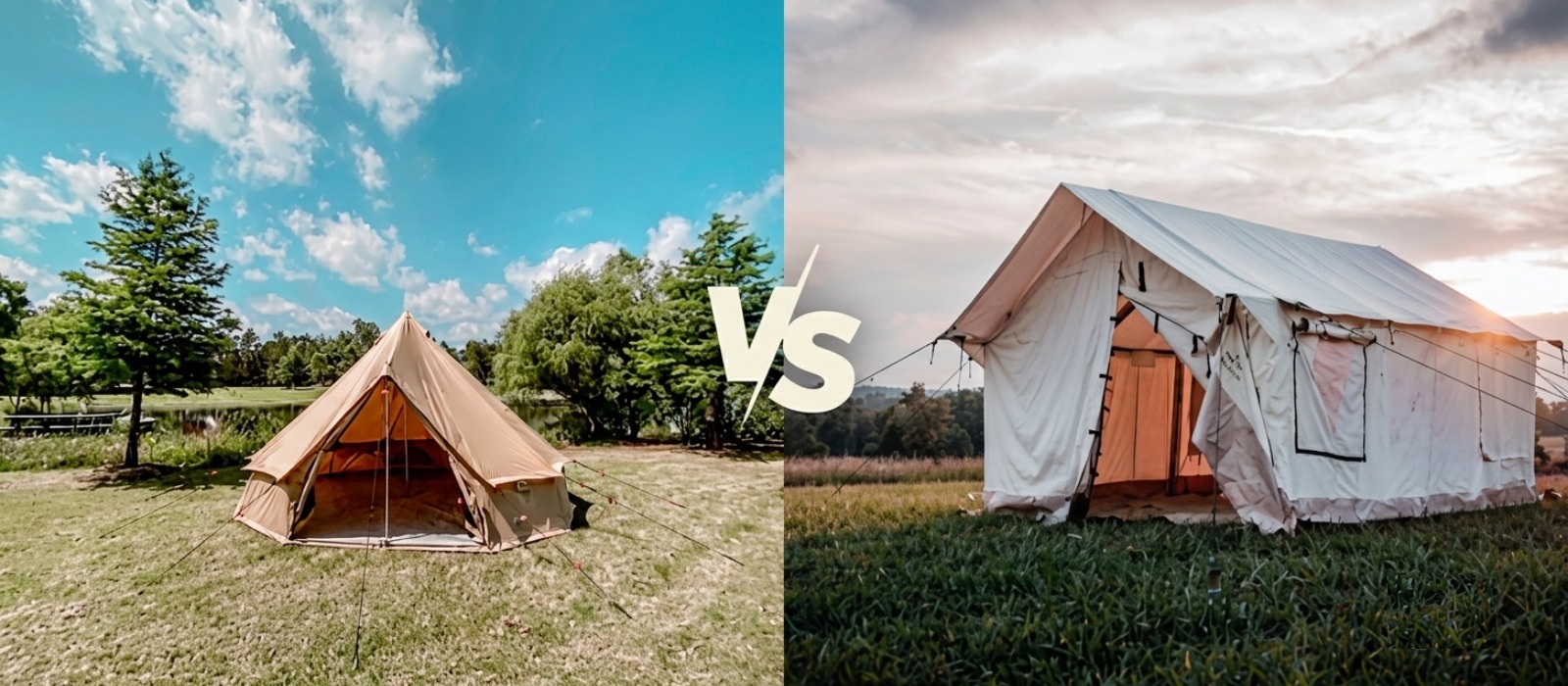
Sometimes in life, we all come to an intersection. A crossroads. It doesn’t happen all the time, but at times we are forced to make really difficult decisions. When we’re young, the decisions are easy: buy the jeans or the jacket. Later, a home, when to have a child. These are among the most nerve-wracking decisions. But they all pale in comparison to what we’re talking about today. When you’re buying a canvas tent, do you go for the bell tent or the wall tent?
Table Of Contents
- Just a Note: What these Tents Actually Are
- How Long, How Difficult, How Many People?
- Square Footage vs. Usable Footage
- Ventilation and Weather: Hot Days, Cold Nights, and Heavy Rain
- Hot Weather
- Cold Weather and Shoulder Season:
- Rain, Rain, Go Away
- The Decision: It’s Never Easy
- Get the Regatta Bell Tent If
- Get the Alpha Wall Tent If
- The Overlap
- The Upshot
The decision is wild. The features are nearly limitless, and if you start to make the comparison without a guide, you’ll end up with analysis paralysis, and no one wants that. What we’ve put together here is a guide to help you navigate this incredibly difficult decision. We can’t make the final decision for you, but we can make sure you think about all the angles before pulling the trigger.
Just a Note: What these Tents Actually Are
If you’re not familiar with a bell or a wall tent, or maybe you know one but not the other, then let’s have a quick rundown of what each of them is. This should give you a good mental picture of what you’ll be getting into, and give you a better idea of the use cases for each one.
The Bell Tent: This is a very attractive and unusual model of a tent that comes in a circular shape with a center pole that creates a cone shape with the canvas material draping to the circular base with a tent skirt. The origins of this shape of tent date back to the Byzantine Era (582-602 A.D.). The reliability and comfort have seen more centuries than some folks reading this have. The Regatta Bell Tent by White Duck is the standard for this incredible canvas tent. That version comes with a sewn-in floor, a zippered door, and roll-up walls. The shape is ancient, but the execution is modern.
The Wall Tent: In earlier settlements of the European and American frontier, the wall tent came into popularity for its durable design, reliable and familiar shape, and the ability to construct a comfortable structure on the wild frontier. This canvas tent has four sides that rest at 90-degree angles with a pitched roof over eight feet high. The rigid pole system forms a taught exterior that makes an ideal interior setting with modest temperature control and water resistance. This big, boxy, configurable shape has been ideal for long camps, base camps, and hunting setups for as long as living memory serves.
Both tents are all-canvas. Both are built to last for decades. And both come from a long history of reliability and durability in any conditions. Now that we have an idea of what we’re working with, let the comparison begin.
How Long, How Difficult, How Many People?
The goal here isn’t to break any hearts. The goal is to provide an honest assessment of what features each tent provides and how they stack up to the other. If you end up hearing something you don’t like, don’t worry, there’s always room in the gear closet for another canvas tent.
The set-up is a key factor in tent selection. People want to know how long it is going to take, if it is a gigantic Rubik’s Cube, and if you will need a small army to set it up. Here’s the honest take:
Bell Tent: The bottom line: The Regatta Bell Tent is lighter, faster, and more forgiving than the Wall Tent. With one person, the Regatta can be set up 15-20 minutes after you’ve done it a couple of times. The sequence is consistent: Lay out the canvas; stake the perimeter; raise the center pole; tension the guy ropes. That’s about as complicated as it gets. The Regatta’s manual uses a useful analogy when it comes to securing the tent. Once you get the lines in place, adding tension to the guy cord is like tuning a guitar. Make small adjustments and move systematically around the tent, perfecting the shape. It becomes a nice release after an afternoon of driving and unloading gear.
Wall Tent: The reality of it is that the wall tent is just more involved. There are more integral parts in the setup processes, and more steps to get the job done. This means more attachment points, more guy lines, and more decisions to be made about placement. Setting up this tent alone is possible, but it’s not quick, and it’s not as easy. Two people are the practical standard, but even then, it’s tough to get it under 20 minutes, even with experienced campers. The frame must be secured first, and pulling numerous lengths of aluminium poles out of a bag that all look the same is a tough start. Many people who seek these tents out consider themselves purists in the frontier sense. There is an American history there that feels like an accomplishment when the task is done. And it is true. When a wall tent is secured in place, guy-lined and staked well, and the exterior wall shimmers with a sleek line, it is a certain satisfaction that can’t be imitated.
Honest Verdict: If you often roll solo, or if you are going for a majority of one-nighters, then the Regatta Bell Tent is the way to go. It goes up in a flash, and it doesn’t take long to set up and tear down. It’s just the right choice for the solo camper. But if you’re looking for a base camp, absolute sturdiness in the wind and rain, and you want your location fixed in place, then the wall tent is for you.
Square Footage vs. Usable Footage
If you were to only look at the footprint of a tent to consider the amount of interior space, it would seem that all tents are created equally. The tent with the largest square footage would be the ideal tent for however many people are in your crew. But this isn’t the case. It is also the case that the volume of the interior space of the tent should be calculated, and then that would give you the most valuable space for your buck. This is also not true. Let’s take a look at square footage vs. usable footage.
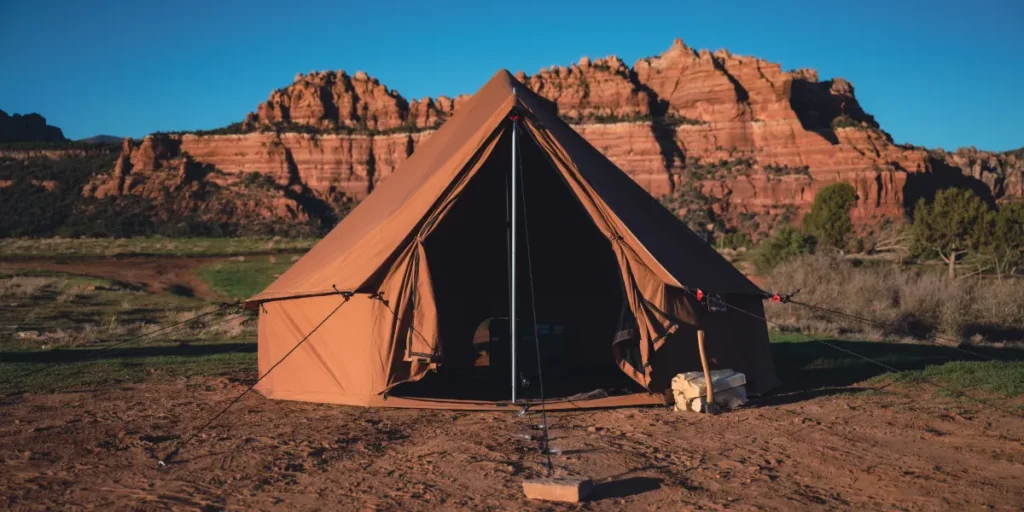
Bell Tent: When it comes to practicality and usable space, this is where the tables get turned. The Regatta Bell Tent takes its shape from the center pole, from which the canvas is draped. There is a front door pole as well that is anchored to the ground with a guy line. Other guy lines are pulled tight around the round edge, leaving about a 24’ space from the ground to the low-angle roof. And here’s where the catch lies. That low-angle roof means that a lot of that edge space can’t be used to, say, sit in a chair next to. The ceiling is just too low. It’s a fine space to leave gear or stack firewood, but that is a lot of ground space that is taken up by a low roof. In some instances, and for larger groups, losing this much space is not ideal.

Wall Tent: Sometimes, simple is plain, and plain is practical. The shape of the Alpha Wall Tent, White Duck’s line of wall tents, is that of a small house. The flat, tall exterior walls make up the rectangular shape of the structure, and they allow for edge-to-edge usable space. Designed for more than just gear to be thrown up against it, these walls welcome a chair, a table, or an open space to change or place a cot.
Honest Verdict: If chairs and tables are in your camping setup and you want to be able to move throughout all the space in the tent, then it’s the wall tent all the way. If you like to lounge, throw some beanbags or piles of blankets on the ground for a comfy sit-in, then the bell tent is your choice.
Ventilation and Weather: Hot Days, Cold Nights, and Heavy Rain
Three weather conditions. Two Tents. No bull.
Hot Weather:
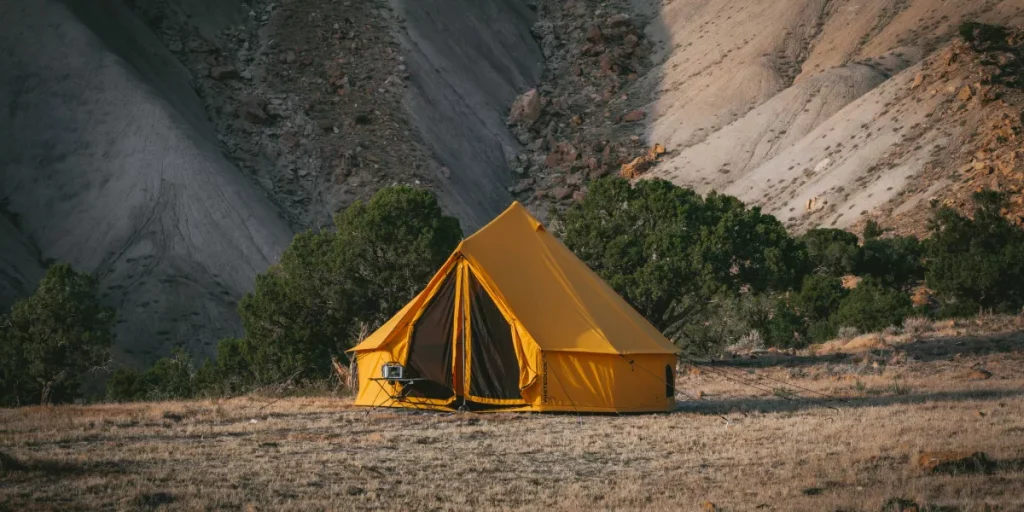
Both tents handle the summer heat well. That’s just a feature of the canvas. The tight-knit canvas allows for air to pass for breathability while maintaining consistent interior temperatures. This feature is not a differentiator. But the bell tent’s conical geometry has a genuine edge here. The pointed center of the tent forms a heat trap and expels through the upper vent. With a strategic wall pulled up, a vacuum forms and pulls the heat out the top. The wall tent manages the summer heat well, but cannot match the clever design of the bell tent. Windows up with insect netting allow for a cross breeze, but some residual heat can still get trapped in the peaks of the ceiling.
Cold Weather and Shoulder Season:
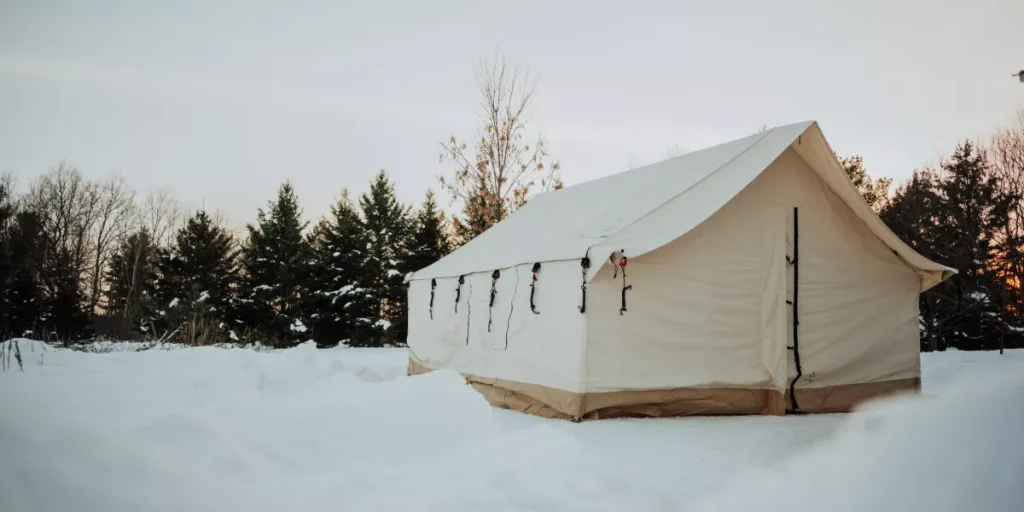
The wall tent wins this one, and it’s not particularly close. The Alpha Tent’s rectangular shape is more efficient with heat when introducing a tent wood stove: you’re warming a box, not a cone. That hot air circulates naturally and doesn’t trap or get held up in one specific space. The vertical sidewalls trap the heat at torso height, making for evenly distributed warmth. The bell tent with a tent stove can be heated, but the geometry works against you. The heat up top and cooler air fall.
Rain, Rain, Go Away:
When you’re under the drip, both tents perform well. It’s about a toss-up on this one. The bell tent’s continuous roofline and ground skirt create a clean, sealed system. The wall tent’s pitched ridge sheds water naturally, so nothing pools. With a rain fly, a second layer of protection keeps you dry in any maelstrom, for any extended adventure.
Honest Verdict: The bell tent is for the fair-weather camper, and the wall tent is for winter and cold-weather camping. Basically, anywhere a stove tent gets involved.
The Decision: It’s Never Easy
These are some of the most pivotal factors to consider: ease of handling, usable space, and weather appropriateness. We could get extremely granular here with insights into every nook and cranny these tents have to offer, but that wouldn’t help much. But it is also true that both of these tents have clearly distinguishable use cases. So, for those that made it this far, let’s break it down simply:
Get the Regatta Bell Tent If:
- You camp solo, as a couple, or in a small family
- Summer and mild-weather trips are your primary use case.
- Set up speed and simplicity matter to you
- Aesthetics are a real factor in your purchasing decision.
- You want a tent that works beautifully at a festival, in a mountain meadow, or in a developed campground.
Get the Alpha Wall Tent If:
- You’re camping in a larger group or need maximum square footage.
- You hunt, and a wood stove in camp is a necessary feature.
- You want a true base camp that you live in for multiple nights.
- You’re a car camper or truck camper, where weight isn’t a constraint.
- You want the most expandable, most configurable canvas tent possible.
The Overlap:
- Both tents are canvas.
- Both tents are four-season capable.
- Both will outlast any of your current gear by a decade or so
The Upshot
If you are genuinely undecided about which tent to get, the first thing you need to do is be honest about your camping lifestyle. Oftentimes we get caught up in what other people are doing, the lifestyles we see on social media, or what we used to practice in the years before a family. Whatever you’re looking for, make sure it’s something you genuinely identify with. If you force yourself and your family into a situation you honestly don’t enjoy, then there won’t be many camping trips in your future, and that’s exactly what we’re here to prevent. Find a tent, stake it down, and have fun.




No Comment! Be the first one.