

Part of the reason many people are apprehensive about even getting into the wild is the things they can’t control. One of the biggest factors is the bugs. Anyone who has camped even a few times knows the feeling. You’ve prepared for everything. There was plenty of wood for the fire and gas for the stove. The guy line securing the taught canvas tent walls is securely in place. The food was delicious, and the bodies were tired. When you lie down to sleep, everything falls into place until you hear it. The buzzing sound of a gnat. It could be a mosquito. You hope it’s a gnat. You don’t want to wake up with bites all over your neck, so you have to get the bug out.
Table Of Contents
- Why Canvas Tents are Ahead of the Game
- Know your Canvas Tent’s Weak Spots by Type
- The Wall Tent
- The Bell Tent
- The Cabin Tent
- Seal the Tent Before the Bugs Have a Chance
- Seam sealing
- Zipper Maintenance
- Stove jack collars
- Ground skirt tips on bell tents
- The Second Layer of Defense: Active Protocol
- Exit and Enter Quickly
- The Buddy System
- Keep the dark outside
- Manage the camp aroma
- Know Your Region, Have Fun
The good news is, this is avoidable. If you’re camping in a canvas tent, then you’re already ahead of the game. Canvas tents, by nature, are better at keeping bugs out than synthetic fabrics. The heavier material makes for better seams between zippers, windows, and doors. But even with this built-in level of protection, there is still the opportunity for small gnats to get in.
This guide covers all the major types of canvas tents: wall tents, bell tents, and cabin tents. Each of them has specific vulnerabilities, and there are good practices for each to prepare for little flying critters. Bell tents have a different entry point than wall tents. They also have different weak spots and floor situations. A simple one-size solution won’t cut it.
Why Canvas Tents are Ahead of the Game
We often think that all the textile science that has gone into designing these advanced fabrics means that those options are simply better. The truth is, they are better at some things. They are lighter, but at a cost. Heavyweight canvas has almost no micro-perforations (extremely small holes). Cheap nylon and polyester, while advanced for tents in the 1970s, often have pinholes and stress-point gaps that open under tension. Tightly woven cotton duck doesn’t. The fabric itself is a barrier that nylon and other synthetics can’t replicate.
Being a miracle fabric, canvas also breathes. This reduces the buildup of internal CO2 and humidity that attracts insects in the first place. Synthetic fabrics become a warm, CO2-rich humidity barn. It’s basically the perfect atmosphere for bugs to breed and grow, which means they will come knocking.
Despite canvas being a miracle fabric, it is not a sealed environment. There are openings, and the number and type vary by tent type. And now we can finally get going.
Know your Canvas Tent’s Weak Spots by Type
There are, effectively, three types of canvas tents. The bell tent, the wall tent, and the cabin tent. This is not an exhaustive list, but for other canvas tents out there that don’t fall exactly into these three categories, their features should overlap enough for this post to be extremely useful.
The Wall Tent:
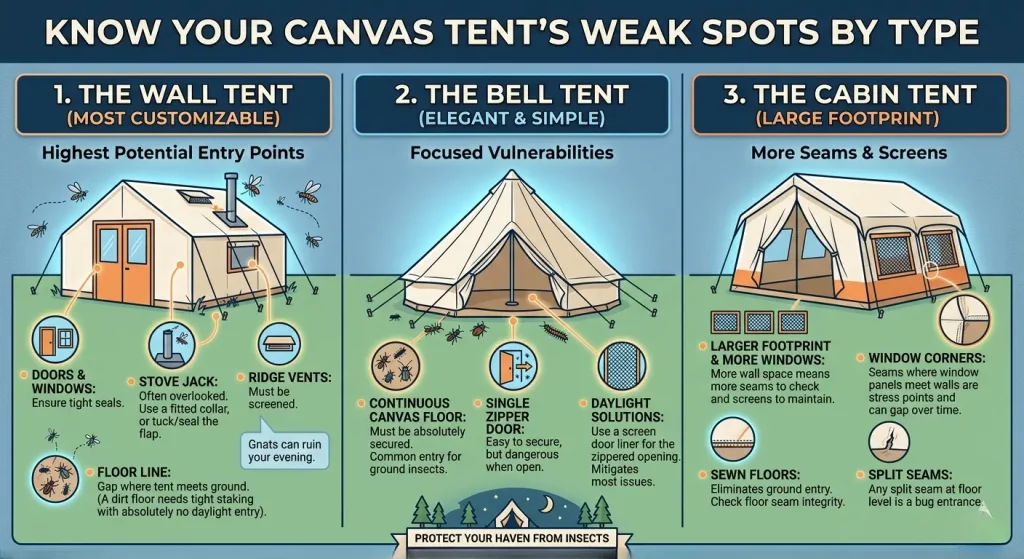
Wall tents are the most customizable canvas tents on the market, which means they also have the most potential entry points of any other canvas tent. Doors, windows, stove jack openings, ridge vents, and the gap at the floor line where the tent wall meets the ground are all vulnerable points of egress. It’s here where the littlest gnats can get in and absolutely ruin an otherwise perfect evening. The stove jack hole is most often the weak spot that is overlooked. It’s up high, right in the high-traffic area for insects. Yet even with a flap lightly draped over it, bugs can get in. Make sure you get a fitted collar or tuck or seal the flap in place. The floor edges on a wall tent also need some TLC. A dirt floor is only bug-proofed if the tent walls are staked tightly into the ground with absolutely no daylight getting in.
The Bell Tent:
Bell tents are, by design, elegant and simple. There is one center pole where the canvas is draped, a continuous ground skirt, and a zippered door. That simplicity makes it easier to secure than the wall tent, but what it really comes down to for the bell tent is the continuous canvas floor. If this feature isn’t absolutely secured, ground-level bugs like ants, beetles, centipedes, and really anything else in the insect kingdom can come walking right in. The single zipper door is a nice feature, and the fact that there is only one of them makes the one dangerous spot easy to secure. But when that door is open, it’s a no-holds-barred for the insects. Make sure your bell tent is buttoned up tight when you’re closed up for the night. For the daylight hours, when the heat is on, a screen door liner for the zipper door is ideal. This will mitigate nearly any insect issues you have.
The Cabin Tent:
Canvas cabin tents often have larger footprints and more wall space with windows than either wall or bell tents. This means there are more seams to secure and more screened openings to maintain. Pay close attention to the corners where window panels meet the tent wall; these seams are stress points that can gap over time. Cabin tent floors are typically sewn, which eliminates the ground entry problem but makes the floor seam integrity more important. Any split seam at floor level is a bug entrance.
Seal the Tent Before the Bugs Have a Chance
For taller wall tents, in the worst seasons, maybe hang some fly tape. Some zappers are battery-powered. There are also the eclectic tennis rackets that are fun to kill mosquitoes with. But those are all reactive measures. All of those won’t even come into your mind as a need if you take proactive measures. There are a few things that you can do to any tent to ensure the bugs will stay out. We’ve addressed the pain points above; now, let’s talk methodology.

Seam sealing:
Canvas seams on older tents or new tents recently conditioned can gap slightly when the fabric dries and shrinks. A bead of seam liner along interior seams and at corners, zipper bases, and where the floor meets the wall eliminates the micro-entries. While keeping the bugs out, this is also a good measure to take for waterproofing. Two birds, one stone.
Zipper Maintenance:
Zippers, by design, have little holes all the way through them. Also, a zipper that doesn’t close tightly means it has gaps. Mitigate this issue by keeping them clean and lubricated, making sure they can seal all the way closed and form a tight closure. A sticky zipper that you have to yank shut is one that has gaps in it.
Stove jack collars:
Most good canvas tents have stove jacks built in. If you’re running one into a wall tent and the stove isn’t in use, the flap on the ceiling of the tent needs to be secured. There are many fitted cloth or silicone rings designed distinctly for that purpose. This is one of the most overlooked ports of entry for insects. Make sure it’s secured.
Ground skirt tips on bell tents:
Pin it. Stake it. Or weigh it down all the way around the base. Not most of the way, and don’t do just a pretty good job. Make sure that there are no gaps in the floor of your skirt on your bell tent.
Cover these areas, and this will make up most of the pain points where insects find spots in your home away from home. The fact is that you do still need to open the door of your tent. There is always going to be a chance for insects to get in. But staying ahead of the game is the best way to stay bite-free at night.
The Second Layer of Defense: Active Protocol
The methods we previously discussed are good ways to stay bug-free when you are not even camping. Those are the practices you prepare for while you are treating your tent and testing in your backyard. The next line of defense is the practice of moving through camp.
Exit and Enter Quickly:
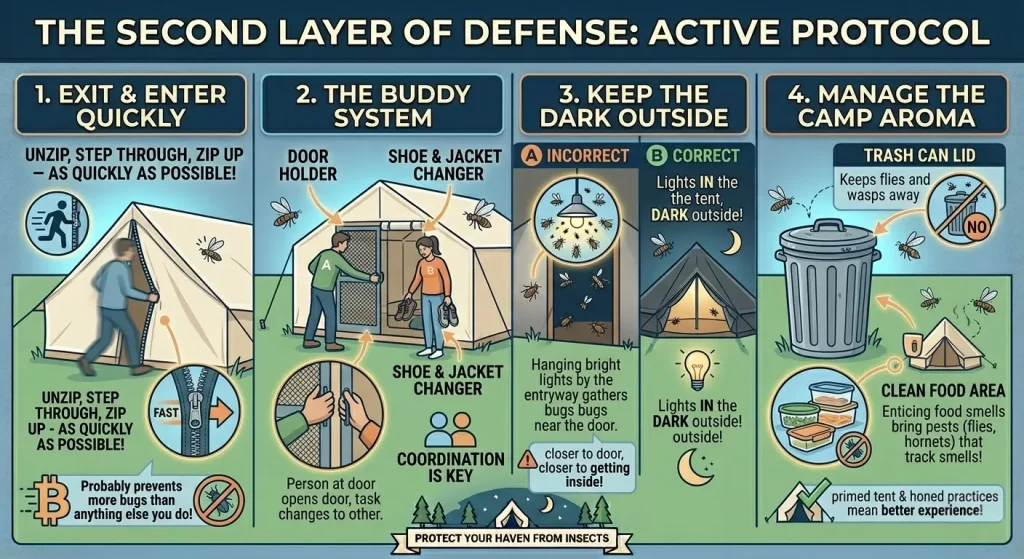
Unzip, walk through, and zip up as quickly as possible. I know it sounds like an archaic practice, but this little act will probably prevent more bugs than anything else you do.
The Buddy System:
Enter the tent at night with a buddy. One person holds the screen door closed while the other takes off shoes and jacket, whatever. Then the one at the door opens the door, and the task changes to the other. This is slightly better than doing it alone and is good for extremely buggy camps. Think of the middle of Montana in July.
Keep the dark outside:
Hanging a bright light by the entryway is the best way to get bugs to congregate by your tent. The closer they are to the door, the closer they are to getting inside. Keep the lights in the tent and the dark outside.
Manage the camp aroma:
The next enticing thing after light for insects is food. They come for the light but stay for the smells. Flies near trash and waste containers are a surefire way to get other bugs in the vicinity to take notice. Hornets and wasps have powerful sniffers, and they will track down some stale barbecue in no time.
If your tent is primed and your practices are honed, you’re going to have a much better camp experience. It’s not difficult to stay on top of bug and mosquito management, but it’s difficult to manage once you get behind.
Know Your Region, Have Fun
If you’re living in Tucson, Arizona, and planning a trip to the northern panhandle of Idaho, you’d better do a little research. While the desert might boast many poisonous critters like spiders and scorpions, the Rockies also have their deadly traps and annoying, persistent insects. Even from mountain region to mountain region, thighs can drastically change. After living in the Cascades for your whole life, heading to the Appalachian range is going to offer a whole new type of experience when it comes to bugs.
Heat, moisture, and sunlight are the biggest determinants for the type of bugs you’re going to find. The mosquitoes in one location could be completely different than the mosquitoes in another. Make sure you’re reading your forums, researching the area, and keeping bug spray on your skin and sealant on your seams. Stay close to nature and keep far from the bugs.





No Comment! Be the first one.