

Bundled up in the cold temps with the skies turned gray and growing darker, Jack Steward heads into the frigid backcountry of Minnesota. Behind him, a white canvas tent is posted up in between leafless trees, guyline securing the taught walls, smoke billowing from the stovepipe rising through the roof from the tent wood stove warming the outdoor shelter. It’s a lovely site and it’s enticing. But getting these views, in this cold season, doesn’t just happen. Camping in a hot tent in weather with temperatures dropping to -9 degrees requires planning and a little expertise. To do it with style and actual comfort, it requires the right equipment.
Table Of Contents
Jack guides us through the stages of packing, loading, trekking, and setting up camp to ensure that anyone can set up a hot tent in even the coldest temperatures.
The Gear Garage
Not every garage will look like this. Some people want to rebuild old motorcycles, and good on them. But Jack’s garage is loaded with organized shelves full of camping and adventure gear. This comes highly recommended; the tubs are organized with all the equipment. For this adventure, Jack is headed out into the snow-covered wild. To make packing all the necessary gear much easier, he’s packed all his equipment on two plastic sleds, which he’ll be able to pull, and a White Duck duffel bag with a padded shoulder strap. It doesn’t look like a lot of gear, but trust me, there is plenty there to keep Jack warm and well-fed through this adventure.
Sledding on Private Land
After parking his car off to the side of the road near snow banks nearly as tall as the hatchback vehicle, Jack takes an assessment of the surrounding terrain and notices how steep the first hill is. It’s notable, but not a concern. More like something to consider as part of the adventure.
Jack has smartly pre-packed all his gear on the sleds and tied them down. This helps minimize his exposure outside. When the cold weather sets in, every minute counts, he begins down the hill, carefully guiding his sleds, navigating through the slim trees. Just moments after setting out toward camp, the bare limbs above silhouetted against the winter sky, his breath made visible with each cold, exasperated exhale, a large buck bounds through the woods. Such beauty and grace make easy work of the terrain. The beautiful animal is a clear demonstration of just how out of place humans have become in the wild. For this, seeing the animal is a gift and a gentle reminder that although deer are common, they are never boring.
Jack points out tracks in the snow and continues to lead the rope-drawn sleds, heavy with gear. At the bottom of the hill, a small obstacle emerges. A fallen tree is blocking the trail. While this is a modest inconvenience, it is also a great assurance that there will be dry, dead wood available for a future fire. Jack takes the sleds one by one under the tree, and after only a few feet more, catching his cold breath, he announces, “This is the spot.” A good hike to get warm in the winter weather is always recommended. Whatever is carried in is always carried out, and in doing so, ensures staying warm both coming and going.
After a good visual assessment of the area, Jack walks a few circles where his tent will be set up. He does this to make sure the snow isn’t hiding any massive boulders, mounds, or anything else that would otherwise compromise a good night’s sleep or the structural integrity of the tent. He finds a log and quickly removes it. Next, he sets to the task of laying out his ground tarp for his tent. For this, he can use a specific tent footprint or a canvas or plastic tarp. Especially when winter camping, make sure there is something under the tent for both protection and an extra layer of warmth. Staying too warm and dry in the winter should never be a problem.
Jack has opted for the Avalon Bell tent by White Duck. It is a breeze to set up, with the center pole going up first and then the adjoining guyline securing the tent walls. These can be staked into the ground or tied to a nearby tree. Keep a hammer or rubber mallet with your tent gear, and extra tent stakes are never a bad idea. To tie down the tent and tighten the guyline that secures the tent walls, Jack’s using White Duck’s designed metal runners that, with a little grip strength, can tighten and loosen with ease. This way, he can adjust his guyline in an instant, making the tent assembly a cinch.
The tent is up, it’s spacious and sturdy, and now it’s time to get the interior warm. Jack begins to remove his shoes and sets his sights on the tent wood stove.
Getting the Fire Going First
Setting up the tent wood stove immediately is highly recommended. There’s no sense in laying your cot and sleeping bag out if it’s just going to sit in a freezing tent. Jack lays out the rugs designed to protect the flooring under the tent stove. It’s always a good idea to have something under the stove, especially when dropping embers is a possibility. The stove assembles quickly with the stovepipe erected through the stove jack, but it’s time for wood.
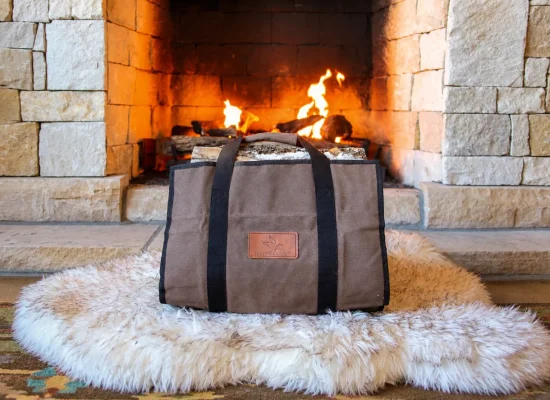
In some national and state parks, it is illegal to fell green trees. Not to mention they don’t burn well, mostly smoke, and are just not enjoyable. So, Jack sets out to find some dry, dead wood. It comes highly recommended and Jack has one on him, but he takes his battery-powered hand saw to cut wood as he gathers. With this handy tool, he can gather wood with a canvas log carrier and never have to take his gloves off. His hands stay warm and with a goodload in the log carrier, he’ll only need one or two trips. These camping accessories are most definitely recommended.
With various thicknesses and lengths of wood, all pre-cut outside with the handy dandy hand saw, the fire lights up immediately, and in no time, the tent warms. There are many ways to start a fire, but Jack is using Titan Stormproof matches. These matches will start a fire in a hurricane. They’re long, windproof, waterproof, and burn hot and long. Winter camping can be tough; cut a few corners whenever necessary, especially if it means getting warmer sooner.
The Complete Hot Tent Setup
Taking a look at Jack’s setup, it’s easy to see the possibilities of turning cold-weather camping into outright glamping. There is a string of remote-controlled lights lining the seam in the tent, illuminating the foldable cot, couch, and stove. It’s warm and inviting, and, with a few pictures and decorations, it looks like Jack could charge to rent the space. It’s quickly become a home away from home and even after only a short set-up time, it feels like Jack could spend a month or so here.
Let’s take a look at everything Jack has going on in his winter glamping setup:
- Cot, Couch, and Tables: These are all of similar design. They all fold down to a fraction of the size; they are lightweight, but make glamping possible in any setting. The cot is almost necessary. It keeps Jack’s body off the cold ground and is a comfortable, flat surface to sleep on. The couch ensures long-term indoor comfort as another spot to lounge, and the end tables have myriad uses.
- Sub-zero Bag: Jack’s bag is tested to at least -20 degrees. This is an ideal temp rating for winter camping. Side note: Sleeping bags are not one-size-fits-all. A subzero bag will roast you in the March-October months. It’s a bad idea.
- String Lights: Long gone are the days of a solo headlamp or one oil lamp for an entire tent. For convenience and style, Jack has a string of lights that is rechargeable, better-powered, and easy to pack and set up. These are practical, stylish, and ideal for any bell tent setting.
- Solar Generator: A good generator will keep devices charged, the string lights powered longer, and if the sun never shows up, the generator is chargeable at home before leaving the house. This completes the glamping setup.
Believe it or not, all of this can and will fit on a couple plastic sleds and a canvas duffel strapped over Jack’s shoulder. It’s enough to keep him warm and comfortable, even in -9 degree temps. Once the inside is lined out, the snow begins to fall. The timing couldn’t be better. Now Jack can enjoy the peace of the lilting snowflakes, and be assured that a hot tent is ready for him to return.
To Settle and Sleep
The evening is setting in, the temperatures are dropping even lower, and it’s clearly a good time to retire and cook a good, hearty meal. Inside, the top of the stove doubles as a cooktop, and Jack can make his meal. He doesn’t have to cramp himself into a small hiking chair because he’s planned for his luxurious camping couch. The mood is mellow and the lights are low. It’s peaceful, and after a long day of planning, hiking, and setting up the perfect hot tent camp, it’s a good time to acknowledge the beauty of being in the wild and appreciate the new snow.
The colder temps ensure restful, deep sleep in a comfortable sub-zero bag, and the morning comes with a chilly delight. Jack was wise enough to keep some water in a moka pot for some morning coffee. Although the early morning sun reflects off the snow and lights the white tent walls, it’s still freezing, and his breath paints the air. He has a nifty trick to build the flame from his small, frozen propane tank. He cups his hands around the tank while the flame is lit, and the warmth from his hands translates to the gas inside the tank, bolstering the blue flame for a few moments before the tank becomes too cold to touch. It’s a clever trick and delightful to watch.
The coffee is hot and the forest is coming alive in the cold. Outside, the woodpecker announces the morning with his deliberate and pleasing rattle. Birds call out, outside the frost inevitably turns to cold water. Morning in the wild winter is here. For Jack, it’s a beautiful day to emerge from his hot tent, stretch his arms toward the brisk sky, and give a little appreciation to the natural world. It’s good to be alive. It’s good to be cold.



No Comment! Be the first one.