
When I was a kid, I was a Boy Scout. Each year, there were two Jamborees, one in the summer and one in the winter. The summer was great with babbling brooks tracking through acres of pop tents, canvas tents, and teepees where people would trade rabbit skins for handmade, bone-handle knives. It felt like living on the frontier where bartering for your next meal was a reality. But winter, winter was purely survival. In the barren flats of Western Utah, I remember holding my gloved hands over a steel drum, fire licking my covered fingers. I was cold to the bone. I held my gloved hands so close to the fire that the insulation melted on the outside, while my fingers froze inside.
Table Of Contents
- A Fortress from the Frost
- Surviving the Subzero—Time-Tested Traditional Tent Methods
- The Hot Rock Method
- Let the Bodies Hit the Floor
- Secure the Seams:
- Put a Candle in the Window
- Fire + Ice = Warm Water
- The Obvious Answer
- The Arctic Avenger: The Tent Stove
- Safety comes first
- Placement and Operation
- Keep it Clean, Keep it Forever
- A Clean Space is a Comfortable One
- The Truth About Fair Weather
At that time, we didn’t have generators and gas heaters in our tents. We had to make do with what we brought. I tucked into bed that night under layers of wool and old Thinsulate, knowing I would get no sleep but confident I’d make it until morning. The audacity of youth makes up for a lack of preparedness, at times. From that point on, I decided I didn’t want to be cold anymore. I set out to learn every trick I could about how to stay warm in a tent without a heater. I’ve outlined a few here for you, so hopefully, when you meet the frigid Father Winter, you’ll walk away cozy.
A Fortress from the Frost
The best way to approach combating the cold is to think of your environment as a series of layers, beginning from the outside in. The very frontlines of protection begin at your tent. There is a tent designed for every ecosystem, weather front, and expedition spanning every price zone over a range of quality. I can’t decide any of that for you. However, I can tell you this: for the price, quality, durability, and flexibility, I now primarily stick to canvas tents.
For the cold, a double-wall canvas tent is ideal. It keeps a layer of air between the outside wall and the interior wall that acts as insulation from the outside elements. This little pocket of air may not seem like much, but it is the very foundation of keeping warm in the winter. The tightly woven fabric of a canvas tent also holds heat in while the fabric material breathes. This means that you’re not going to use up most of the oxygen in your tent, leaving only carbon dioxide, which freezes at a higher temperature. The result is a colder tent that sweats. Cold + wet = misery.
Canvas tents are incredibly durable and come in numerous sizes. If you’re looking for a home base for your hunting crew, go canvas. If you want the family all in one place, go to Canvas. If you want your solitude and plenty of space to stretch out, you guessed it, go canvas.
Surviving the Subzero—Time-Tested Traditional Tent Methods
Before anyone ever had a generator or a gas heater, they had a grandma. Let me explain. If you want to know how people have been surviving for thousands of years without modern amenities, then ask the people who are 1,000 years old. I’ve camped with older generations for all my life. While I now have my own methods, there are some facts of life that are undeniable. Consider the following:
The Hot Rock Method:
This one takes one part grit, two parts common sense. The idea here is to find a nice, big river rock. Something more round, smooth, and about the size of a cantaloupe. A couple of hours before bed, when everyone is chatting around the fire, place the rick at the edge of the coals. About every 30 minutes, be sure to rotate the stone and warm all sides. Just as you head to bed, wrap it in a thick wool blanket and place it at your feet in your sleeping bag. I know this sounds nuts, but pioneers did this for decades, and they were onto something. Use thick leather gloves to handle the rock, and make sure it remains completely wrapped. My family has been doing this all my life.
Let the Bodies Hit the Floor:
Small tents depend on it; people in rescue situations have survived it: keeping bodies close generates an immense amount of heat. When I’m staying in a canvas tent with my family or friends, I keep all the bodies to one side of the tent. With everyone packed closely together, everyone will stay warm. When some people stay in large tents, they like to sleep on cots. This is something to be wary of in the winter months. Cots let cold air circulate under your body. Believe it or not, the ground provides natural warmth. Place a few blankets on the ground to insulate from the initial cold, and as everyone settles in, the heat shall rise.
Secure the Seams:
The edges of your tent are like the head and feet of your body: That’s where all the heat bleeds from. This is particularly bad at the base of the tent. A lot of cooler air can get in through the seams in the tent, so the easiest way to fix this is to insulate those places. If you’re not knee deep in snow, take some pine needles, fallen foliage, and dried leaves. If you are in knee-deep snow, then use packed snow. It will naturally build an insulated layer that will keep the wind away and trap the inside air in. Indigenous peoples used this technique for centuries because it works.
Put a Candle in the Window:
Similar to the idea of body heat, even a small candle in an enclosed area can produce an incredible amount of heat. In a canvas tent, a couple of candles strategically placed can not only change the whole atmosphere, but they can really warm your tent up before you pack the bodies in. As always, when dealing with an open flame, keep it away from the tent walls, and mind the dripping wax. But a few simple candles are easy to manage.
PRO TIP: Keep a little ventilation moving through your tent if you light a candle. They will burn up a lot of the oxygen in your tent. If you don’t want what I described above to happen, let the breeze blow.
Fire + Ice = Warm Water:
Similar to the Hot Rock Technique, a warm bottle of water will do the same. If you’re apprehensive about placing a hot rock in your sleeping bag, then get a good ole Nalgene; the classic ones work the best. Before bed, while you’re around the campfire, heat up some water to a good boil. From that water, make yourself a nice cup of hot cocoa, tea (I like chamomile), or just throw some cinnamon sticks and cloves in a mug, and get warm from the inside out. With the rest of the water, place it in your old Nalgene and, while wearing gloves, wrap it in a towel and place it in your sleeping bag. This is extremely effective at the beginning, but mind you, the water will cool down faster than the rock does. So, be prepared for a little temperature drop at night.
The Obvious Answer:
Wear. Good. Clothes. That’s it. That’s the last line of defense against the cold. Make sure you have merino wool, breathable base layers, and socks to sleep in. Cover yourself from head to toe. Take care of your head and take care of your toes; this is where a lot of heat escapes. I have friends who wear gloves to bed, but that isn’t my fancy. It doesn’t mean it’s not a good idea; it’s just not for me. The more skin that is exposed, the more hot air will escape. Outside of that is your sleeping bag, so invest in a sub-zero winter bag that can handle the heat in the kitchen…wait. But seriously, always keep extra layers to throw underneath the sleeping area, and cover everyone in the crew. Keep this rule in mind: You can always take layers off, but if you don’t have them, you can never add more.
The Arctic Avenger: The Tent Stove
All of these techniques are fantastic for keeping warm in a canvas tent, or whatever situation you see fit to take on in December in the wild. If you really want to get comfortable, and I mean corn-cob-pipe-in-a-Pendleton-cardigan-reading-Dickens comfortable, then get a tent stove setup. I’ll start by saying that White Duck has a fantastic line of different styles and sizes of tent stoves, but also some awesome accessories (more on those later) to enhance your experience. So, let’s tackle that.
Safety comes first
Without a doubt, canvas tents can safely handle the heat. That is no reason to be careless. There needs to be good clearance from the walls and smart stovepipe installation. White Duck offers adjustable elbows, and their canvas tents come ready with stove jacks, so your installation is done the right way, every time.
Placement and Operation
This will require a little strategic thinking. I try to keep the stove away from the sleeping area, but also close to where the heat can circulate. With a stove, like a candle, the air can get heavy, and the oxygen can get used up. Luckily, there is plenty of heat in there, so you can crack open a door on the canvas tent. This is one of the best non-electric ways to heat a tent.
Keep it Clean, Keep it Forever
It is a fact that you’ll need to clean your chimney regularly and check all the stovepipe connections. Like anything, while you’re camping, the stove is a tool that needs to be maintained. Doing so will keep it burning clean, smelling good, and when you put the fire out, it won’t smolder, a huge plus.
A Clean Space is a Comfortable One
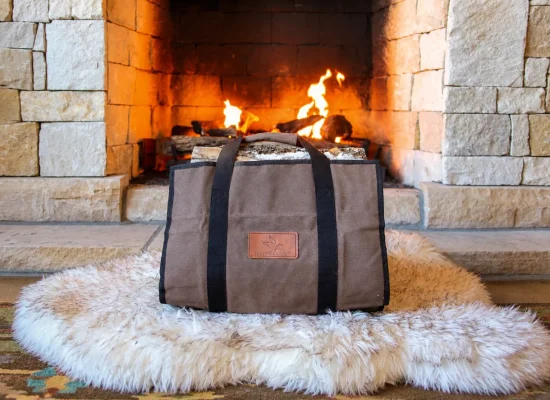
I highly recommend a stove mat and a firewood log carrier. The mat keeps the floor clean under your stove, and the log carrier keeps the slivers out of your clothing. Combine these two and you’ll have a tidy setup that will ensure everyone stays warm, without tripping over the woodpile.
The Truth About Fair Weather
I’d like to tell you that every moment of every camping trip is going to be bliss, but I won’t lie to you. Winter and cold camping can be tough. It requires a whole different set of skills and equipment. As I try to impart to my kids and friends new to the outdoors, the effort is part of the reward. It’s easy to watch television. It’s easy to adjust the A/C in our house to a setting so specific that we don’t even need season-appropriate clothing. That is great, and I’m very thankful for those amenities. But sometimes it feels really good to work to be comfortable. To make the efforts our ancestors couldn’t choose to make, but had to. To experience the wild in its most honest and indifferent form draws something out of us that both engenders individuality while connecting each of us to a larger community, a collective that values effort and a deep adoration of outdoor spaces. Stoke the fire and bundle up. I’ll see you out there.


No Comment! Be the first one.