
Camping tents come in many styles, each offering different benefits for use cases. There’s a lot to uncover about every one of these outdoor shelters, from their origins to their modern functionalities. Today we’ll dive specifically into yurt tents, starting with a rundown of the basics that make this style of camping tent what it is. Then, we’ll break down five fun facts about yurt tents, from how they got their name to what luxurious accessories you can use with them. Without further ado, let’s get into it!
Table Of Contents
What Is a Yurt Tent?
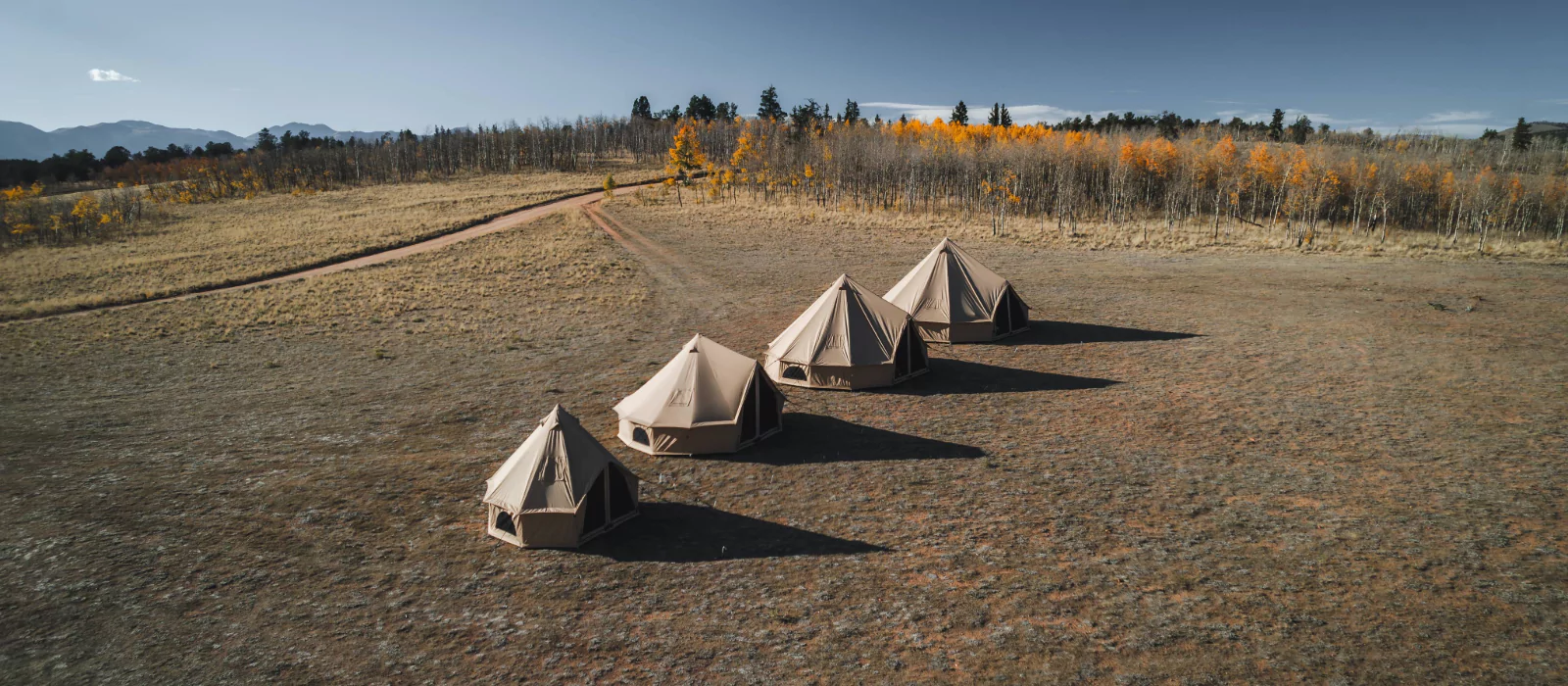
Arguably one of the best luxury tents on the market, the yurt tent is a popular cotton canvas camping shelter. The design features a single central pole that serves as the main support, a circular base, and a large A-frame entrance. The roof of the yurt tent slopes dramatically to meet the side walls, creating its recognizable cone shape. Thanks to their use of modern performance cotton canvas, this type of tent can easily be used throughout all four seasons, offering breathability and ventilation in summer and necessary insulation in the winter. Outside of these basics, the exact features of yurt tents can vary, including characteristics such as the incorporation of mesh screens, the number of windows and doors, whether or not they come ready with basic accessories like canvas tarps, and their overall size.
Five Facts About Them You Didn’t Know
You may think that their stylish nature and iconic design are all there is to know about this tent style, but there’s a lot more to them than meets the eye. Here are five interesting facts about yurt tents you may not have already known!
The name “yurt” has roots in Russia and Turkey
“Yurt” is an interesting name for a tent, much more so than other tent styles, such as wall and dome tents, whose names unquestionably derive from the shape of the shelter. So how exactly did we start calling yurt tents, yurt tents? The English word “yurt” comes directly from the Russian word “yurta.” But the etymology doesn’t end there! “Yurta” itself comes from the Turkic word “jurt,” meaning “people,” “homeland,” or “the land on which people roam.” This origin makes a lot of sense when you consider the purpose of yurts. That is, to provide a portable shelter for people on the land they live on.
Since traditional yurts have origins in central Asia where they served as popular shelters among nomadic communities, you may also hear them referred to as “gers.” Ger is simply the Mongolian word for yurt. That being said, in Western countries, especially the United States, “yurt” is the more common name for this style of shelter.
They have a rich, slightly confusing history
When we talk about yurt tents in the modern age, we don’t mean traditional yurt shelters. This fact makes for a bit of a complicated history! So let’s break it down.
As described above, yurt tents are a type of canvas camping tent with a circular base, central pole, and iconic cone shape. This distinct shape and structure was an enhancement of the Tipi style of tent. Unlike Tipis, modern yurt tents feature straight walls that meet the conical roof and utilize guyline ropes to create tension and reinforce the tent’s shape. Yurt tents were popularized in the West during the mid-1800s, specifically for military use. Thanks to their spaciousness, durability, and weather resistance, yurt tents are still a popular choice for campers and glampers today.
Traditional yurts, on the other hand, are semi-permanent circular shelters that land somewhere between cabins and camping tents but aren’t quite either. The structure is built from lattice wood framing which is then covered in animal skins and felts. This type of shelter can be traced back to nomadic societies of Central Asia before it spread to Eastern Europe with the expansion of the Mongolian Empire. Their popularity stood the test of time, and you can still book a stay in a traditional yurt today.
While both types of shelters are awesome outdoor abodes, yurt tents, and traditional yurts are different, each with their own distinct benefits and purposes.
They’re also known as bell tents
When someone talks about a yurt tent, there’s a good chance they’re referring to the bell tent! That is, as long as they’re not confusing yurt tents for traditional yurts. When shopping for a yurt tent, know that you can use the term “bell tent” interchangeably. You may want to use the term “bell tent” instead to avoid the common confusion with traditional yurt shelters. So, to put it simply, bell tents = yurt tents ≠ traditional yurts!
They’re extremely versatile
Few camping tents on the market are as versatile as the yurt tent. Between their spaciousness, durability, user-friendliness, and weather resistance, you can take a yurt tent practically anywhere and create a successful adventure. Their breathable canvas material and large entrances make them perfect for beating the heat of summer. Their durability helps them withstand harsh winter conditions and the roughness of festival camping. Their unmatched spaciousness is necessary for glamping, long-term living, hosting retreats, and setting up a workshop. The opportunities and use cases are truly endless when it comes to the yurt tent.
They’re compatible with a range of luxury accessories
If you’re looking to deck out a camping tent with all of the latest luxury accessories, yurt tents are for you. Thanks to their modern performance canvas fabrication, yurt tents are usually compatible with the coveted camping tent stove. Their large doors and common incorporation of mesh also help to ventilate the interior when using an accessory like a stove. Just make sure your yurt tent is fitted properly with a stove jack to ensure your safety. Many outdoor brands offer other accessories specific to yurt tents, like awning extensions, circular ground tarps, and front porch additions.
Wrapping It Up
Yurt tents are luxury camping tents featuring a circular base and a central support pole, creating an iconic conical shape recognizable to any outdoor lover. But what else is there to know about yurt tents? Between the origin of their name, their rich history, their unmatched versatility, and more, there’s a lot to uncover when it comes to this style of camping tent. Now that you know the five fun facts discussed above, you can venture into the outdoors with a deeper understanding of the famous yurt tent. At the very least, we hope you learned something new!





No Comment! Be the first one.