


Not all tents are created equal. Even if you care and properly maintain a tent, you want it to have the inherent quality of keeping you secure in the middle of nowhere and maybe even be multipurpose so you can get the most out of your investment.
Table Of Contents
Wall tents do not get enough PR for the functionality they pack. Here are the top 5 reasons why they are the superior choice for your camping adventure.
They Are Comfortable
The biggest perk of a canvas wall tent is how roomy it is. You don’t have to crouch or stand in the middle of the tent to get the most headspace; a wall tent is designed like a tiny house. The smallest wall tents can support two occupants.
With the extra space, campers can store camping gear so that it stays dry barred from the outside elements.
You can even install a bed for a comfortable night’s sleep without having to cramp sleeping bags when sharing the tent.
They are Made out of Canvas
Cotton canvas is a breathable material. Fresh air is the leading motivation to go on a camping trip in the first place. When camping in humid climates you will find that your tent soon becomes musty, and your skin clammy. But a breathable fabric means there is a way for the moisture to escape and not condense on the inside of the walls of your tent. Nylon tents tend to have lingering smells because the air gets trapped.
In addition, thanks to the large walls, the windows of a wall tent allow for optimum ventilation. This means you are not boxing yourself inside a suffocating box.
Canvas is superior to nylon and plastic. It’s denser and therefore resistant to rips and tears.
They Are Built to Endure
Wall tents are designed to last. Everything from the material to the shape of the tent contributes to this.
The tried and tested fact is wall tents last decades. Even if you damage it, it is super easy to repair and maintain. The aluminum frame is straight without any special tethering. Any rip in the canvas can be mended with a patch and locked with waterproof sealant. That being said, canvas wall tents are popular for not easily tearing.
Wall tents do not degrade under harsh sunlight. A plastic one will not only incur damage to its synthetic fibers but will also trap heat inside the tent. Its plastic rods may expand from the heat, collapsing the tent.
During a rainy spell, the canvas of a wall tent tightens owing to the cotton weaves that expand when dampened. This locks the moisture out, keeping the occupants dry. This is why it is always a good idea to go for a quality white duck canvas when browsing wall tents for sale.
Unlike plastic tents, a canvas wall tent does not shake noisily in the wind. You may feel like the wind is howling, but thanks to the thickness of the canvas you will be spared from the noise inside.
A canvas wall tent is a 4 season tent. If you’re looking for a winter camping tent, you need look no further. Your first thought may be that a synthetic tent can guard you from the snow, but it is the chilly weather that should concern you more.
Cotton is a terrible conductor. This means it keeps the heat out during summer and the freezing temperature during winter. But that is not all. Wall tents have a star feature, they come with a stove jack. You can attach a wood or liquid fuel stove inside your tent. This is imperative in cooking indoors when it’s chilly outside, and to keep yourself warm in cold weather. Because of the ample space, you do not have to worry about the stove taking up too much area.
They Are Designed for Amenities
You cannot use a wall tent without being tempted to furnish it with modern amenities. This is why they have always been the top choice for semi-permanent homes and glamping sites.
A wall tent can be fixed with electricity to power appliances and lights. Occupants can even move in bed frames as opposed to making do with sleeping bags. The stove installation can be treated as a mini kitchen space.
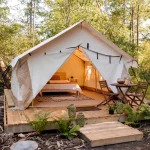
Since glamping sites have wood foundations to erect tents on, a wall tent is perfect because it does not have a floor canvas in its design. Occupants get to enjoy wooden floors as part of their glamp.
Other than a yurt no other tent can house amenities like this. But yurts are difficult and time-consuming to set up when compared with a canvas wall tent.
They Are Sustainable
If you have already googled some canvas wall tents by now, you would know that compared to synthetic tents wall tents lean a bit on the pricier side.
But the price is justified. You get a long-lasting and tough tent that leaves you with peace of mind when you shelter in the wilderness. But that is not the limit to the wall tent. The canvas of the wall tent is sustainably built. You are likely to never buy another wall tent in your life, and because it is easy to repair you’re reducing environmental waste.
If you do the math, a canvas wall tent is not really that expensive. Because of its longevity that spans decades, you are spreading the overhead cost quite thinly; making them a smart investment for a camper.
Nylon tents though colorful and cheaper are mostly single-use tents made for music festivals and special outdoor events. Wall tents, on the other hand, are known to be handed down to the next generation. When a canvas wall tent is beyond use and you feel it is time to purchase a new one, the old one can be composted as it is biodegradable.
Just as you would not support fast fashion, you should support businesses that employ skillful labor to craft top-quality canvas tents.
Wall Tents Vs. Bell Tents
Wall tents get confused most often with bell tents. At first glance, you can spot the difference between the two tents by the shape. A bell tent has a steeper and larger roof while a wall tent is almost cubic in shape.
- A bell tent withstands snow better because it slides right off the large arched roof. With a wall tent, you have to swipe it off the roof in the morning before it melts.
- A wall tent has more headspace than a bell tent. A bell tent relies on the center pole instead of the walls to pan its height.
- Bell tents are more expensive because they appeal to a certain aesthetic of a photogenic campsite. Their conical arches are a favorite amongst outdoor parties.
- Bell tents are diverse in use like the wall tents, but the wall tent is a staple amongst the hunting community and the military for its practical features and space.
- Wall tents take a little more time to set up than bell tents do. A bell tent has fewer parts to fit.
- Both the tents are similar in weight.
- Both tents are crafted out of canvas.
- Both the tents have adequate ventilation. A bell tent has multiple vents around the peak and can be fitted with mesh lining to keep the mosquitos out.
- Both bell tents and wall tents have a stove jack.
- Both tents have no floor sewn in.
Top Tips for Camping in a Wall Tent with Family
If you have never set up a wall tent before, it helps if you do a practice run at home. Not only will this save you time at the campsite, but you know which parts to lay out in the order you would need them first. It is also easier to set up a wall tent with two people. If you get more helping hands it will cut down your set-up time to under an hour.
Canvas wall tents have a lot of floor space but no floor. You can counter this by bringing a tarp as part of your canvas tent camping kit or bringing shelves and hooks where you can place items so they do not make contact with the dirt on the ground. To keep everyone from tracking mud inside the tent, you can place an old mat at the door flap.
If the weather forecast predicts heavy winds, you may want to pack extra stakes. This would help you with keeping the canvas in place so it does not get swept away while you are setting the frame.
Ready to make your first and hopefully last purchase of a canvas wall tent? Find a variety of options from our bestseller list. If you want to take the experience up a notch, the alpha wall tent with canvas porch will upgrade the trip.



No Comment! Be the first one.