
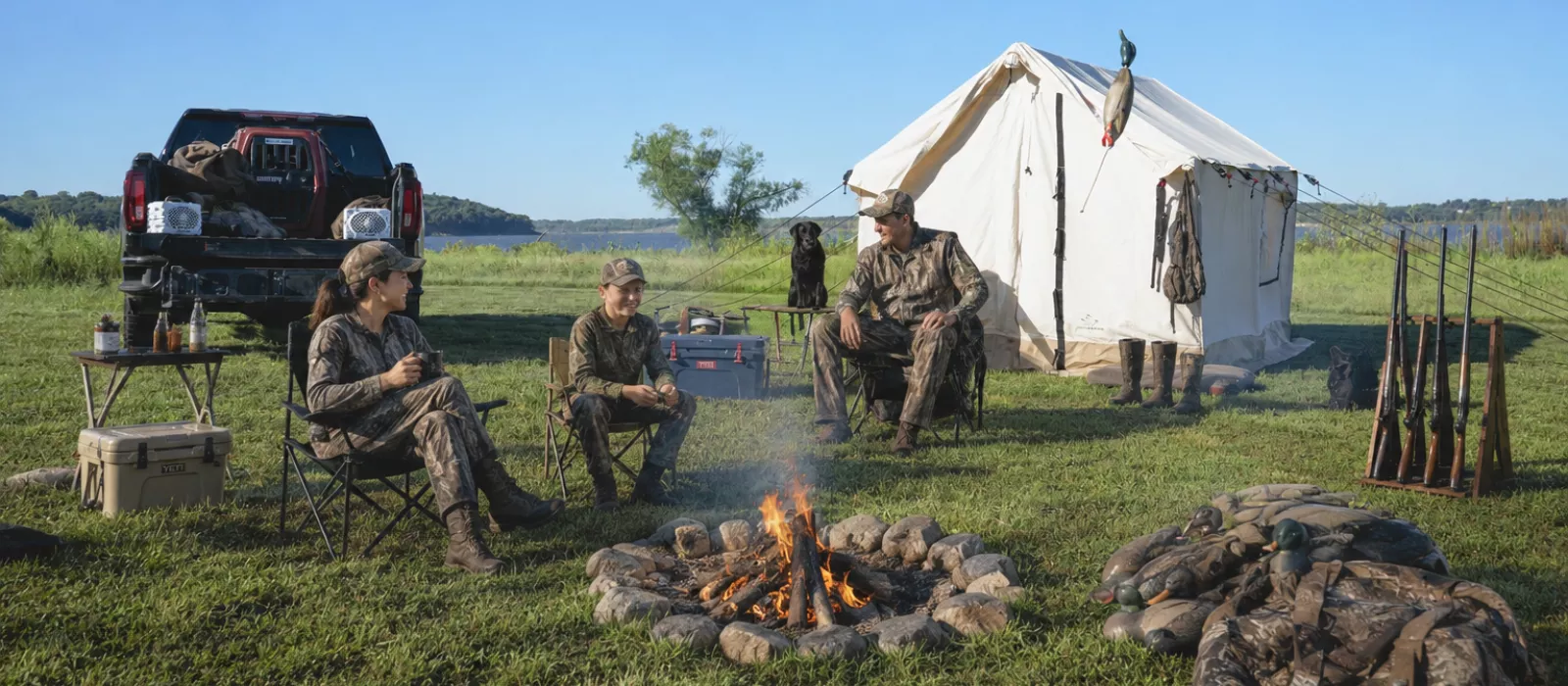
Sometimes, before the sun crests over the mountain range in the dewy morning, when it’s chilly but not quite cold, and the gray light in the morning leaves only enough room in the air to cause a small fog beyond your lips, everyone wakes up slowly, well-rested and ready for the day ahead. No one is complaining about getting up before the sun. The air is quiet and tense. This is what it feels like before the hunt. Everyone has already planned the gear they will haul out, their packs are ready, and they are already visualizing the day ahead.
Table Of Contents
- Why Family Hunting Creates Bonds that Other Activities Simply Don’t
- This does not happen in wild spaces.
- Hunting is the Reason; the Trip is What You Remember
- Base Camp is Where the Magic Actually Lives
- If They Don’t Know, Now They Will
- Firearm Safety
- Patience
- Reading the Landscape
- Accountability
- How to Be Bored, But Stay Present
This moment feels distinctly unique, but is totally relatable. This is the feeling that we chase for 11 other months out of the year when we’re not on family hunting trips. Family hunting is a time-tested tradition that spans generations, includes passing on knowledge and tradition, and, at the end of the day, isn’t all about getting a kill. It’s a part of our ability to adapt as animals that entices us to create meaning out of some kind of abstract activity. Hunting is precisely that. We don’t need to hunt; we have grocery stores. We don’t need to secure shelters in the wild, pitching a sturdy family tent in the forest; we just arrived from a perfectly good home.
This fact does not detract from the fact that being outside, together, with those you love and care about is a perfect opportunity to create lasting outdoor memories and engender a feeling of longing for the outdoors. This is what keeps families coming back for generations to come. This feeling cannot be manufactured anywhere else. This post is about what happens, what makes it stick, and how to set up the perfect trip so your family has the best shot at getting that feeling and coming back to it.
Why Family Hunting Creates Bonds that Other Activities Simply Don’t
When you open an email, turn on the television, hear a commercial on the radio, or see a billboard, something happens in your brain. A decision has to be made: Do you offer your intrigue, or do you provide criticism? These are not the same things. If a brand jingle aligns with your thinking or triggers a memory, then that marketing has done its job. You feel a small dopamine rush (at this point, it’s nearly imperceptible to your conscious brain), and you feel calm, or pleasant, or relieved. But it doesn’t stop there. There is another jingle in a few seconds, and maybe you didn’t like that one as much. It shuts off that dopamine spurt. You get critical, you have a negative reaction, you don’t want to buy or think about the item in the commercial. And this kind of rollercoaster runs on repeat with all of our stimulation from screens, ads, signs, lights, and constant information bombarding the brain, unable to handle this load of stimuli.
This does not happen in wild spaces.
In the beginning moments, especially for those unfamiliar with the outdoors, it can be genuinely frightful being in unfamiliar territory, an odd space. But our brains are wired to receive the tempo in these wild places. We are designed to interact with the landscape, to hear the sounds of wind twisting through the aspen leaves, and wonder beyond the constant, low rush of a mountain stream. While the initial hit in our primordial brain is that dopamine again, putting us in a euphoric but alert state, something else is happening. We immediately begin feeling endorphins run in our veins, and these are similar to dopamine in that they make you feel good, but they last longer, steady your body’s rhythm, and make you feel swollen with good energy. If you throw your family in that setting with you, it only gets better.
Family hunting trips have this effect and more. Hunting is an activity that requires knowledge and repeated practice. It requires the participant to interact with and learn about the wild spaces they will inhabit. This builds confidence and knowledge. Studies show that people who are in supportive environments learn more quickly, remember longer, and have a more positive experience performing the task or activity in the future. It would appear that teaching your family how to hunt, providing a safe space for them to feel confident, and letting them make difficult decisions on their own is a great way to build a positive bond. Nature is out there. All we have to do is engage.
Hunting is the Reason; the Trip is What You Remember
All of these chemicals and situational analysis are fine; it’s good to know what our brains are doing when we’re just doing stuff. But it’s tough to really put a finger on a single reason why we tread into the wild. Is it to hunt? Yes. Is it to be with our family? Also, yes. This is why family hunting is the best of both worlds.
We often assign these tasks, these events, these prescribable moments that are, in essence, arbitrary. It may be true for some that they are thankful for the pilgrims, for the sacrifices many made to be able to settle this land, but that is exactly the abstract thought that is inherently unfamiliar. We can’t imagine the strife a people undertook to battle a wild continent, navigate a new place where they didn’t know the terrain, the people, or the language. But what we can express gratitude for on Thanksgiving is our own family, and those we care about and love. The point is, it’s not really about the holiday. It’s about seeing family and expressing love to be with them. The same goes for family hunting trips. The deer may come or go, but it’s the family that remains.
This is not to suggest that just walking into the woods with your family will solve all your problems. Quite the contrary. There is a lot of planning and coordination that goes into pulling off a memorable family hunt. And that’s really what we’re here to talk about today. The first thing you don’t want to mess up is the family tent. This is where memories happen, or horror stories begin.
Base Camp is Where the Magic Actually Lives
You’ve got your tags and licenses. You’ve packed every outdoor comfort item you can think of. The menu is set, there’s fuel for the fire, and everyone has their essentials. Did you plan enough space, though? Family hunting trips usually require long exposures in the elements. It can be hot, frigid cold, windy, wet and rainy, snowy, and even, at certain elevations, give a good sunburn. This means that everyone is going to need a lot of gear, and a lot of gear means you’ll need a large place to put all of it. Much of it can be left in the truck or trailer; no problem. But room to change, pack up inside in bad weather, and huddle around a tent wood stove at night are all necessities. So, again, did you plan for enough room?
For a proper hunting base camp, you’ll want to think about your people, let’s say four, and then double the room they would traditionally need. For a structure that size, we’re going with a canvas tent. A solid wall tent with tall, straight walls set at 90 degrees, a high-pitched ceiling, and a stove jack for that tent wood stove is ideal. These simple rectangle structures are easy to cordon off space and create different “zones”.
There is, of course, a place to sleep, and then around the stove, but on many hunts, it helps to have a table to clean guns, lay out maps to plan hikes and routes to the interior, and on this same table, you’re going to need a space to eat. Wall tents are incredibly durable, and canvas can hold up to almost any kind of bad weather. They are water resistant, they hold in heat in the winter, and they keep hot air out in the summer. When you want a no-nonsense structure, the canvas tent is the way to go.
If They Don’t Know, Now They Will
If this is the first trip your kids are going on, there is much to learn. It’s important that they don’t get bombarded with everything all at once. Each day, pick a new task for them to learn. Don’t be insistent and help them to understand that what they are doing is important. This is how they feel connected to the task at hand, but also participate in an act of contribution to the family unit. Here are some ideas to consider:
Firearm Safety:
This is one of the most transferable, lifelong skills a parent can pass down. The single best lesson they can learn here is that the rules are the rules. There are absolutely no exceptions. These zero-sum circumstances are awesome for the kind of life lessons that need to be learned once and never forgotten.
Patience:
Some people call this a soft skill, but children who learn this early are often the most prepared, the most well-adjusted, and the most emotionally balanced children, which translates well into adulthood.
Reading the Landscape:
We spoke about this above, but one of the most valuable skills a person can learn is how to be safe and comfortable in the wild. Recognizing storms on the horizon, knowing what to do in flash floods, being mindful of lightning, sunburn, exposure, and frostbite: all of these are results of being able to read what is happening in your surroundings and being able to act accordingly.
Accountability:
Another one of those “soft skills”. Tying knots is a fantastic skill, but tying a poor knot, having it slip, and then lying about who did it, and shrugging off like it’s not a big deal, is absolutely inexcusable. Having accountability means that when a person fails, they own up to it. It is a method of learning, of improving, and being self-aware.
How to Be Bored, But Stay Present:
This might be the most important skill of the 21st century. Can you sit in a blind for 6 hours, quietly? Can you remain focused and track the landscape in front of you for hours? Does aloneness bother you? These are the foundations of self-reliance and are the product of more confident people.
These are not only skills that young people have to learn. They are also not skills that you learn once, and they just stay with you forever (it’s not tying your shoes). They require a lifetime of learning and practice to maintain. But teaching is also the best method of learning. When we get the practice of logically spelling out a task for someone else, we find the simplest way to describe something, and we practice what we say simultaneously.
What we teach our children is what we reinforce for ourselves. If we commit to a lifetime of engaging with wild spaces and doing it responsibly, with care and attention, and we pass these habits down for generations, we are not only bound to be good stewards of the land, we are bound to be good stewards to each other.


No Comment! Be the first one.