

I have spent a good deal of time alone in the backcountry. I’m no Christopher McCandless (thankfully), but on more than a few occasions, I’ve ventured into the unknown with little more than a few Ed Abbey essays under my arm. I’ve never been unlucky enough to be caught on a 12,000-foot peak in the Sierra Nevada range with snowy wind whipping over my exposed body while I lie, gripping the Earth, but not all of us can be John Muir. I have, however, had plenty of chances to make mistakes that I believe I’ve learned from, and hopefully I can impart some of that knowledge to you here.
Table Of Contents
- If It’s Not Safe, Don’t Go
- Rule 1. Tell Somebody
- Rule 2. Make a Plan
- Rule 3. Adventure Watch/PLB/Necessary Tech
- Rule 4. First Aid Kit/Knowledge
- On to The Fun Stuff
- The Solo Basecamp
- The Tent:
- The Kitchen:
- The Latrine:
- Beyond Basecamp
- Pack Light, Layer Right
- Base Layer
- Midlayers:
- Insulating layer:
- A Few Solo-camping Necessities
- Hatchet
- Multitool
- First Aid Kit
- Lighting
- Bear spray
- The Tough Gets Easier
My solo camping philosophy has evolved over the years. I’ve let go of a lot of the ego, but the peace I feel while secluded in the wilderness remains entirely desirable. So, I’ll provide some tips, tricks, and things to avoid so hopefully you don’t pull a John Muir but still end up in the same moment of reverie.
If It’s Not Safe, Don’t Go
It’s a simple principle, but one I stick to dearly. I am all about Type 2 Fun and pushing myself into uncomfortable situations, but I never go too far to where it’s dangerous, foolhardy, or outright stupid. That said, especially while you are trekking solo in the backcountry, there are some ways to mitigate danger, or at least have an emergency plan if things go awry.
Rule 1. Tell Somebody
It only takes a phone call, but be thorough. Don’t just tell them which range you’re going up, or which turn off into the desert. Provide detailed plans of arrivals and departures, and check back in when you get back in service. If you are in a national or state park, give a ranger an itinerary of your stay.
Rule 2. Make a Plan
Rules 1 and 2 go together. To tell someone specifically where you’re headed, you need to know specifically where you’re headed. So map it out, stick to the plan, and do your best to hit your arrival and departure times.
Rule 3. Adventure Watch/PLB/Necessary Tech
Whether you like Garmin, Suunto, Coros, or something else, a good adventure watch that tracks your location and has an emergency notification system built in is always a good idea. I use mine to upload maps and regions of where I’m going, and I save the battery when I’m at camp, so I only use it in times of need. A PLB is a Personal Locator Beacon that doesn’t require a subscription and is basically a 9-1-1 button for the backcountry. Press one button and the PLB relays its location off a satellite (or series of satellites) and sends a distress signal. Whether you have a smart watch or not, a PLB is mandatory for backcountry solo trips.
Rule 4. First Aid Kit/Knowledge
This is a no brainer, but everyone should have a basic first aid kit in their camping gear and make sure it stays on your person. I recommend wilderness survival courses to get some basic knowledge on how to set a broken bone, build a splint out of tree branches, dress a wound, and treat burns. These basic skills should keep you alive until help arrives after hitting the distress signal on your PLB.
On to The Fun Stuff
I gotta have the disclaimer to make sure everyone stays safe, but let’s move on to why you’re here. I used to drive my old Tacoma as deep as I could into the mountains, load up an ultralight pack, and go uphill until there was no sign of civilization. These kinds of adventures aren’t for everybody, and I’ve since modified my solo trips.
At least once a year, I like to get back to the Uinta Range alone. This is the longest east-to-west running mountain range in the U.S., and it is breathtaking. Pristine glacial lakes and crisp rivers you can drink right out of keep you company. The cutthroat trout are pan-sized and fight like badgers. There is so much to see, it’s impossible to do everything I want to with just the camping gear I can fit into a backpack. Plus, when I camp, I like sleeping in my canvas tent. It’s practically a movable hotel. So, I chose the best of both worlds.
The Solo Basecamp
I like to fish, hunt, shoot a bow, hike, chop wood, read, whittle, sleep in a hammock, cook over the fire, and generally just be outdoors. Cooking over a Jetboil isn’t bad, in fact, I highly recommend it, but I also like to slow roast some potatoes and onions and eat well when I’m alone. I still drive my 4Runner as deep as I can into the Uinta Range, but now I set up a base camp with a sturdy canvas tent, and with just a few other tent accessories, I can have an incredible setup in just a couple hours.
The Tent:
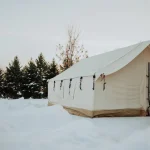
There are many options out there, but I prefer White Duck Bell Tents. The size is plentiful, the shape is stylish, and the optional additions make the camp. I added a canvas awning to mine as well because I like the option to be outside but not worry about sun during the day. If I’m a mess, I can shed my gear under there as well. It’s one of the best tent accessories I can recommend.
The Kitchen:
I bake sourdough, I make my own kimchi, and with a few of my chickens’ eggs, I like to combine all three. For this, I do a lot of fire cooking. I take a little metal pot, add some homemade sauerkraut and spices, and bury it under my fire. After the first night, you have the best kimchi you’ve ever tasted. If I’m out there for a while, I will bake a loaf of bread, just for fun. I do all this in a half-kitchen I’ve made right next to the fire. Portable stoves are great, but when I’m out in the wild, I like to feel like I’m at home.
The Latrine:
Next to camp, I keep a makeshift bucket with a lid and a seat. I don’t like to dig a cathole unless I absolutely have to, so I save those moments for deep in the backcountry. This is a good time to remind you to pack out everything you pack in (even your own waste). There are good bathroom practices in the wild, but do your best to pack it out if you can.
I tell you all this because a base camp is what puts you closer to the deep country. I set up my camp, and after the first night, I pack up my backpack, and I head out into the range. This way I’m not limited to one or two nights. I can set out and hike for hours, fish, climb, run, play like a kid, and then come back that night to a great camp and have an amazing meal and sleep in a comfortable canvas tent. For that solo trip beyond Basecamp, it takes a little more planning.
Beyond Basecamp
Not only does planning a basecamp get me deeper into remote spaces, but it acts like my refueling station. I’ll set up camp the first night and have my big adventure planned the second day. The keyword here is planned. I map everything out, I tell a few people and at least one authority figure (sometimes my old P.E. Coach), and I pack well and set out. For those heading out alone, I recommend the following:
Pack Light, Layer Right:
This is where your lightweight gear comes in handy. You want your Jetboil, extra fuel, your freeze-dried food, and always keep plenty of water if you’re in dry country, and a water purifier if rivers or semi-safe water is accessible. For clothing, always pack in layers and consider the possibility of sweating even when it’s cold and sunburning in the winter.
Base Layer:
Being that this stuff is in direct contact with your skin, it is the most important layer. Be mindful of any irritations you have to the fabrics, but make sure it clings to you, it’s sweat-wicking, and you have the right weight for the weather conditions. I like stretchy Merino wool. It can come in different thicknesses and is awesome for sweat.
Midlayers:
There is still going to be some sweat getting through, and there is going to be heat lost from the base layer; the midlayer assists in both these aspects. I keep a solid midlayer just under my insulating layer that will keep me warm while I’m shedding in the hotter hours.
Insulating layer:
This keeps all the warmth in. Honestly, I rarely go to these measures unless I’m in snowy conditions or at night above 10,000 feet elevation. A good down puff is ideal here, but I recommend something from Patagonia or The North Face. They are more durable than other designer brands, and they’ve been consistently good quality for years.
A Few Solo-camping Necessities
Whether hanging at Basecamp or heading into the wild, I recommend just a few items to keep on your person at all times.
Hatchet:
As Alexander the Great proclaimed, “My kingdom for a horse,” I will always say, “My kingdom for a hatchet.” They really are their own multitool. They can be a hand knife, a chef’s knife, an axe, a hammer, all in one. So many uses, so little time.
Multitool:
If you’ve got extra tent accessories, a guy cord, a canvas tarp, extra stakes, and a multitool, you can help you do pretty much whatever your creative mind can conjure. Covered bathroom/shower area: no problem. Modified potholder: got it. Drilling a hole through wood to anchor your hammock: done. The options are really endless.
First Aid Kit:
I covered this above. This is just a reminder to always keep one on you.
Lighting:
A HEADLAMP WILL SAVE YOUR LIFE. I’ll say that again: A HEADLAMP WILL SAVE YOUR LIFE. I have over a dozen around the house, in my vehicles, and in different compartments of my camping gear. Keep what you can around camp, kerosene/gas lamps, but always keep your headlamp with you. If I set out for a trail anytime after 12:00 pm, I bring a headlamp.
Bear spray:
They come in many shapes and sizes, and so do bears. You can’t out run them, you can’t outclimb them. The best you can do is spray, run, and eventually play dead. When in the backcountry, just try to make lots of noise. IT usually scares all the large quadrupeds away from a few hundred yards away.
The Tough Gets Easier
It is no easy feat setting out alone into the wild. There will be strange sounds at night that you can’t justify away. You will get scared. You might get bored in the middle of the day and start thinking about how to characterize this adventure on your next social media post. That’s a normal spot to start. My recommendation is to go further and go more often. Soon, you’ll listen closer and hear less noise. You’ll think clearer and see no blur. It will smell different, and it will sound different. And once you’re there, go further.


No Comment! Be the first one.