
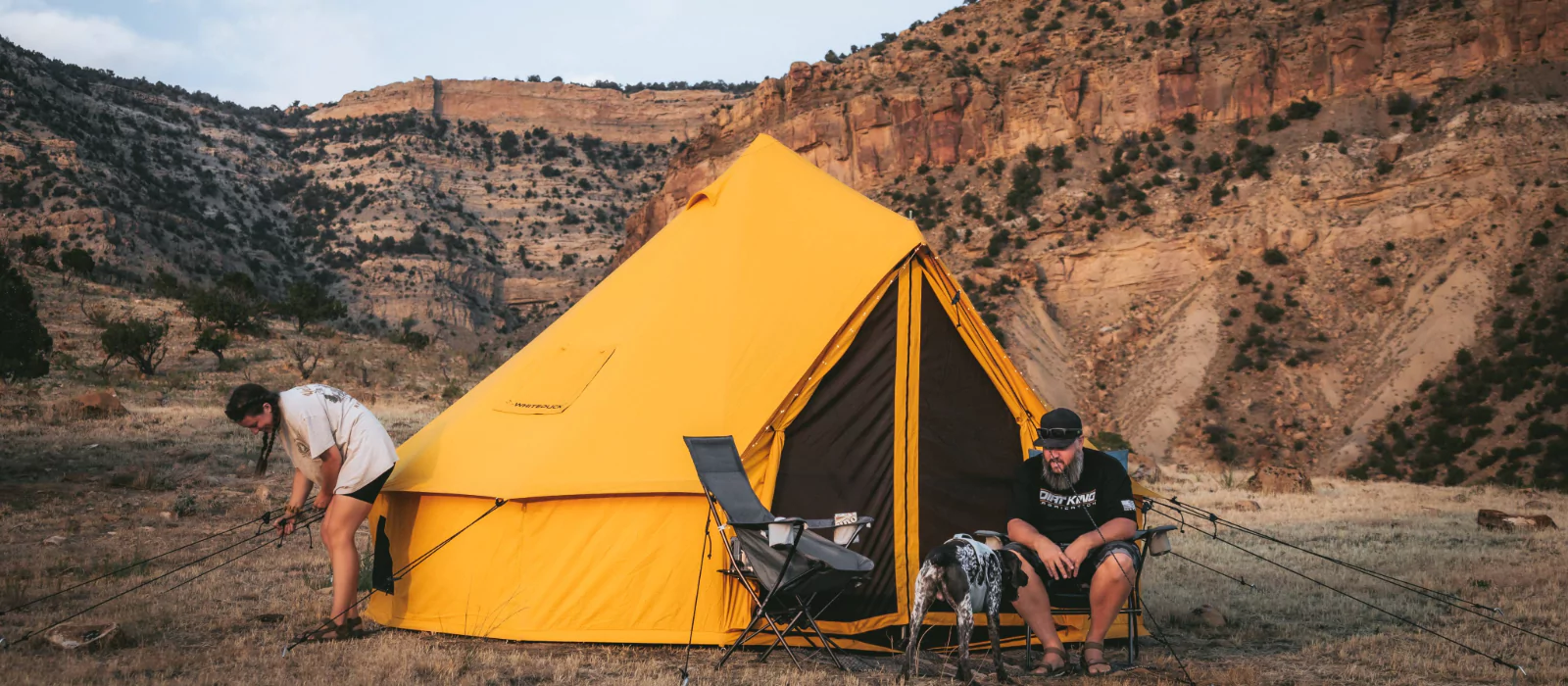
We’re almost there, that coveted time of year when we welcome the heat and invite the long days with the sun lingering late into the evening. The kids get out of school and begin a neighborhood tromp that seems as endless as a siege. Every year when this time creeps up, it’s that notion of freedom that gets me all itchy. Maybe inside I’m still just a 10-year-old with no aim or direction in the dog days of summer, but I get the need to escape.
Table Of Contents
I think of tall pine trees that sway in the high mountain breeze or sprouting horns of water when the ocean rolls in on a rocky shore (maybe I’m dreaming of the Pacific Northwest). Either way, summer is the time to escape, and for that, I need some shelter with the best tent features for hot weather. Wherever you want to go, I’ve put together some things to consider for the best summer camping tents for any condition. Summer is upon us, so let’s get going.
What Your Camping Tent Says About You
I don’t want to stir up an identity crisis, but where you sleep when you sleep outside says a lot about you. These are not key, defining features of your character, but rather an explanation of what kind of outing you’re on. I have been on dozens of solo trips through alpine wildernesses hundreds of miles from civilization. The tent I used on those trips is not ideal for maximum comfort. In those situations, I was really focusing on surviving, not thriving. This summer I intend to take a different approach. I want my tent to tell the wild world a few things:
- I am comfortable here!
- I can stay for as long as I want!
- I am safe!
- All are welcome!
I want my whole crew to feel the same. For that, I turn to my canvas tent.
What is it About a Canvas Tent?
A canvas tent is the only outdoor structure that can truly boast to be a four-season tent. Its sturdy materials keep out the ruthless winter cold, the sidewalls roll up from the bottom, and the windows have bug screens to open for a cross-breeze. Moreover, absolutely any weather condition you can think of is casual for the canvas. The only real difference from a brick rambler is the indoor plumbing.
There are, however, differences in canvas tents. While each of them boasts the best tent features for hot weather, there are some other attributes to consider. I’ll break them down into three categories:
1. Wall tent
2. Bell tent
3. Cabin tent
While each has its specific advantages to keep you and yours blissfully comfortable in the wild, all of them have the following tent features for hot weather (and any season, really).
- Breathable material for awesome temperature regulation
- Water and mildew-resistant canvas
- Multiple windows and doors for ventilation and natural light
- Easy setup design with clear instructions
- Large entrance doors for easy access
- Fire-resistant treatment to keep the heat in and the fire out
- A quality tent that you’ll hand down for generations
The Wall Tent: The Heart of Your Camp
In simplicity is strength. No truer words could be spoken about the wall tent. It’s a big, tall, strong, protective rectangle—and you might not want to leave. Other, smaller tents made from synthetic fibers are only made to sleep in. Canvas, and particularly the wall tent, is designed to live in. A wall tent is the perfect home base for everyone to hang out in with enough room to spread out gear—cots/sleeping area, clothes/changing area—and still have room to set up a table. Play cards, have lunch, and mellow out inside while it’s hot outside.
The wall tent is an awesome single-family camp experience with enough room for everyone for every hour of the day. Also, the wall tent is a perfect base camp for larger groups for a kitchen and dining room, a place to plan the next hike or expedition, or turn on a solar fan and control the temps from inside when necessary. The following features make it one of the best summer camping tents out there:
- Large doors and windows with bug screens
- Rollable walls for maximum breeziness
- High, pitched roofs for the heat to rise
- Provides cool shade, 24/7
- Space for solar-powered fans to control temps
While the wall tent is fantastic on its own, White Duck Outdoors makes a canvas porch for their Alpha Wall Tent that creates an automatic sunroom off the front of the tent. Breezy and shaded, this is another option for cover when the crew is enjoying some well-deserved downtime.
For Whom the Bell Tent Tolls
If you’re looking for 360 degrees of comfortable camping living space, the bell tent tolls for you. Put simply: I love these tents. They remind me of ancient dwelling designs that give me an instinctive feeling of shelter and security. They are beautiful, architecturally sound, and the multiple angles provide natural, built-in room separations.
The roof on these beauties pitches high and features vents to roll back where heat can escape. During the day, you can roll up the walls and sit inside, protected by a bug screen, and avoid the heat. The floor is covered so I usually enforce a No Shoes rule. The center pole acts as a natural gathering point. When people get together in the bell tent, everyone instinctively sits in a circle. With the odd shape, the acoustics are perfect so grab your banjo and pluck away, the setting is perfect.
Bell tents are some of the best summer camping tents out there, and they come in numerous sizes with multiple accessories to consider. Like the wall tent, the bell tent can act as a base camp or central hub. But they’re also perfect to pitch up on a solo trip with space to sleep, read, write, eat, lounge, and do early morning yoga sessions in the cool crosswind. Whatever you desire.
With every tent, I recommend a good canvas or plastic ground tarp. When it finally does rain in July, the water will hit the ground and creep under your tent. I don’t recommend the wet spots. Also, as I mentioned for a wall tent, a canvas awning doubles your square footage in a snap, and I’ll never argue with more space to relax.
The Cabin Tent in the Woods
My father had a cabin tent. My grandfather had a cabin tent. For me, it’s been a reliable part of my tent arsenal for decades. Cabin tents are classics for a reason. It’s a simple design, simple construction, and built like a tank. They’re also homey, like a cabin, and the no-frills design, just a square on the ground in the woods, is perfect for designating specific spaces.
Some designs can accommodate up to 8 people, but even when I’m on a solo mission I like a little extra room. I spent the better part of a summer trekking through the Sawtooth Range and kept a cabin tent as my home base. I could leave it for a couple of days, push a few peaks, and bushwack some deer trails, and when I returned it’d still be standing, through all the wind and rain. Cabin tents are durable and reliable, and when you get back to camp, they will always be standing.
I would recommend an awning, but cabin tents usually have one built in. This is a perfect place to disrobe your muddy gear and keep the dirt out of the sleeping quarters. I like to plant a chair under the awning in the morning and sit barefoot with my coffee, curling my toes through the long grass.
A Few Items to Never Forget
Even the most experienced woodsman can never compete with the most prepared. Let me explain. It doesn’t matter if you are born on the back 40 and spend all your waking hours drinking river water and snaring cottontails for rabbit stew. If you don’t have tent stakes, it will blow away. So, the prepared person, the one with plenty of the right gear, will always last. Set aside everything on this list for your tent and always keep it with you.
- Tent stakes: If your setup requires 10, carry 30. Keep them straight and replace them as needed.
- Rubber mallet: Don’t be the one pounding your stakes in with a rock.
- Guy cord/rope: You can never have enough rope, the wind doth profess. If you don’t need it, someone at camp will.
- Ground tarp/tent footprint: Keep the inside dry and protect your tent. It’ll add years to the life of your canvas tent.
- Fly sheet: If you’re anticipating rain, get a fly sheet. If you are headed to the Three Sisters Wilderness in Oregon, get a fly sheet. If you want another layer to keep the heat from the sun out, get a fly sheet.
- Spare poles: It’s all fun and games until you perp all your tent parts for setup and Travis backs over a pole…Travis.
- Awning/canvas porch: I’ve said it once and I’ll say it again. I love the extra shade and square footage of a little canvas tent patio.
I stand by the fact that the best summer camping tents are the ones that keep you the most comfortable. With these designs, you can’t go wrong. Figure out which one suits your needs and get to higher ground. When July and August hit, remember: the temps drop 3 degrees for every 1,000 feet of elevation you climb. So hit the high country. That’s where I’m headed.


No Comment! Be the first one.