

Living in a Tent
Centuries ago in Europe, medieval tent living was the way of life. On the other side of the world, Native Americans followed herds of buffalo across the Western United States long before the English arrived to colonize, living in tipi tents. Humans have been embracing the nomadic tent-living lifestyle for longer than we have known how to live in one stationary home. In recent years, the nomadic way of living and even raising a family has made a significant comeback. Following 2020, there was a huge increase in remote working versus being required to physically go into the office every day. This meant that suddenly, the entire world opened up for families who had found themselves tied to one place for years and years. Whereas it once seemed a last resort option for those with no steady place to call home, tent house living enabled those with the desire to travel to fully embrace the nomadic lifestyle while still holding onto their jobs.
Table Of Contents
- Living in a Tent
- Pros of Tent Living
- Location Flexibility
- Lower Cost of Living
- Positive Ecological Impact
- Immersion in Nature
- Simplicity of Lifestyle
- Little to No Maintenance
- Sense of Community
- Cons of Tent Living
- Exposure to Elements
- Lack of Utilities
- Limited Space
- Security Concern
- Legal & Zoning Issues
- Comfort
- Helpful Accessories
- Tent Footprint or Ground Tarp
- Tent Stove
- Solar Heater
- Storage Solutions
- Gear Loft
- Tent Organizers
- Portable Toilets
- Weather Protection
- Rain Fly
- Tent Repair Kit
- Overview
Pros of Tent Living
Location Flexibility
Tent living provides a level of unmatched flexibility and mobility that can not be achieved in traditional housing. It is extremely easy to pick up and move your entire living situation to a new spot when you find yourself feeling restless for new scenery and wanting to explore more diverse locations. This particular positive aspect of tent living holds significant weight for families who value adventure and novelty.
Lower Cost of Living
One of the biggest advantages of full-time tent living is the affordability. Where adventure and novelty might come in varying places on different families’ priority lists, we’d venture to say that low cost of living is a universally shared desire in these times. Living in four-season tents can lessen the weight of expensive day-to-day living costs for families, such as rent/mortgage and utilities, making it an extremely appealing option for those who’d rather redirect extra money to travel, hobbies, and experiences.
Positive Ecological Impact
A family camping tent will naturally have a much smaller environmental footprint as compared to a traditional home, as living in one requires fewer resources and has a much smaller waste output. Additionally, 4 season tents require very little effort to maintain in comparison to a home that needs to be winterized–you can move tents to good weather all year long–further reducing your overall energy consumption.
Immersion in Nature
Living in a tent means that there are quite literally only walls of canvas standing between you and the great outdoors. Whether you realize it along the way or not, living this way leads to a syncing with nature and a much greater appreciation for the serenity, balance, and go-with-the-flow requirements of the lifestyle. Such a lifestyle change can do wonders for both mental and physical health.
Simplicity of Lifestyle
With extremely limited space for needless clutter, full-time tent living also requires even the maximalist family to adopt a certain level of simplicity. Living in a tent house can be appealing to those looking to downsize and take the pressure off that comes with excessive belongings. you absolutely have to prioritize which of your possessions are most useful, storage-friendly, and important to keep around. This can lead to a much more organized lifestyle and allows you to focus on what truly matters.
Little to No Maintenance
Tents generally require less upkeep than traditional homes– and any maintenance/repair they may require is extremely simple and cheap to execute. There’s no need for extensive cleaning of multiple rooms or catastrophic repairs beyond the occasional patching.
Sense of Community
In campgrounds or outdoor communities filled with people who have adopted a similar lifestyle, you will find a strong sense of camaraderie and support. It takes a village to survive, especially when you live a life that requires unique resourcefulness and innovation.
Cons of Tent Living
Exposure to Elements
Tents, because they are made of such flimsy materials, offer very little true protection from extreme weather conditions such as heavy rain, high winds, extreme temperatures, and other challenges. When the weather becomes unpredictable and severe, not having a hard-sided dwelling for protection can become quite uncomfortable and even dangerous.
Lack of Utilities
Typically, tents do not come with essentials like running water, electricity, or plumbing. Cooking may become a difficult hassle, as may maintaining proper refrigeration for perishable foods. Heating and cooling your tent could also become very cumbersome to maintain without a consistent electricity source.
Limited Space
While having limited space to accumulate stuff might be appealing, tents generally provide very little space to actually spread out and get comfortable. Lack of space can make it difficult to store valuable belongings, move about your dwelling comfortably, or have privacy to change clothes, rest unbothered, or spend quality time with loved ones.
Security Concern
It goes without saying that tents are not the most protective of dwellings and can be exponentially more vulnerable to theft and vandalism compared to traditional homes. Traditional homes offer deadbolts, window locks, and hard sided walls that are not easily penetrable. Tents are difficult to lock up and offer little protection against break-ins or other security threats.
Legal & Zoning Issues
Depending on where you live, there may be legal or zoning restrictions on living in a tent long-term. It’s important to check local regulations to avoid potential issues.
Comfort
Generally, tents are not as comfortable as traditional homes. Sleeping on the ground or an air mattress can be less comfortable than a regular bed, and living in a confined space can lead to a feeling of claustrophobia for some.
Helpful Accessories
Never fear the con list, though, because if you are seriously considering taking up residence in your family tent, we know of several helpful tent accessories for camping that can also make long-term tent living a bit easier.
Tent Footprint or Ground Tarp
Protects the bottom of your tent from abrasions, moisture, and sharp objects. Extends the life of your tent and adds an extra layer of insulation.
Tent Stove
Purpose: Ensures warmth during cold weather. Look for safe, portable heaters designed for tent use, and always prioritize ventilation and safety.
Solar Heater
Solar-powered gadgets are becoming more and more refined and widely available. Solar powered heaters, in specific, are a great way to keep your tent temperature safely regulated without electricity.
Storage Solutions
Storage may be limited in a small space like a tent, but that doesn’t mean it doesn’t exist at all.
Gear Loft
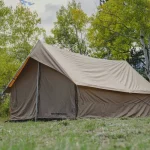
If you are living in a wall tent or bell tent, build a gear loft nearly as tall as your ceiling to keep your gear safe, dry, organized, and off the ground–minimizing clutter and frustration.
Tent Organizers
Mesh pockets or hanging organizers can help keep your mobile devices, small accessories, and gear tidy and easily accessible. Sew your own pockets into the lining of your tent, or purchase hanging organizers for cheap.
Portable Toilets
Portable toilets provide an easy and hygienic solution for personal sanitation even without the convenience of running water. You may also choose to add or construct a privacy shelter around your portable commode for comfort and privacy.
Weather Protection
Rain Fly
A rain fly sheet can help lessen the chances that rain or other unwanted precipitation seeps into your tent, damaging belongings and making the whole experience pretty doggone uncomfortable.
Tent Repair Kit
General tent repair kits are available for purchase, making patching mild damage easy and convenient no matter where you are.
Overview
In conclusion, living in a tent offers a unique blend of benefits and challenges that may be more or less appealing depending on different families’ preferred lifestyles and preferences.
On one end of the spectrum, tent house living provides a deep connection to nature that you may not have the chance to tap into by living traditionally, serious financial savings, and a simplified way of life that can be both adventurous and healthy for the environment and your own psyche.
On the other hand, it poses significant challenges, such as exposure to unpredictable weather, limited space, unreliable security, and a lack of essential utilities, which can impact comfort as well as personal health and hygiene.
Ultimately, whether or not living in a tent is a suitable choice depends on individual priorities and the ability to adapt to its many challenges and unique limitations. For those who value adventure, spontaneity, and a minimalist lifestyle, the experience can be rewarding; for others who may prefer luxury, comfort, and predictability, traditional housing may prove a more practical option.


No Comment! Be the first one.