
Each year, thousands of people head into the backcountry with rifles, bows, muzzleloaders, loaded down into trucks that are heavy with gear. For many of these folks, safety is second nature. When you’ve been doing something long enough, it becomes more of a routine and less like a checklist or even a practice. The secret to having a successful hunting season year after year isn’t only about getting your tag. It’s about keeping your crew safe in unpredictable situations.
Table Of Contents
- Why Bears Come to Hunting Camps (and what it means to you)
- Know the Signs: Bear Activity Around Camp
- Tracks
- Scat
- Disturbed vegetation or torn-up logs or tree trunks
- Camp disturbances at night
- Bear-Proofing a Hunting Camp: The Specifics for Hunters
- The 100 Yard Rule
- Hang Your Game
- Carcass & Gut Pile Placement
- Coolers
- A Tent to Outlast Any Other
The fact is that the longer you stay in wild places, the more likely it is that something is going to go wrong. It’s important to remember that that is okay. While this can inspire a sense of fear in some people, it should be understood that safety is not about fear. It is about preparation. Planning ahead and proper preparation can mean the difference between a good trip and a bad one. Experienced hunters don’t hope it doesn’t rain; they prepare for a downpour. They don’t skip the first aid kit; they know every item that’s in it. And they don’t avoid bear country, they go in ready.
Bears go where hunters go. That’s a fact. They are often after the same prey as the hunter. The truth is that most hunting failures are not that dramatic. Bears have their space, and humans have theirs. No one really wants to get into the others’. But when food is left out, smells are wafting, then a bear is going to do what a bear is going to do. This is a guide to hunting and camping safety tips to help establish those reminders and let you know how to avoid any incidents.
Why Bears Come to Hunting Camps (and what it means to you)
Although the wild is full of food for all predators, from mountain lions to badgers to bears, not unlike us humans, wild animals are a little bit lazy. If their choice is to rummage through a stream looking for fish, hike up a hillside to munch berries, or just wander into a camp and sift through some garbage and grab some snacks, they’ll take the garbage every time. While it is the garbage that they end up nosing through the most, it’s what’s inside the garbage that counts.
Bears are still instinctively drawn to certain smells. After years of evolution, they are going to go first after raw meat, blood, hides, gut piles, fish guts, coolers, cooking smells, and discarded fresh fruits and veggies. If someone walked into your front yard and set a table with a perfectly cooked fillet mignon, you’d be drawn to take a taste. Understanding a bear’s motivation is the foundation of bear-proofing your camp. A bear wandering into camp isn’t going to be aggressive. At the end of the day, they are just following their instincts and their noses.
In the continental US, there are three types of bears hunters might encounter:
- Black Bears: These are the most common bears in the United States, and they are found in 41 states. They are generally conflict-avoidant, but they are also opportunistic. They move through camps quickly and intentionally, looking for food. Most hunting camp bear encounters are black bears going after food.
- Grizzly Bear: These are present in the Greater Yellowstone, northwest Montana, and parts of Idaho. These can be more aggressive and dangerous in an encounter, especially near a carcass.
- Brown Bears: These are primarily in Alaska. They have a different behavior profile and a defensive response. It’s really best to just let them do their thing and stay out of their way.
On this last point, that is the response that everyone should have with a bear. Stay out of their way, let them do what they are going to do, and don’t get between them and the food source. If you have a trophy buck hanging in camp and any one of these bears appears, get to safety, and leave the carcass.
Know the Signs: Bear Activity Around Camp
Before a bear walks into camp, there is going to be evidence of them around camp. Learning these signs can help you avoid any kind of interaction. If you are heading directly into bear country, there are a few signs to check out around camp before you strike camp. Here are a few things to look for when staking ground.
Tracks:
Weighing hundreds of pounds, bears leave tracks. Black bear tracks show five toes in a roughly semi-circular pattern with short claw marks close to the toes. Grizzly tracks are much longer and extended, with long claw tracks extending far beyond the toe pads. If either of these sets of tracks is around your camp area, bears are nearby.
Scat:
Scat is, well, poop. For hunters, this is one of the key signifiers of a good hunting region. You should know the difference between elk and deer, so you should also be able to identify bear scat. If you come across some, break it up with a stick and note the contents. If it is fibrous and is berry-heavy, then the bear is in food-acquisition mode. If there are chunks of bone or meat, then there may be a more opportunistic bear in the vicinity.
Disturbed vegetation or torn-up logs or tree trunks:
Bears in search of food will rip up rotten logs looking for grubs and scratch at the soil looking for the same. If there are larger patches of vegetation that have been pressed down, it means that a bear has recently been in the area. If that is the case, that might not be the wisest spot to break camp. A bear will come back to the same location to bed down; if not back-to-back nights, it will remember the spot. Best to avoid the chance of confrontation.
Camp disturbances at night:
Bears are active at night, especially if they are cued by a smell that signals food. When bears are under the cover of darkness, they also feel safer approaching camps with humans. Most bear confrontations happen at night, early dawn, or late dusk. Like humans, they like to go to bed with a full belly and wake up to eat.
Proper bear protection is an essential hunting safety tip. As much as you prepare for cuts, rolled ankles, sunburns, or other types of exposure or minor incidents, so should you prepare for a bear wandering into your camp.
Bear-Proofing a Hunting Camp: The Specifics for Hunters
Standard camping safety and hunting camping safety tips are definitely not the same thing. The real difference is the carcasses. If you and a group of people set out to get your tags and you’re spending a week or so in the wild, you’re likely going to amass some dead animals around camp. This is the most pressing scenario for hunters and the highest risk point for bear contact.
A camper manages food scraps and trash; a hunter manages raw game: blood, organs, hides, and processing equipment. To mitigate any risk here, there are certain protocols that need to be followed.
The 100 Yard Rule:
Hunting camps should really be broken down into two camps: sleeping camp and processing camp. Wherever you’re going to be sleeping, you should be breaking down your kill at least 100 yards away. That is not the max; that is at least how far it should be away. With that distance, a bear can still smell other intriguing scents, so camp smells still need to be well managed.
Hang Your Game:
As another general rule, harvested meat should hang at least 10 feet off the ground and at least 4 feet away from the trunk. This is the same principle as a traditional bear hang, but accounting for size and weight. You can also use game bags to reduce the scent while maintaining air flow. The one forever and always rule is you never store meat inside a tent, even a cooler in the tent.
Carcass & Gut Pile Placement:
Gut piles and carcasses can attract bears within hours. In certain breeds, they will get more aggressive at the smell of blood. Place them as far from camp as is practical, downwind, and inform every member of your party of the location of the gut pile.
Coolers:
Not all coolers are created equally, and some of them are more ideal for keeping bears out and keeping smells in. Hard-sided, bear-resistant coolers are the minimum standard for grizzly country. In black bear country, a quality hard cooler stored away from tents and secured with a strap or cable is sufficient.
These are the most relevant pain points and cover most of the hunting safety tips. Along with a good canvas tent, your basecamp for your hunting trip this year should be safe from bears.
A Tent to Outlast Any Other
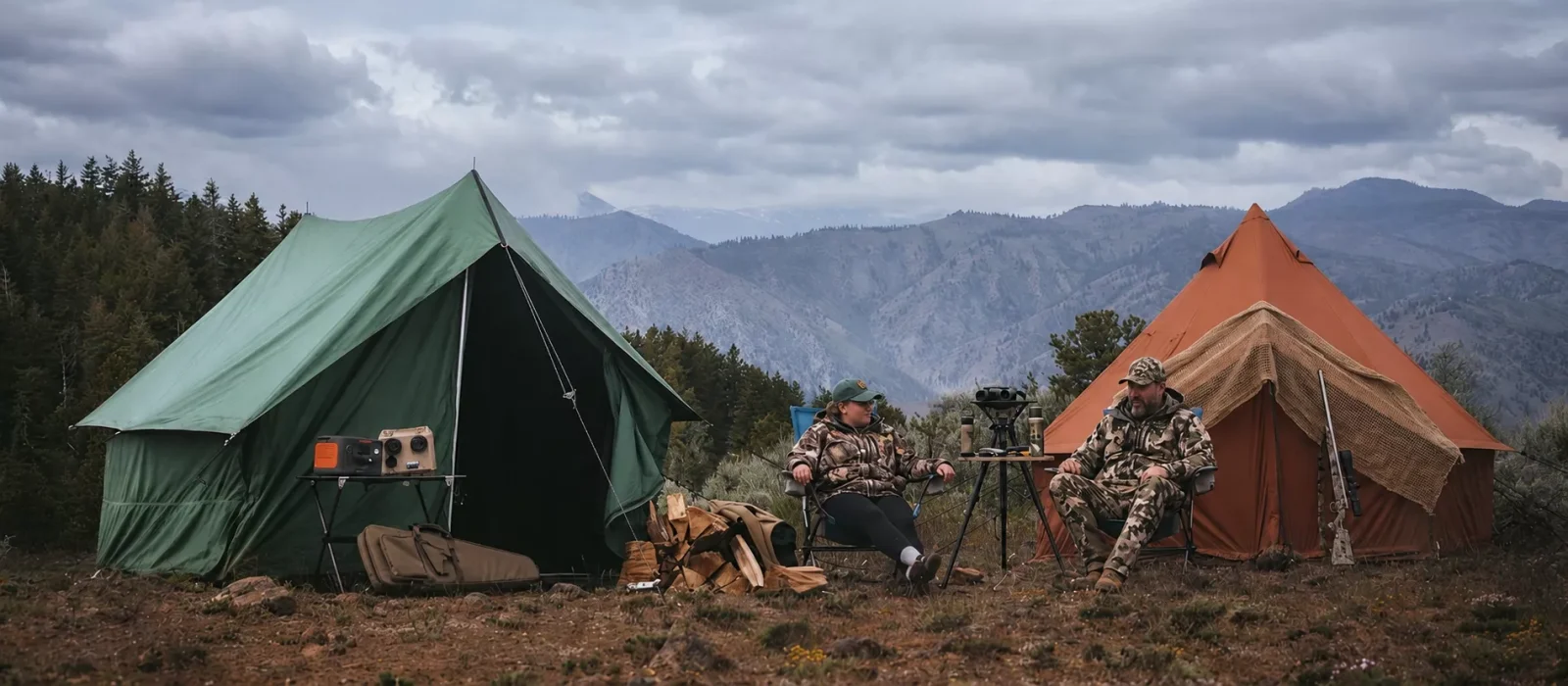
There are dozens of options for hunting tents on the market, but nothing is going to serve each specific hunting purpose like a canvas tent. Wall tents are ideal for hunting base camps. They are spacious, come in various sizes, and have perfect features for any hunting camp. They feature large doors and windows with bug screens. This is ideal if inclement weather hits and you have a kill to break down. If you’re doing so in the warmer hours, it’s wise to let the tent completely air out and remove any surfaces that previously had blood on them.
If the larger crew is made up of a few groups, scout tents are great for hard weather protection, sleeping quarters, and storing gear for 3-4 adults. Most hunting seasons, especially for large game when bears might be present, are in the late fall. This is the most uncertain time for bad weather during the year. The days can still be hot, while the temperature swings at night can be drastic. Canvas tents maintain steady temperatures while providing great insulation. They keep the outdoor temperature out and the indoor temperature in. While it gets wild outside, inside a canvas tent stays warm and predictable.
The best hunting camping safety tip is to pitch a strong tent. If everything else goes haywire, if you don’t get your tag, if you can’t track after a snowstorm or rain, if there isn’t an antler to be found, at least you can come back to a comfortable canvas tent. Plan ahead, and stay safe, not scared.




No Comment! Be the first one.