

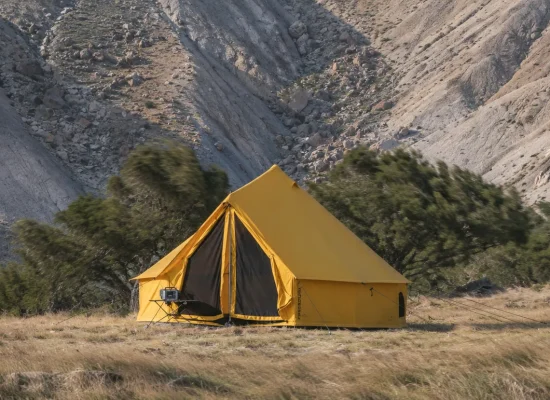
There are many factors to consider when factoring in canvas bell tent wind resistance: the angle of the pitch, the temperature, the tension of the guyline. But real-world reports show a properly staked canvas bell tent can withstand winds from 40-65+ mph.
Table Of Contents
The range is the honest answer here. There are no lab tests being done to certify this rating in any controlled environment, and there really isn’t one for any other type of tent on the market either. In some extreme mountaineering tents (the type that hold fast on Everest), there are some more intensive tests. What does exist for the White Duck canvas bell tent is a large body of customer experiences and reviews that overwhelmingly record the tent as being able to hold up in seriously windy conditions.
What the Number Actually Depends On
The real difference between a bell tent that holds up in 60 mph wind and one that tumbles in 30 mph is not the tent, but the setup. Three variables determine that outcome.
The first factor is staking angle. Stakes driven straight down pull out under an upward load. Stakes driven in at a 45-degree angle oriented toward the tent resist a load attempting to pull them straight out of the ground. This is by design. The bell tent FAQs cover the specific staking in detail. Angle your pegs at 45 degrees and stake them 2 to 4 feet out from the sidewall. These are not optional in windy conditions.
The second is guyline tension. Loose guylines will do almost nothing for you. A properly tensioned guyline transfers the load from the canvas to the ground anchor, which is exactly what it should be doing. Remember: A guyline that feels hand-tight at setup will be loose and have slack as the canvas adjusts to the tension and rests into place. Similarly, the canvas changes with temperature, so it’s likely to loosen overnight. Make sure you check your lines and tighten them before bed and a few hours after setup.
The third is perimeter staking. The groundskirt of a bell tent needs to be staked all the way around, for 360 degrees, not missing a spot. One unstaked section in twenty feet of perimeter is the section that lifts and gives a wind path underneath the tent. This can prove to be detrimental in a wind storm. The complete technical guide for both staking and guyline setup is in the camping in high winds post and the guylines 101 guide.
Real Reports vs. Lab Rating
There is no bell tent wind rating for the Regatta, and that’s not just specific to White Duck. Almost no consumer canvas or dome tent manufacturer publishes a lab-tested mph rating. The category simply doesn’t work that way.
What does exist is a consistent pattern of real-use reporting across three independent sources. A customer on White Duck’s own bell tent page describes 40 mph gusts on a hunting trip with no structural issues. An independent gear reviewer documents reported accounts of the Regatta handling 50+ mph winds without deformation when properly guyed out. A White Duck representative on Reddit cited online brand footage of the Regatta in 65+ mph conditions, and it was still standing.
Taken from different data points, under different conditions, but resulting in the same outcome. The reports converge on one finding: a well-set bell tent handles real wind conditions very well. Presenting a single, tidy number in that range that acts as a defining moment of failure just isn’t realistic. The range is the honest answer, and the setup is the variable that changes everything.
Why the Shape Helps
The bell tent’s conical shape is not only attractive to the eye, but it also serves practical purposes as well.
When wind abuts a flat surface, all that force and drive gets met with as much resistance as possible. When considering a tent in a wind storm, the wind is unavoidable, but what you can do is choose a shape that doesn’t present the most obvious, obdurate direction to the wind. The bell tent’s sloped, circular profile deflects the wind, never providing a spot for it to squarely land. Wind rolls over the structure rather than absorbing the full load of a flat face.
This is the same principle behind aircraft fuselages, bridge cables, and any other structure engineered to exist in moving air. The bell tent was not designed with aerodynamics as a stated goal, but that doesn’t mean the geometry doesn’t provide a favorable shape in the wind. Observers have reported pitching both a bell tent and a dome tent and notice the bell tent receives less deformation than the dome tents in high winds. If a bell tent is safe in high wind, then it’s the shape doing all the work.
What Actually Fails First
When a bell tent fails in the wind, it usually doesn’t start at the canvas. It starts at the ground.
The most common failure point is a stake being pulled out, likely out of soft or sandy ground, or saturated soil where a J-peg does not have enough holding power. In these extreme conditions, try upgrading to a longer stake or using a deadman anchor: a stake or packed rucksack buried in the ground and staked perpendicular to the guyline. This will provide the necessary holding power that a standard stake cannot. Upgraded stakes, anchor hardware, and tent accessories and spares are always a good idea to have on hand.
The second failure point is the ground skirt failing you by lifting. When the perimeter is not properly staked, an edge of the sidewall can lift, exposing a small section to the wind. With one large gust, the whole tent can be lifted, changing the direction of pull against the stakes and upending everything.
The third is guyline slack. A line that was tight after setup is not going ot remain that way all night. On the first day of camp, it’s a good idea to just tighten the guylines every hour. If you’re the forgetful type, set an alarm to do so. It’s that important. Even in prolonged wind, check the lines. In rare instances where you might get caught in severe wind storms or tornadoes, or hurricane-level conditions, it’s best to completely take the tent down. Those conditions are wrong for any structure, let alone a canvas tent.
Common Questions
Is there an official wind rating for a bell tent?
No, and this is true of almost any consumer tent on the market. Independent lab wind ratings are not standard in this product category. The best results for the Regatta bell tent are the consistent body of user research and comments that note the tent’s high performance in extreme wind conditions.
What matters more, a tent or the setup?
The setup. A bell tent staked correctly at 45-degree angles with full perimeter coverage and properly tensioned guylines will meaningfully outperform the same tent pitched carelessly in a hurry, regardless of what the online reviews say. The canvas is the same in both cases. The only different variable is the way the tent is constructed.
Should you take a bell tent down in a severe storm warning?
Yes. A properly staked bell tent is reliable in strong winds, but no consumer tent is prepared for tornado- or hurricane-level winds. A severe weather warning is not a situation to play around and guess with. While there is concern that the tent could be damaged, blow away, or not withstand the wind gusts, simply being out in those conditions with flying debris can be deadly hazardous.
Closing
When it comes down to how much wind a bell tent can handle, the answer is a serious amount of wind. The reported range of 40-65+ mph is reported consistently, and the shape of the bell tent also lends itself to holding its structure in the gale forces. What the number assumes in every case, though, is that the tent has been properly guyed and set up with attention and care. The tent holds up its end of the deal. The setup is yours.





No Comment! Be the first one.