
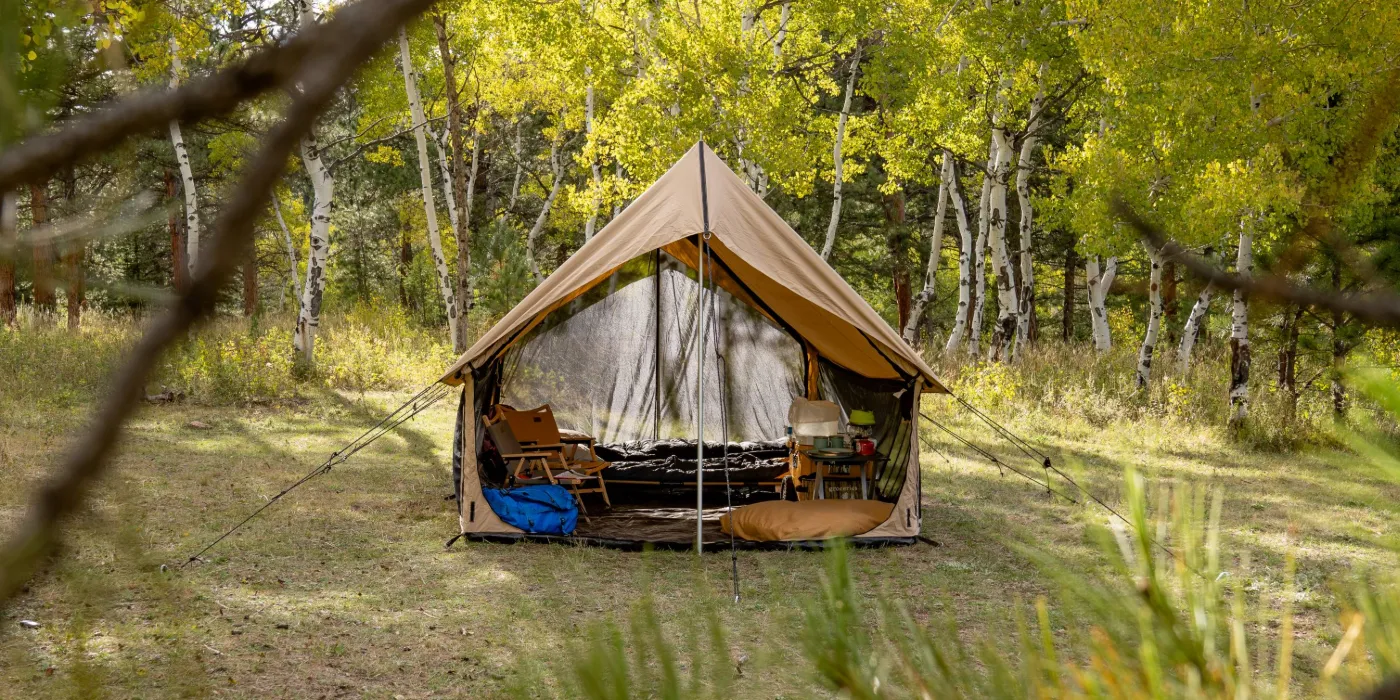
The camping industry often defines tent capacity much like airlines define seat size: technically, you can fit, but the comfort is questionable. The standard 4-person tent has become the industry default, yet actual sizes differ significantly by brand due to varying shapes, historical reasons, and some arbitrary choices. To make a smart choice, it’s crucial to understand where these sizing conventions originated.
The History of Tent Sizing
It would be simpler if everyone had the same size and sleeping habits, but that’s not reality. Commercial tents can’t be custom-made, so compromise is necessary.
The Informal Origins:
Manufacturers have always based capacity on the bare minimum: how many bodies, laid side by side, could they technically fit across the floor of the tent. As you can imagine, this changes wildly based on myriad factors. There’s no real historical evidence of how these manufacturers arrived at the decision, but they typically use a footprint of 2.2’ x 5.5’. That seems pretty small. The idea is that it is the size of a person lying on their side in a slight fetal curl. That’s no gear. No rolling around in the night. No dignity.
The ISO Attempt:
An international standard does exist, and it’s referred to as the ISO (International Organization for Standardization). It was first published in 1985 and has undergone multiple revisions, the most recent being ISO 5912:2020. The standard covers safety, performance, and fitness for use. The one topic it does not cover is comfort-per-person space standards. So, it covers the material used for the tent and its strength and waterproofing, but not whether 4, 6, or whatever can fit in that specified tent size.
The Result:
There is no industry-accepted standard for a 4-person tent, and different manufacturers have different interpretations on who can fit where. Meaning, two different tents from two different outdoor companies can mean two very different things.
The Practical Reality:
The bottom line truth is that the average 4-person tent has a rated capacity for 4 adults. An ideal capacity is likely closer to two people and their gear. Floor space, on average, runs about 60-70 square feet. Again, fine for two and gear, not ideal for four grown adults.
The very term 4-person tent has more to do with marketing than it does with size. Because of this, you’ll want to consider what you want from a tent, and then buy the size accordingly. Below are some useful things to keep in mind when looking for your next bomber tent.
The Fabric Debate
It seems to some that the natural evolution of tents went from natural fiber to synthetic. Just because polyester was invented after canvas or cotton doesn’t make it any better. It’s just different. Both synthetic and natural materials have their benefits and drawbacks. As much as relative tent size changes for manufacturers, so does the preference for materials change from person to person.
The Synthetic Side:
The most obvious advantage of synthetic fibers is that they are lightweight and packable. This was a key selling point in the 1970s when tents got smaller and materials became more sophisticated. This was good news for trekkers and backpackers.
For the average camper, the proliferation of these tents, their ease of construction, and mass distribution meant that they were much cheaper for the upfront cost. This has remained the case over the years. They are cheaper out of the gate, and they come in various sizes, shapes, colors, use cases, and, now, price ranges. These designed tents can range easily into the thousands. But a simple 4-person tent can also get in under $100.
There are other benefits as well. They dry quickly when they get wet on the outside, the setup time is usually minimal, and their basic dome shapes make them fairly intuitive to set up. The downfall is that this material, while easy to transport, traps heat, allows condensation to build up, and suffers UV degradation (meaning the material breaks down in the sun). Seams can get flimsy, the pole sleeves can wear down and rip, and the zipper points can give under stress.
Put simply, synthetic tents are not multi-generational heirlooms. They are not your grandfather’s tent.
Notes on Natural:
Tents have been made out of many different materials over the decades. Depending on the location, odd materials have been used to make tents. Animal hides, woven goat and camel hair, linen or flax, felt, and various types of cotton. In times of shortages, denim was used, but that is really a form of cotton.
Canvas ended up being one of the more reliable and consistent fabrics to make tents out of. It is cotton, but it can be woven into different thicknesses, which results in different tensile strengths. But there is much more to canvas than being a durable fabric.
A canvas tent breathes naturally and allows humidity and body heat to escape through the weave. This allows for temperature regulation in both directions (warm in cold and cool in heat), and eliminates the condensation problem. It is true that canvas tents can cost a bit more up front, but these will last decades, not seasons. The value pays for itself after you invest.
The Roominess Factor: 4 is Just a Number
When considering the interior space in a tent, the 4-person, the 5-person, or whatever, is really just an arbitrary measure. If you’re looking for the best use of space, then going by square footage is the best way to imagine the area. To consider this, though, means that shape plays a distinct role in the roominess of the tent.
Consider this: A 4-person dome tent is going to maintain the specified space above based on the footprint, the bottom of the tent. Dome tents quickly slope up the sides. It should also be noted that touching the interior of a synthetic fiber tent allows for the oils from your skin to get all over the tent wall, allowing condensation to gather there. Put simply, it’s not ideal to touch the interior walls of a dome tent. This means that those sleeping on the floor of the 4-person dome tent need to clear the walls, without touching them.
An ideal solution would be, you guessed it, flat walls. This would allow for the most utilized space on the floor without needing to touch the walls. While it’s pretty difficult to find flat walls in synthetic fiber, canvas tents are available in incredible designs, extremely spacious, and feature myriad types of flat walls.
The Canvas Tent Solution
There are numerous styles of canvas tents in many designs. The square-walled tent is a very traditional architecture that dates back as far as tents have been in production. This version looks like a small house with a pitched roof and four 90-degree angled walls. It’s practical, easy to imagine, and if you’re the type that likes to plan ahead, you can pace out the measurements on the ground and make it fit exactly to your 4-person tent needs. No standards. No misrepresentation.
White Duck Outdoors makes an incredible 4-walled tent in a 4-person size: the Scout Tent. The footprint for the canvas Scout Tent comes in 6’x8’, 8’x9’, and 8’x13’. Considering this, there is a perfect size for you and three others to put together your best 4-person tent setup. The center height at the pitch for the Scout Tent is seven feet. With the spacious floor, there is plenty of headroom for nearly every camper.
If the straightforward, square-cornered design is not to your liking, there’s another style that can accommodate those looking for the more hip camping solutions. White Duck’s Regatta Bell Tent has vertical walls with a round footprint. These come in numerous sizes. The 8-foot mini, 10’, 13’, 16’, and 20’. For the best 4-person Bell Tent, the 8-foot mini or the 10-footer would do just fine. The shape of this tent is circular around the center pole, and it drapes down 360 degrees. This makes for a communal interior that makes conversing and sharing in an open space ideal. The walls can be rolled up to accommodate hot or cold weather, and in brutally cold winters, a tent wood stove can be installed to keep the heat stoked all night.
The Best 4-Person Tent is Up to You
10 different people could walk into an outdoor retailer and have 10 different ideas for the perfect 4-person tent. If you want to go fast and light, then a canvas tent may not be the best choice for you. If you’re looking for a bit of a slower speed, a tent that will last you generations, and an awesome option for a base camp, a canvas tent is the way to go.
No matter what material you decide on, make sure you overshoot for the space you’ll need. A good idea is to take a full pack, double the size, lay out your sleeping bag, and add one foot per person. That should give you plenty of room for everyone in the crew to spread out. Consider your space, think about how you camp, and find the best 4-person tent for your needs.



No Comment! Be the first one.